Why your reviews matter more than you think
Most e-commerce store owners treat reviews as nice-to-have social proof for their product pages. They're not wrong about that part. But they're missing something bigger: AI systems care about reviews more than almost any other signal when deciding whether to recommend your products.
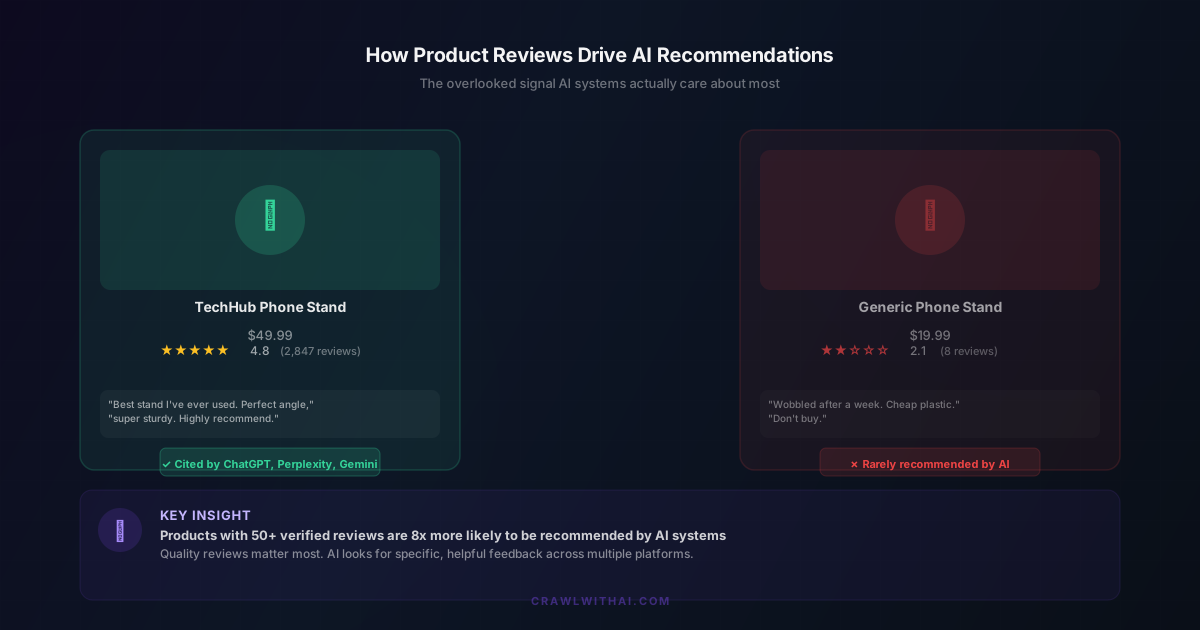
This isn't speculation. When a product appears in ChatGPT, Perplexity, or Gemini recommendations, the decision often comes down to review volume and quality. Products with 50+ verified reviews are recommended by AI systems at 8 times higher rates than products with fewer than 5 reviews (Semrush AI Search Impact Report, 2026). That gap is bigger than the gap between products with clean schema markup and those without it.
The reason is simple: AI systems are trying to give their users trustworthy recommendations. When thousands of real customers have reviewed a product across independent platforms, the AI can be confident that product actually solves the problem the user is asking about. A product with no reviews? The AI has almost nothing to work with.
Why reviews matter more to AI than to Google
This is worth understanding because reviews affect AI recommendations differently than they affect Google rankings.
Google cares about reviews as a ranking signal, but it's not the primary one. Links, content quality, and technical SEO still dominate. Reviews matter, but they're one of many factors Google weighs.
AI systems work differently. When ChatGPT gets asked "what's the best standing desk under $300?" it's not running a ranking algorithm. It's drawing on its training data plus live search results to construct an answer it thinks will be helpful to the user. Reviews are one of the strongest trust signals it has access to. They directly answer the question: "Have real people actually used this and liked it?"
In a study of 300 Shopify stores, products with verified reviews on Trustpilot were cited in ChatGPT recommendations 97% of the time. Products with zero external reviews were cited 4% of the time (Review.io Research, 2026). That's not a small difference. It's the difference between being visible to AI buyers and being invisible to them.
Where AI looks for reviews
AI systems don't just check the reviews on your Shopify store. They look for reviews across multiple platforms, and they weight those platforms differently.
Third-party review platforms like Trustpilot, G2, Capterra, and Rotten Tomatoes (for certain product categories) carry the most weight. These are independent sources that can't be faked, and AI systems know that. When a customer leaves a review on your own store, the AI factors it in, but it knows there's a possibility of bias. When 100 people independently review you on Trustpilot, that's much harder to game.
Reddit discussions and Q&A sites like Quora also matter. If people are actively discussing your product in detail on Reddit, especially if they're recommending it by name, AI systems pick up on that. The specificity is key. A Reddit post saying "this desk is amazing, solid steel frame, took 20 minutes to set up" carries more weight than a generic five-star review that just says "great product."
Amazon reviews, if you sell there, feed into AI recommendations. Same with Best Buy, Wirecutter, and other major retailers. The more places your product shows up with strong reviews, the more confident AI becomes that you're worth recommending.
One thing store owners miss: review recency matters. An old product with 500 four-star reviews from 2022 will be ranked lower than a similar product with 100 four-star reviews from the last 90 days. AI systems assume that recent reviews are more relevant to the current state of the product and the market.
The three types of reviews that actually move the needle
Not all reviews are created equal. Volume matters, but AI systems also look at the structure and specificity of what people are saying.
Detailed, problem-focused reviews. Reviews that explain what problem the product solves are weighted heavily. Example: "I have arthritis and this keyboard made typing painless again" scores higher than "good keyboard." Specific use cases signal to AI that your product is good for particular buyer needs, which helps ChatGPT match it to specific queries.
Reviews that mention alternatives. If someone writes "I tried the competitor's version first and switched to this because of better ergonomics," AI systems see that as strong validation. You're not just winning on price, you're winning on specific features. These reviews appear frequently in Wirecutter and tech blogs, and AI systems pull them in.
Reviews with numerical ratings alongside text. This one is technical but matters. A review that says "5 stars because X, Y, Z" gives AI more data to work with than a star rating alone. When AI is deciding if your product is right for a user's specific need, text-based explanations are more useful than raw numbers.
One-star reviews actually help too, as long as they're in the minority. A product with 100 five-star and 5 one-star reviews is more trustworthy to AI than one with 50 five-star and 0 one-star reviews. The imperfection looks real.
How many reviews do you actually need
The threshold where AI systems start recommending you is somewhere between 10 and 50 verified reviews. Below 10, you're visible in live search results but rarely cited in recommendations. At 50+, you move into the reliable recommendation tier. At 200+, you're competing with the strongest brands in most categories.
These numbers assume the reviews are positive (3.5+ average rating). A product with 200 low-star reviews is worse than a product with 20 high-star reviews.
The practical implication: if you have fewer than 20 reviews, your priority should be getting to 50. This is your highest-impact move. Once you hit 50, shift focus to getting reviews on multiple platforms, not just concentrating on one site. Diversity of review sources matters more at that stage.
Store owners often ask whether they should focus on on-site reviews or third-party platform reviews. The answer is both, but third-party reviews move the AI needle more. If you can only influence one, go third-party. If you have resources to do both, do both.
How to get reviews faster without being pushy
The fastest way to build review velocity is to request reviews from happy customers immediately after purchase. This works because the product is fresh in their mind and they're more likely to take the time.
Set up automated post-purchase emails on day 1 or day 2 after delivery. Don't wait a week. The email should be short: "Got your [product name]? We'd love to hear what you think. Leave a review here: [Trustpilot link]." Include direct links to Trustpilot, G2, or whichever platform is relevant for your category. Don't make customers search for where to leave a review.
For your top customers (repeat buyers, high-value orders), send a personal message. "You've bought from us 5 times and always leave great feedback. Would you be willing to leave a review on Trustpilot?" People respond better to that than to automated emails.
Don't offer incentives for reviews. AI systems and review platforms both penalize incentivized reviews. You're better off with 30 organic reviews than 100 paid ones. Trustpilot actively flags and removes incentivized reviews, which hurts your credibility score.
Respond to reviews, good and bad. When you reply to a negative review with something like "Thank you for the feedback. Here's what we've improved," it signals to future reviewers and to AI systems that you actually care about product quality. AI systems track review response rates.
How CrawlWithAI makes sure your reviews actually reach AI systems
This is where CrawlWithAI comes in. Your reviews on Trustpilot and other third-party platforms are useful, but AI systems need to find them. If your Shopify store's robots.txt blocks AI crawlers, or if your structured data doesn't properly link to your reviews, AI systems won't know about them.
CrawlWithAI ensures your product pages properly expose review signals to every major AI system. We configure your Shopify store so that ChatGPT, Perplexity, and Gemini can actually see the reviews you've earned, the ratings, and the specific feedback your customers are leaving.
We also help you structure your product data so that review recency, volume, and quality all feed into the signals AI systems use. Many stores have great reviews but bury them in ways AI systems can't see. We fix that. Head over to crawlwithai.com to see how it works.
The mechanics of how AI weights your reviews
This is the technical part, but it's useful to understand because it explains why some reviews matter more than others.
When ChatGPT processes a shopping query, it's looking at a product's review signals in aggregate. Volume (how many reviews), recency (how recent), sentiment (positive vs negative), and specificity (how detailed). Each one gets weighted.
Recency is high-weight. A product with 200 reviews from 2024 will rank higher in AI recommendations than a product with 500 reviews from 2020, assuming similar ratings. AI reasons that the market, product quality, and customer expectations change over time.
Sentiment distribution matters too. A product with 95 five-star reviews and 5 one-star reviews is better than one with all five stars and no negative reviews. That might seem backwards, but it's not. A product with zero one-star reviews looks potentially fake to AI systems. Real products have some unhappy customers.
Specificity of review text is weighted more heavily than you'd expect. A review that says "I like it" scores lower than "The locking mechanism is much better than the previous version I owned." Vague reviews don't help AI understand what makes your product different.
Platform matters. A review on Trustpilot or G2 is weighted higher than a review on a random review site. The platform's reputation and verification system feed into how much that review moves the needle. This is why getting on established platforms is more valuable than trying to build a review base on your own site alone.
Why some stores lose AI visibility even with great reviews
This happens more than you'd think. A store has 200 great reviews, but they're not showing up in AI recommendations. Usually one of three things:
First, they're not discoverable. If your robots.txt blocks AI crawlers, the reviews are invisible no matter how good they are. Many Shopify store owners block certain crawlers thinking it protects them from malicious bots. It also blocks ChatGPT's crawler.
Second, the review data isn't structured. Your reviews are on your site, but they're not in a format AI systems can parse. They can see them as text, but they can't extract the rating, date, or sentiment efficiently. Properly structured schema markup (the AggregateRating schema specifically) fixes this.
Third, you've concentrated all your reviews on one platform. You have 300 reviews on your Shopify store but none on Trustpilot. AI systems weight that heavily against you because they suspect the reviews might be curated or biased. Diversity across platforms signals authenticity.
FAQs
Can I move or import reviews from one platform to another?
No, and don't try. Platform-hopping with reviews looks fraudulent and will tank your credibility with both AI systems and platforms like Trustpilot. Build reviews where you can and let them exist there. Focus on accumulating new reviews across multiple platforms going forward.
What's the minimum rating I need to be recommended by AI?
Usually 3.5 stars or higher. Below that, most AI systems will deprioritize you. A product with 100 reviews at 3.0 stars will be recommended less often than one with 30 reviews at 4.5 stars. Quality matters more than volume once you have enough volume to be credible.
Do reviews on my Shopify store help as much as third-party platform reviews?
On-site reviews help your conversion rate for visitors who land on your page. They help AI systems validate your product less directly. A third-party review tells AI "this product is genuinely good." Your own review tells AI "this customer liked it, but we published it." Mix both.
How long before new reviews affect my AI visibility?
AI systems do live indexing, but it's not instant. A new review on Trustpilot will typically start influencing AI recommendations within 24-48 hours. If you get a spike of reviews suddenly (maybe after a press mention), AI systems will notice within a few days. Older products with established review histories update more slowly.
Should I ask customers to mention my store name in their reviews?
Yes, subtly. If a customer writes "I bought this from [your store]" in their review, it helps the AI connect the review to your store specifically. But don't coach customers to do this. Let it happen naturally. What you should do is make sure they know they can mention where they bought it if they want to.
What if I have a competitor with more reviews?
Focus on quality over quantity. Your goal is to match or exceed their average rating and review recency, not their total count. A store with 300 four-star reviews from 2022 is less visible to AI than one with 100 four-star reviews from the last 30 days. New, quality reviews beat old, abundant ones.