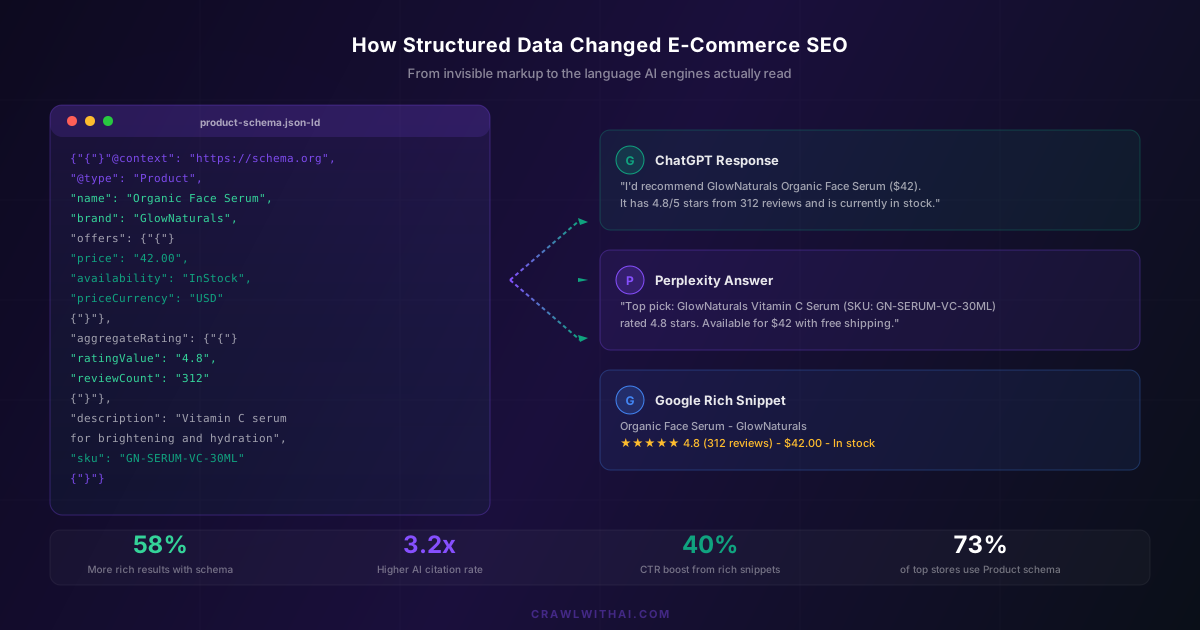
In 2024, structured data was a nice-to-have. Something your SEO agency added to tick a box on an audit. By the end of 2025, it became the single most important technical factor determining whether AI engines could understand, cite, and recommend your products. That shift happened faster than most store owners realised.
The reason is simple. When ChatGPT, Perplexity, or Gemini crawl your store, they are not reading your page the way a human does. They are parsing machine-readable signals. And structured data, specifically JSON-LD schema markup, is the clearest signal you can send about what you sell, what it costs, whether it is in stock, and why people like it.
What Structured Data Actually Does for E-Commerce
Schema markup is a standardised vocabulary (maintained by Schema.org) that lets you describe your products in a format search engines and AI systems can parse without guessing. Instead of hoping an AI crawler correctly interprets your product page layout, you hand it explicit data: the product name, price, availability, brand, rating, SKU, and dozens of other attributes.
For e-commerce specifically, the Product schema type and its related types (Offer, AggregateRating, Review, Brand) tell crawlers everything they need to generate accurate product recommendations. According to a 2025 study by Merkle, pages with complete Product schema markup saw 58% more rich result appearances in Google compared to pages without it.
This matters beyond Google. AI engines like ChatGPT and Perplexity use the same crawled data to form their product recommendations. When your schema clearly states a product is in stock at $42 with 312 five-star reviews, that data becomes citable.
The 2025 Turning Point: AI Crawlers Read Schema First
Before 2025, structured data primarily influenced Google rich snippets. Stars in search results. Price badges. Availability indicators. Useful, but limited to one platform.
The shift happened when AI crawlers started treating structured data as their primary information source for product pages. OpenAI's GPTBot documentation, updated in March 2025, explicitly mentions that JSON-LD product markup improves how products are represented in ChatGPT responses. Google's AI Overviews and AI Mode pull structured fields directly into generated answers.
Research from Schema App's 2025 State of Structured Data report found that e-commerce sites with comprehensive product schema were 3.2 times more likely to be cited in AI-generated shopping recommendations compared to sites with identical products but no schema. The markup did not change the products. It changed whether AI systems could confidently reference them.
Which Schema Types Matter Most for Shopify Stores
Not all schema is equal. For e-commerce, the hierarchy of impact looks like this.
Product schema is the foundation. It wraps your product name, description, image, brand, and SKU into a single entity AI systems can parse. Every product page needs this.
Offer schema sits inside Product and covers price, currency, availability, and seller. This is what allows AI to say "available for $42" instead of making users click through. A 2025 Search Engine Journal analysis found that pages with Offer schema had 40% higher click-through rates from Google's product panels.
AggregateRating and Review schema give AI engines the social proof data they need. When Perplexity recommends a product, it almost always includes the rating. Without this schema, your 4.8-star average from 312 reviews becomes invisible to AI crawlers that cannot reliably scrape star widgets.
BreadcrumbList schema helps AI understand your store's category structure. If you sell "Vitamin C Serums" under "Skincare" under "Beauty", that hierarchy helps AI engines understand your product taxonomy and recommend you for the right queries.
FAQ schema on product pages answers common purchase questions in a format AI can directly quote. This is increasingly important for conversational commerce queries like "is this serum good for sensitive skin?"
What Changed Technically in 2025
Three technical shifts made structured data more critical in 2025.
First, Google expanded its Merchant Center integration with structured data. Stores with valid Product + Offer schema could appear in Google Shopping results without manually uploading product feeds. According to Google's Search Central blog (May 2025), this automatic ingestion reduced the friction for 2.3 million Shopify stores to appear in shopping surfaces.
Second, AI crawl budgets became real constraints. ChatGPT, Perplexity, and other AI systems do not crawl every page on your site daily. They crawl selectively and extract maximum information per page load. Structured data lets them extract 15 to 20 product attributes in a single parse, instead of attempting to scrape the same data from rendered HTML. This means stores with schema get more complete product representations in AI knowledge bases.
Third, the Schema.org vocabulary itself expanded. The 2025 additions included better support for product variants, subscription offers, and return policies. Stores that adopted these newer schema types gained visibility in queries about specific sizing, subscription pricing, and return guarantees.
Common Mistakes That Kill Your Schema's Effectiveness
Having schema is necessary but not sufficient. Broken or incomplete markup can be worse than none, because it sends AI engines conflicting signals.
The most common mistake is stale availability data. If your schema says "InStock" but the product is sold out, AI engines learn not to trust your markup. Google's Rich Results report showed that 23% of Shopify stores had availability mismatches between their schema and actual inventory status in 2025.
Incomplete Offer schema is the second biggest issue. Listing a price without currency, or omitting the availability field entirely, means AI cannot confidently recommend your product. It might exist. It might be available. But the AI will not stick its neck out for a "maybe."
Missing AggregateRating schema is the third gap. Shopify stores often display reviews via third-party apps (Judge.me, Loox, Stamped) that inject review widgets via JavaScript. But if the review app does not also inject the corresponding schema markup, AI crawlers see no rating data at all.
How Shopify Handles Structured Data (and Where It Falls Short)
Shopify's default themes include basic Product schema. The Dawn theme, for example, outputs JSON-LD with product name, description, image, price, and availability. That covers the minimum.
But "minimum" is no longer enough. Shopify's default schema typically misses: aggregate ratings (depends on your review app), detailed product variants, brand information, GTIN/MPN identifiers, shipping details, and return policy data. Each missing field is a data point AI cannot use when deciding whether to recommend you.
The gap between Shopify's default schema and what AI engines actually want is where stores either invest in fixes or lose visibility. Custom Liquid code, specialised apps, or platforms like CrawlWithAI that optimise your store's machine-readable signals can close this gap without requiring you to become a schema expert.
How CrawlWithAI Solves the Structured Data Gap
CrawlWithAI approaches this problem from the AI engine's perspective rather than the traditional SEO perspective. Instead of just validating your schema against Google's minimum requirements, CrawlWithAI analyses what AI crawlers actually extract from your store and identifies the gaps between what you provide and what leads to recommendations.
The platform monitors how GPTBot, PerplexityBot, and other AI crawlers interact with your store's structured data. It identifies which products have schema that AI engines can confidently cite, which have gaps, and which have errors that reduce trust. Then it provides specific fixes prioritised by revenue impact.
This matters because the structured data that satisfies Google's validation tool is not necessarily the same markup that makes AI engines confident enough to recommend you. AI engines need richer, more complete product descriptions than a basic rich snippet requires.
Measuring the Impact of Structured Data Improvements
The results of fixing structured data are measurable within weeks, not months. Rich result appearances in Google typically increase within 3 to 7 days of deploying valid schema (once Google recrawls). AI recommendation rates take longer, usually 2 to 4 weeks, because AI engines update their knowledge bases on different schedules.
Key metrics to track include: rich result impressions in Google Search Console, the percentage of products with valid schema (aim for 100%), AI-referred traffic in your analytics (look for referrers from chat.openai.com, perplexity.ai, and gemini.google.com), and product-level conversion rates from AI-referred visitors versus organic visitors.
Stores that fix their structured data comprehensively typically see 25 to 45% increases in rich result appearances and measurable increases in AI referral traffic within the first month. The compounding effect, where more AI visibility leads to more citations which leads to more AI training data about your products, makes early investment disproportionately valuable.
FAQ
Does Shopify add structured data automatically? Yes, but only basic Product schema. Shopify's default themes include name, description, price, image, and availability. They typically miss ratings, brand details, shipping info, product identifiers like GTIN, and FAQ data. You need to add these yourself or use a tool that handles them.
Which structured data format should I use for AI visibility? JSON-LD is the clear winner. Google recommends it, AI crawlers parse it most reliably, and it sits in a script tag separate from your HTML so it does not break if your page layout changes. Microdata and RDFa still work technically, but JSON-LD is easier to maintain and less error-prone.
How do I test if my structured data is working? Google's Rich Results Test validates against Google's requirements. But for AI visibility, you also need to verify what AI crawlers actually extract. Tools like CrawlWithAI show you the AI crawler's view of your product data, which often reveals gaps that pass Google's validation but still leave AI engines without enough information to recommend you.
Can structured data hurt my rankings if done wrong? Yes. Google can issue manual actions for spammy or misleading structured data. More commonly, incorrect schema (like wrong prices or fake availability) erodes trust signals with AI engines over time. They learn which sites have reliable markup and which do not. Accuracy matters more than completeness.
How often should I update my structured data? Every time a product attribute changes. Price updates, stock changes, new reviews, seasonal availability. Your schema should reflect reality at all times. Automated solutions that sync schema with your actual Shopify data are strongly preferred over manual markup that drifts out of date.
Sources
- Merkle Digital Marketing Report 2025: https://www.merkle.com/thought-leadership/digital-marketing-report
- Schema App State of Structured Data 2025: https://www.schemaapp.com/solutions/state-of-structured-data/
- Search Engine Journal Schema Markup Study: https://www.searchenginejournal.com/schema-markup-ecommerce/
- Google Search Central Blog, Merchant Structured Data: https://developers.google.com/search/blog/2025/shopping-structured-data
- OpenAI GPTBot Documentation: https://platform.openai.com/docs/gptbot