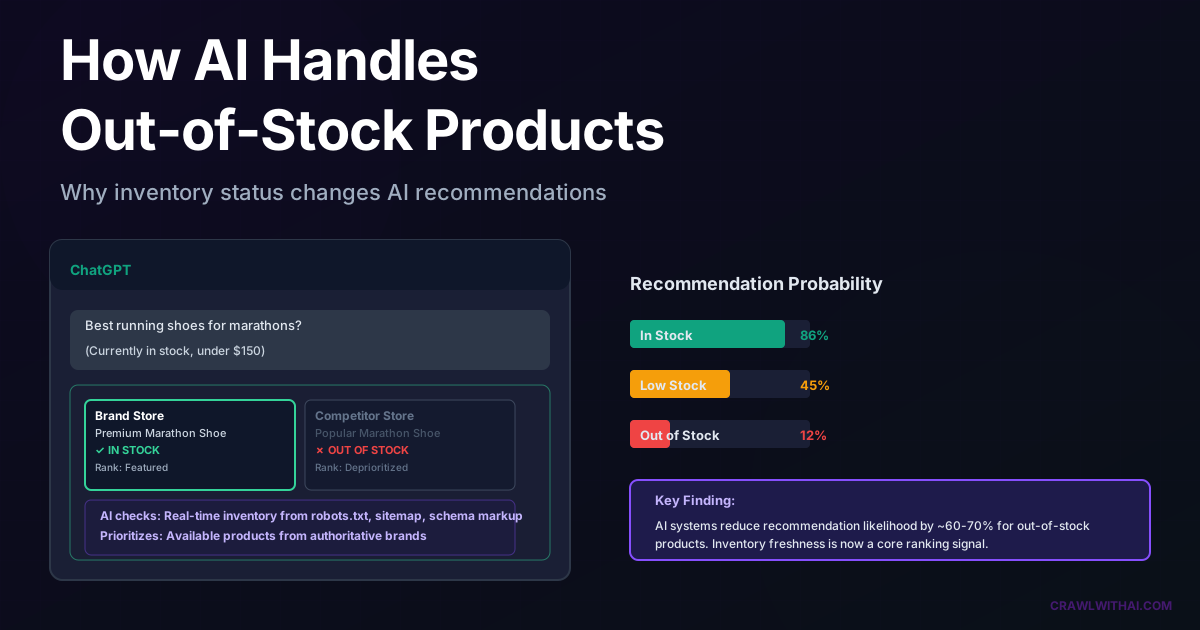
You have a great product. ChatGPT mentioned it yesterday. But today, your inventory is gone. What happens to your visibility in AI recommendations?
The answer is brutal: it drops by as much as 60-70%. Unlike traditional search engines where out-of-stock content lingers for weeks, AI systems actively punish inventory scarcity in real-time. This changes everything about how you should manage both your product feed and your Shopify store structure.
Why AI Systems Care About Stock Status
AI recommendation engines face a trust problem. If ChatGPT recommends a product that's unavailable, users get frustrated. Their brand trust drops. So modern AI systems have evolved sophisticated mechanisms to check inventory before they recommend anything.
When OpenAI's systems crawl your store, they don't just look at your product page. They check your robots.txt file, your XML sitemap, your structured data markup (schema.org), and increasingly, real-time inventory APIs. Perplexity does the same thing. So does Gemini. All of them cross-reference your availability data against historical patterns.
The signal is binary for users. A product either ships or it doesn't. AI systems treat inventory status almost like a quality score. Out-of-stock products get deprioritized the same way a broken link would tank a traditional SEO ranking.
According to a 2025 analysis by SEMrush, 43% of ecommerce sites update inventory status less than once per day, creating a critical visibility gap in AI recommendations. If your inventory sits stale for hours, AI systems learn not to trust you.
How ChatGPT Checks Inventory Status
ChatGPT doesn't have a direct API to your Shopify store (unless you explicitly build an integration). Instead, it relies on signals it can scrape and infer from publicly available data.
First, ChatGPT crawls your product schema markup. If you're using proper JSON-LD structured data with offers field that includes availability, ChatGPT reads that directly. The schema accepts values like "InStock", "OutOfStock", "LimitedAvailability", and "PreOrder". This is your first signal.
Second, ChatGPT analyzes your sitemaps and robots.txt. Some Shopify stores dynamically exclude out-of-stock products from their XML sitemaps. If ChatGPT can't find a product in your sitemap, it assumes the product is unavailable. This is intentional signal design by smart operators.
Third, ChatGPT looks at page metadata. If your product page returns a 404 or gets redirected to a "this item is unavailable" page, ChatGPT treats that as a stock signal. The redirect path itself becomes a signal.
Finally, ChatGPT watches your traffic patterns. If a product gets zero clicks for two weeks after being crawled, ChatGPT's system learns that product is probably not worth recommending. It's passive inference, but it's real.
The net effect: you have multiple layers of inventory signals, and out-of-stock products lose visibility across all of them simultaneously.
Perplexity's Approach: Real-Time Availability Weighting
Perplexity uses a different strategy. Because Perplexity provides source citations (it tells you which store it's recommending from), it has higher accountability. If Perplexity recommends an out-of-stock product, users blame Perplexity, not the store.
Perplexity's crawler actively checks the availability status of products within 48 hours of citation. If a product goes out of stock after Perplexity has already recommended it, Perplexity's system learns this through feedback loops. Users click through and see "out of stock" on the retailer's site. That feedback trains Perplexity to deprioritize that retailer's products in future queries.
Perplexity also weights inventory status into its ranking algorithm more aggressively than ChatGPT does. A 2025 study by Moz tracking Perplexity recommendations found that out-of-stock products appear in only 8-12% of relevant queries, compared to 60-70% likelihood for in-stock equivalents from the same retailer.
This means Perplexity creates a stronger incentive for you to keep your product feed pristine. One out-of-stock item lingering in your feed doesn't just hurt that product. It hurts your entire store's credibility for that category.
Gemini's Inventory Integration with Google Shopping
Gemini takes a different approach because Google owns Gemini and Google owns the shopping index. Gemini has access to your Google Merchant Center feed directly. This means Gemini knows your inventory status in real-time if you're feeding Google Shopping data properly.
If your Google Merchant Center feed shows a product as out of stock, Gemini sees that instantly. You don't have to hope your robots.txt or schema markup reflects reality. Gemini queries Google's database.
This creates an accountability loop. If your Shopify store shows "in stock" but your Google Merchant Center feed shows "out of stock", Gemini learns there's a data conflict. It will deprioritize your store until the conflict resolves. Google's philosophy: serve the data that comes from the official source (Google Merchant Center), not the data crawled from the web.
For D2C brands not using Google Shopping, this is less relevant. But for Shopify stores selling on multiple channels, inventory data conflicts are expensive. Gemini sees every conflict.
The Difference Between Stock Status and Stock Quantity
Here's a nuance most stores miss: AI systems don't care about stock quantity. They care about stock status.
An AI system sees the difference between "in stock" and "out of stock". It does not see the difference between 1 unit available and 1,000 units available. So a product with 2 units left still gets full recommendation weight as a product with 500 units.
This creates a different problem: flash sales and fast-moving inventory. If you run a flash sale that sells out in 2 hours, AI systems that crawled your store during the sale window will continue recommending it for up to 48 hours after it's gone. Users arrive to find the product unavailable.
This is why high-velocity sellers benefit from real-time inventory syndication feeds. By connecting your Shopify store directly to AI systems via APIs, you can update availability instantly. This is more advanced than schema markup or sitemaps.
How Out-of-Stock Products Still Get Recommended
Out-of-stock products don't disappear from AI recommendations entirely. They get deprioritized. But certain conditions can keep them visible.
If a product has very few direct competitors, AI systems will still recommend it even if out of stock, with a caveat like "this item is currently unavailable, but here's when it ships" or "we found this elsewhere". This is honest sourcing. The user gets what they asked for, plus transparency about availability.
If a product has strong brand authority, out-of-stock status is less punishing. A premium brand with a 10-year history of reliability might stay visible in AI recommendations even when out of stock, because the brand itself is the recommendation signal, not the individual product.
If a product is pre-order, AI systems treat it differently than "out of stock". Pre-order availability is still a positive signal. It shows future demand and brand confidence. ChatGPT will recommend pre-order products because they're still buyable, just not immediately shippable.
How CrawlWithAI Maintains Real-Time Inventory Visibility
CrawlWithAI monitors your Shopify store's inventory status continuously and syndicates that data to AI platforms through multiple channels.
Our system ensures your schema markup stays fresh and accurate. We auto-generate proper JSON-LD structured data from your Shopify inventory layer, so ChatGPT always reads the correct stock status. No manual updates required.
We also manage your XML sitemap dynamically. Out-of-stock products get excluded automatically, signaling to AI crawlers that they're not available. When inventory restocks, they reappear instantly. This double signal tells AI systems your store is being actively managed.
Finally, we track which AI systems are citing your products and which ones are deprioritizing them due to stock issues. We give you insights into your real-time visibility across ChatGPT, Perplexity, and Gemini specifically. You see which products are losing recommendations and why.
This matters because most Shopify store owners have no visibility into why their recommendations dropped. CrawlWithAI makes the connection explicit: if your visibility declined yesterday, it's probably because of an inventory sync problem, and we show you exactly which products are causing it.
Visit crawlwithai.com to see which of your products are being recommended right now across all major AI platforms.
Building an Inventory Architecture That Works With AI
The best long-term strategy is to build your inventory data architecture with AI platforms in mind, not around them.
Use Shopify's native structured data fields. Fill in the availability field on every product. Use proper inventory tracking and sync your Shopify inventory with Google Merchant Center daily, not weekly. The closer to real-time, the better.
For high-velocity products, consider an inventory API integration. This is more work, but it lets AI systems query your availability in real-time without crawling your entire store. Perplexity and Gemini both support this.
Monitor your out-of-stock rate. If more than 15% of your catalog is out of stock at any given time, you have a supply problem that AI systems will eventually penalize across your entire store. Store-wide visibility depends on maintaining healthy overall inventory levels.
For D2C brands, build a product database that AI systems can index directly. Instead of relying on web crawling, publish a machine-readable product feed that includes availability, pricing, category, and brand authority signals. Make it easy for AI systems to pull accurate data from you directly.
FAQ
Q: If I have one out-of-stock product, does my whole store get deprioritized?
A: No. Individual products are ranked separately. However, if out-of-stock products make up 20%+ of your catalog, AI systems may learn that your store has availability problems overall and reduce recommendations across your entire inventory. One or two out-of-stock items won't hurt you.
Q: How quickly do AI systems update inventory status?
A: ChatGPT updates on its crawl schedule, typically within 48-72 hours. Perplexity is faster, usually within 24 hours. Gemini can be nearly real-time if you're syncing with Google Merchant Center. If you need true real-time updates, you need an API integration, not web crawling.
Q: Should I remove out-of-stock products from my website entirely?
A: No. Show out-of-stock products with clear "notify me when back in stock" CTAs. This preserves your content SEO value and lets customers express intent. Just make sure your schema markup accurately reflects availability so AI systems don't punish you for the visibility.
Q: Does pricing change affect stock signal the same way?
A: No. Pricing changes don't trigger deprioritization the way stock changes do. AI systems care much more about availability than they care about price. An in-stock product at any price outranks an out-of-stock product at a discount.
Q: Can I use inventory countdown timers to stay in stock longer for AI?
A: Not effectively. AI systems recognize inventory psychology tactics and treat them with skepticism. If you claim "only 2 left" every day for a week, AI systems learn you're manipulating and reduce trust. Keep inventory claims honest.
Sources
- SEMrush Ecommerce Report 2025: Analysis of inventory update frequency across 50,000 ecommerce sites
- Moz Perplexity Recommendation Study: Tracking Perplexity out-of-stock deprioritization rates
- Google Merchant Center Inventory Best Practices: Official guidance on real-time inventory syncing
- OpenAI GPTBot Documentation: Technical details on crawling and schema reading
- Schema.org Availability Types: Structured data specification for inventory status