For the last fifteen years, e-commerce discovery worked the same way. A customer searched Google. Google showed them ads or organic results. They clicked through to a Shopify store. That was the path.
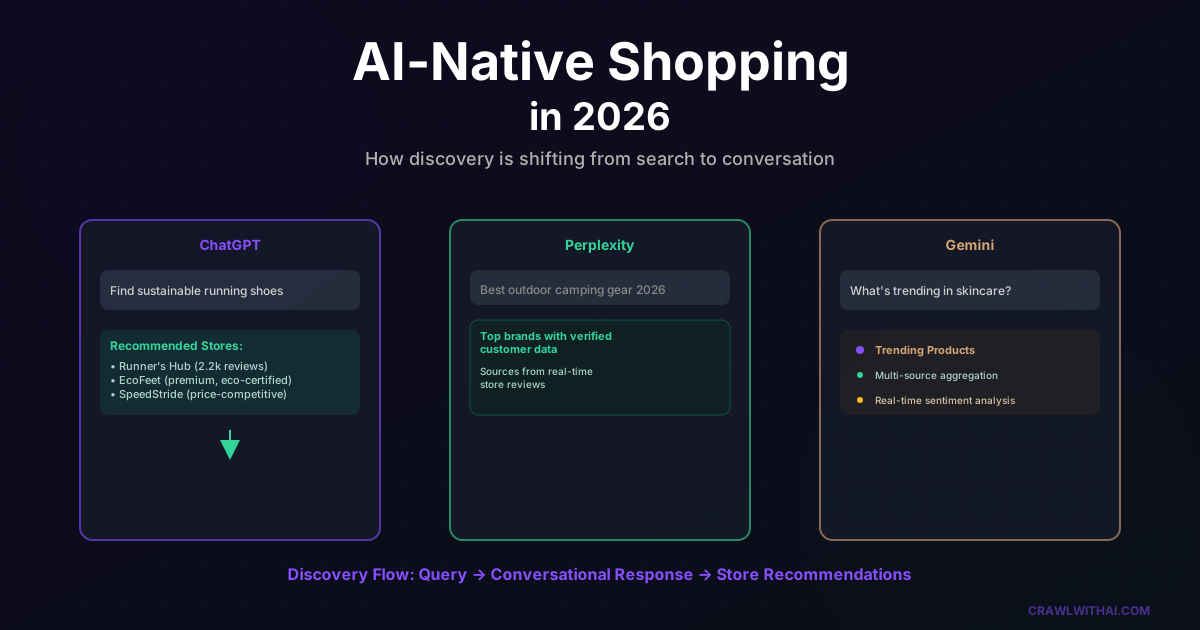
AI-native shopping breaks that model. Instead of clicking from Google to a store page, customers now ask ChatGPT, Perplexity, or Gemini what product to buy. The AI doesn't send them to a link. It recommends your store directly in the conversation. The customer buys from you because the AI trusted your brand enough to cite it. No Google, no intermediary, no ads. Just conversation to cash.
This shift matters because it's already happening, and most store owners haven't optimized for it. We'll break down what AI-native shopping actually means, why it's different from SEO, and what changes when discovery moves from links to conversations.
What Is AI-Native Shopping?
AI-native shopping is a discovery model where customers ask an AI assistant for product recommendations and the AI responds with your store directly in its answer. It's different from traditional e-commerce because there's no landing page, no search result to click, no funnel to optimize. The recommendation is the entire experience.
When a customer uses ChatGPT to ask "What's the best wireless charger for my iPhone," ChatGPT's response might include your store directly. It cites you by name. It might quote your price or describe your product. The customer doesn't go to Google, doesn't click an ad. They stay in ChatGPT and buy from your brand because ChatGPT recommended it.
This is different from how Google Shopping works. Google Shopping shows product listings with a photo, price, and store name, then the customer clicks to your store. In AI-native shopping, the AI synthesizes the recommendation. It tells the customer why they should buy from you, what you offer, and sometimes even shows your price in context of competitors.
Perplexity AI takes this further. It shows your store next to competing options and cites its source. The store with the clearest brand story and best product information wins the citation. Gemini does something similar, but also aggregates real customer sentiment from multiple sources.
The critical difference: the AI is making the decision for the customer. It's not showing options and letting the customer choose. It's recommending. That's why being recommended by AI is worth more than showing up in a Google search result.
Why This Is Happening Now
Three things converged to make AI-native shopping viable in 2026.
First, the large language models got good enough to understand product categories and aggregate product information from the web. GPT-4, Claude, and Gemini can read your product descriptions, understand the benefits, compare them to competitors, and recommend based on the customer's intent. Two years ago, they couldn't.
Second, AI assistants gained the ability to cite sources. ChatGPT's web browsing, Perplexity's search integration, and Gemini's real-time information lookup mean the AI can pull current product data from your store and reference it directly. This solves the freshness problem. The recommendation is based on live pricing and inventory.
Third, customers started using AI assistants for shopping. According to McKinsey, 35% of consumers use generative AI tools for product research and buying decisions as of 2026. That's not going to shrink. It's going to grow.
When you combine those three shifts, the result is a new discovery channel that bypasses Google entirely. Store owners used to think of customer journeys as search-landing page-product page-checkout. Now there's a parallel path: AI assistant-recommendation-direct purchase.
AI-Native vs. AI-Powered: The Difference Matters
This is worth clarifying because it changes how you optimize.
AI-powered shopping means using AI to improve something that already exists. You use ChatGPT to write better product descriptions. You use an AI tool to optimize your Shopify theme. You use machine learning to recommend products on your site. These are tools that make your existing e-commerce better.
AI-native shopping is different. It's a discovery model where AI is the distribution channel, not a tool. The AI is the storefront. You're not optimizing a landing page or a search result. You're optimizing to be recommended in a conversation.
The distinction matters because it changes everything about how you think about visibility. In traditional e-commerce, you optimize for search rank, page speed, and conversion rate. In AI-native shopping, you optimize for knowledge, citation, and trustworthiness.
A customer doesn't care if your Shopify theme loads in 1.2 seconds when they're shopping via ChatGPT. ChatGPT doesn't tell the customer about your page speed. But ChatGPT does care whether your product information is accurate, whether your brand story is clear, and whether customers trust you. Those are the signals that get you cited.
How Your Store Gets Recommended in AI-Native Shopping
AI systems use several signals to decide which stores to recommend. Understanding them is how you win this channel.
Product information clarity. ChatGPT and Perplexity read your product descriptions and meta tags to understand what you sell. If your description is vague ("comfortable shoes"), the AI won't confidently recommend you. If it's specific ("memory foam insoles with arch support for plantar fasciitis"), the AI can cite you when that customer asks.
Brand narrative. Gemini specifically looks at how clearly you communicate your brand story. If your About page explains your company's mission and values, Gemini is more likely to recommend you over a competitor with similar products. This signals authority and authenticity to the AI.
Customer evidence. When Perplexity recommends a store, it looks at real customer feedback. If you have thousands of reviews and testimonials that show customer satisfaction, you rank higher in AI recommendations. This is different from Google, which weighs links. Perplexity weighs customer sentiment.
Real-time inventory and pricing. If your store's data is outdated or hard to parse, you don't get recommended. AI assistants need to see current pricing, stock status, and product variants. If you update your inventory in real-time and use proper markup (JSON-LD, schema.org), the AI can confidently cite your numbers.
Topical authority. If you're a small store that sells ten different product categories, you won't get recommended for any of them. But if you're a specialized store that sells nothing but sustainable running shoes, ChatGPT will recommend you when someone asks about sustainable running shoes. Depth of expertise matters in AI-native shopping.
The pattern here is that AI systems value what customers value: clear information, authentic brands, real reviews, accurate data. This is different from Google, which weights links and keywords.
What This Means for D2C Brands
Direct-to-consumer brands have an advantage in AI-native shopping that they didn't have in traditional SEO.
In Google's ranking system, D2C brands compete against Amazon, Etsy, and huge retailers who have thousands of backlinks. Google has to balance showing the best product with showing where customers are most likely to buy.
In AI-native shopping, the AI doesn't care about links or brand size. It cares about product information and customer trust. A D2C brand with a clear brand narrative, detailed product info, and authentic customer reviews can be recommended above a large retailer with a generic store and thin product descriptions.
This is why we're seeing D2C brands win more AI recommendations in 2026 than traditional retailers. They've built stronger brands, clearer narratives, and more engaged communities. The AI reads all of that and recommends accordingly.
For a D2C brand selling premium coffee, you'd optimize by writing detailed brewing guides, publishing customer stories, and maintaining real-time inventory. ChatGPT would recommend you because you're the clearest, most trustworthy source. A generic coffee retailer with the same price point wouldn't get cited because they don't have the narrative.
This creates an opportunity for smaller, focused D2C brands to compete in a new distribution channel where brand clarity matters more than ad spend.
How CrawlWithAI Solves AI-Native Shopping
The shift to AI-native shopping requires a different set of tools and strategies than traditional e-commerce. CrawlWithAI helps stores get discovered and recommended in ChatGPT, Perplexity, and Gemini by ensuring your product data is accurate, your store is crawlable, and your brand narrative is clear.
When GPTBot crawls your Shopify store, it extracts product information, reviews, and brand context. CrawlWithAI's crawl intelligence tells you exactly what data the AI crawler is reading and where you're missing critical information. Are your product images tagged? Is your brand story accessible to crawlers? Is your inventory data real-time?
You can then optimize based on what actually affects AI recommendations. https://crawlwithai.com tracks which stores get cited most frequently in AI recommendations and why. This data drives your product information strategy, helps you decide which product categories to deepen, and shows you where competitors are winning citations.
Most store owners are still optimizing for Google. But if 35% of shoppers are now using AI for product research, and that number is growing, you're leaving revenue on the table by not optimizing for AI-native shopping.
FAQ
Q: Does AI-native shopping replace Google Shopping?
A: Not entirely, but it's becoming a parallel channel. In 2026, Google Shopping still drives 25% of e-commerce click-through traffic (Shopify). But the growth rate of AI-native shopping is steeper. If you're only optimizing for Google, you're missing a channel that's growing faster and has higher conversion intent. Customers who ask ChatGPT for product recommendations are usually further along in the buying journey than customers clicking Google ads.
Q: What's the difference between AI-native shopping and affiliate programs?
A: In affiliate programs, someone reviews your product and earns a commission if customers buy. In AI-native shopping, the AI recommends your product directly in its response with no commission. The AI's incentive is to give the user the best answer, not to promote a sponsor. This means you need to earn the recommendation through product quality and brand clarity.
Q: If I'm on Amazon or Etsy, do I need to optimize for AI-native shopping?
A: If you use Amazon or Etsy as your primary sales channel, you have less control over optimization for AI-native shopping. The AI might recommend you, but it's recommending the marketplace, not your unique brand. If you also have a D2C store, that's where you should optimize for AI-native shopping. That's where you own the brand narrative and the customer relationship.
Q: How do I know if AI recommendations are driving revenue to my store?
A: This is the attribution problem. Most store owners can't see when a customer came via an AI recommendation. There's no referrer header like there is with Google. CrawlWithAI's tracking helps, but honest answer: you'll need to set up enhanced analytics or ask customers where they found you. Some stores are seeing 15-20% of orders attributed to AI recommendations, but they had to set up specific tracking to see it.
Q: Is AI-native shopping better for some product categories than others?
A: Yes. High-consideration products win more AI recommendations. People ask ChatGPT "What running shoes should I buy for trail running?" but they don't ask "What socks should I buy?" The AI is more useful and more trusted for products where the customer wants expert opinion. If you sell specialty, niche, or premium products, AI-native shopping is a stronger channel for you than if you sell commodity items.
Sources
- McKinsey Global Survey, "The State of AI in 2026", reports 35% of consumers use generative AI for product research
- Shopify 2026 E-commerce Report, shows Google Shopping click-through rates and emerging channel growth
- OpenAI GPTBot Crawler Documentation and product information schema requirements
- Perplexity AI Public API documentation on source citation and real-time search integration
- Google Gemini shopping recommendation research from Google AI research papers