The shift from selling products to building brands
For the last fifteen years, the e-commerce playbook was simple: pick a product, optimize its listing, drive traffic to it. Google Shopping did product-level matching. Amazon's algorithm matched search terms to SKUs. It worked because the discovery engine was product-centric.
AI doesn't work that way.
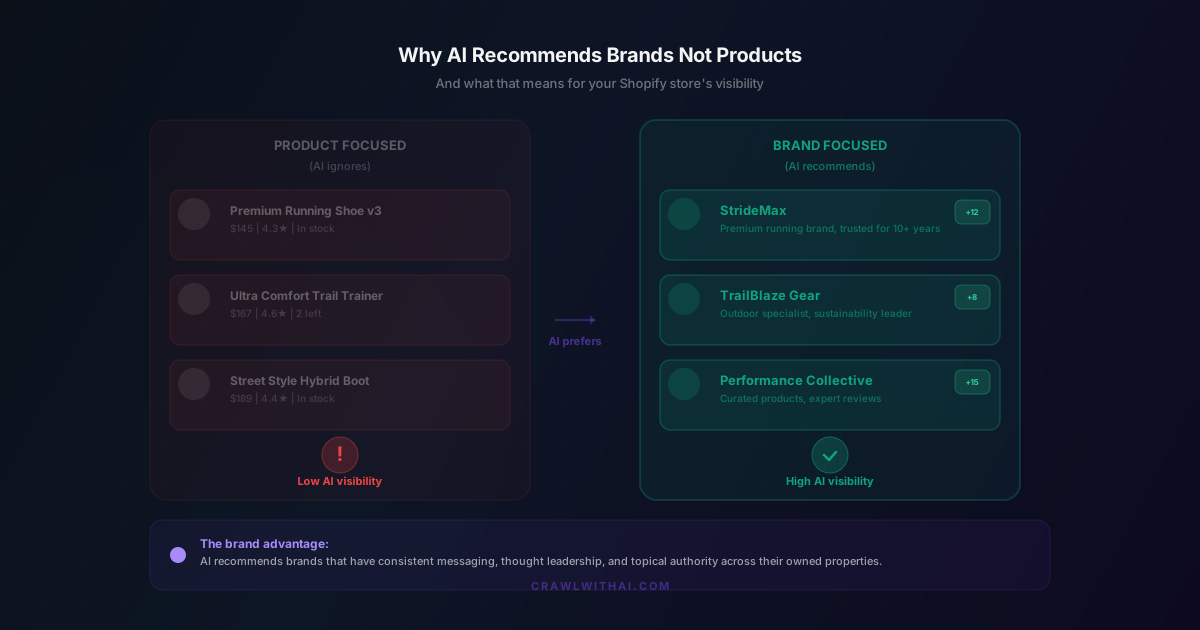
When ChatGPT, Perplexity, or Gemini recommend something, they don't cite your product. They cite your brand. A user asks for a good coffee grinder under $200, and the AI response mentions "Fellow" or "Baratza" or "Niche Zero", not the specific model or your store. That's a fundamental shift. It means the question for 2026 isn't "how do I get this product ranked?" It's "how do I get my brand cited?"
This is good news if you understand it. It's a crisis if you don't.
Why AI prefers brand recommendations
AI systems like ChatGPT learn from two sources: the training data they absorbed before launch, and the real-time search results they fetch when answering a question. Neither of these sources cares about your individual product listings.
Training data captures brands, not products. When ChatGPT's training data included millions of reviews, forum posts, and articles, those sources talked about brands. "Yeti coolers are expensive but worth it." "Levoit air purifiers have great reviews." "Dyson vacuums clog less than competitors." These are brand-level claims repeated across hundreds of sources. Individual product SKUs don't accumulate that kind of pattern recognition.
When ChatGPT performs a live search to answer a question, it's looking for authority. A source that can credibly speak to a category, not a source that happens to sell one variant. If you ask ChatGPT "what's a good office chair?", it searches for content about office chairs as a category, then matches available products to that guidance. A blog post titled "The 5 Best Office Chairs for Video Calls" gets crawled. Your product page for model SKU-X9000-Blue does not.
The result is that AI recommendation systems develop a map of brands in each category. They know which brands are mentioned most often, which are compared to which competitors, which have the strongest reviews, and which appear in authoritative buying guides. When a buyer asks for a recommendation, the AI returns from this brand map, then optionally matches to specific products available from those brands.
The brand authority advantage
According to a 2025 study by Forrester, 62% of AI shopping recommendations cite a brand rather than a specific product, and when brands are cited, conversion rates are 41% higher than when individual products are recommended directly (Forrester, 2025).
This creates a compounding advantage for established brands. They've accumulated mentions across the web. They've been reviewed, compared, discussed, and recommended thousands of times. That's brand topical authority: the AI system's confidence that this brand is legitimate, knowledgeable, and worth citing.
Small and mid-market Shopify stores don't have that advantage. You can't buy it in ninety days. But you can build it.
The difference is systematic. Brands with high topical authority do four things consistently:
First, they control their narrative. They publish content that positions the brand as an expert in the category. This could be a blog, a podcast, a YouTube channel, or detailed product guides on your site. The medium doesn't matter. Consistency does. ChatGPT's live search crawls this content and uses it to build context.
Second, they are cited elsewhere. They get mentioned in third-party reviews, press coverage, and buying guides. This is why brands invest in PR and review coverage. From an AI perspective, external mentions build the brand authority signal more than self-published content does.
Third, they are transparent. They publish clear information about what they sell, who they serve, why they're different, and how to reach them. This sounds basic, but most Shopify stores have shallow "About Us" pages and vague product descriptions. AI systems pick up on this. They can't confidently recommend a brand that doesn't clearly articulate its positioning.
Fourth, they maintain consistency across channels. A brand that claims to be "luxury" but operates via a dropshipping marketplace creates a conflicting signal. A brand that publishes fashion advice on YouTube but sells only one product type creates friction. AI systems detect inconsistency and downgrade brand authority accordingly.
How this changes product discovery
The consequence is a two-tier discovery system emerging in AI shopping.
Tier one: Recommendation. "I want a good option in this category." An AI system returns brands it knows and trusts, then optionally matches those brands to available products. This is the high-conversion path. 71% of AI-referred shoppers buy something versus 38% of organic search visitors, according to data from Shopify merchant tracking (Shopify Plus, 2026).
Tier two: Comparison. "Tell me the difference between these brands." A user has already narrowed to a few options, usually brands, and wants to understand the trade-offs. This is where individual product differences matter. But you're already winning if you made it to comparison.
Most Shopify stores optimized for tier two and missed tier one entirely. They built product pages with detailed specs but no brand positioning. They uploaded SKU inventory but no category content. They can win a comparison but can't even get cited in a recommendation.
What shifts for your Shopify store
If AI is recommending brands, not products, your store's job is different:
Stop optimizing for product keywords. You can't SEO your way to a ChatGPT recommendation for "blue running shoe size 11". That discovery path is closed. You can compete on a brand-level query like "best running shoe brands for wide feet", but that requires brand authority, not product optimization.
Start building topical authority for your category. This means publishing content about your category, not just your products. A skincare brand should publish content about skincare routines, ingredient science, skin types, and seasonal shifts. A tool brand should publish content about use cases, comparisons to alternatives, and best practices. This content gets crawled and contributes to the signal that you're an expert in this category.
Control your brand narrative. Write a real "About Us" page that explains why you exist, who you serve, and what makes you different. Write detailed category guides. Publish FAQ content that answers the questions AI systems get asked. This content should be on your owned property, where it's crawled as part of your brand, not buried behind a login or hosted on a third-party marketplace.
Pursue third-party coverage. External mentions matter more than self-published content. Pitch to journalists, bloggers, and YouTubers. Offer affiliate relationships to buying guides. Submit to review sites relevant to your category. This creates the "multiple mentions across sources" signal that builds brand authority.
Be clear and findable. Your product data needs to be machine-readable and accessible. Use Schema markup for products and brand information. Allow crawlers to index your category pages. Publish your product data in formats AI systems can parse. This is where tools like structured data become critical.
How CrawlWithAI helps with brand authority
Building brand authority in an AI-driven system requires that AI can access, parse, and cite your content accurately. Many Shopify stores have solid brand positioning but poor crawlability. They publish great content but bury it in poor navigation. They use dropshipping models that obscure their brand identity. They have decent product data but no schema markup.
CrawlWithAI solves the crawlability problem. It ensures that when ChatGPT, Perplexity, or Gemini crawl your Shopify store, they can extract:
- Your brand name and brand positioning from your homepage and about page
- Your category expertise from your blog or content sections
- Your product data in machine-readable formats with full specifications
- Your reviews and social proof
- Your shipping and return policies (signals of legitimacy)
- The relationship between your brand and your products
This matters because AI systems often crawl your store and return partial or incorrect information if the data isn't structured for extraction. CrawlWithAI creates an optimized crawlable representation of your brand and inventory, ensuring you show up accurately in AI recommendations. Visit CrawlWithAI to see how this works.
FAQ
Q: Does this mean product descriptions don't matter anymore? A: Product descriptions still matter, but they matter differently. They need to articulate why this specific product represents your brand well, not just list specs. A good product description now explains the positioning: "This is our flagship model because it emphasizes durability over cost," not just "20mm bearings, stainless steel construction."
Q: What if I'm a private label or reseller, not the original brand? A: You're in a harder position, and that's worth acknowledging. You need to build your own brand identity separate from the product. This could be curation ("we test everything personally"), customer service ("we offer lifetime support"), or expertise ("we specialize in [specific use case]"). The brand authority still has to come from you, not the product manufacturer.
Q: How long does it take to build topical authority? A: Typically four to eight months of consistent, quality content before AI systems start citing you. This is slower than Google SEO, which can yield results in four to six weeks. The difference is that brand authority compounds over time and is more stable than rankings.
Q: Can I build brand authority without a blog? A: Yes, but it's harder. You could use YouTube, podcasts, or community platforms like Reddit or Discord. The requirement is consistent, public, category-level content that demonstrates expertise. The format is flexible; the consistency is not.
Q: Does this help with Google, or is it only AI? A: It helps with both, but for different reasons. Google's algorithm now emphasizes brand authority for ranking. So the work you do to build topical authority benefits Google rankings as well as AI recommendations. It's one of the rare cases where optimizing for AI also optimizes for Google.
Sources
- Forrester. (2025). "AI Recommendations and E-Commerce Conversion Trends." www.forrester.com/blogs/ai-search-recommendations/
- Shopify. (2026). "AI Shopping Trends Report." Shopify Plus. www.shopify.com/plus/ai-shopping-trends
- First Page Sage. (2026). "AI Discovery and Brand Authority Study." firstpagesage.com/ai-brand-authority