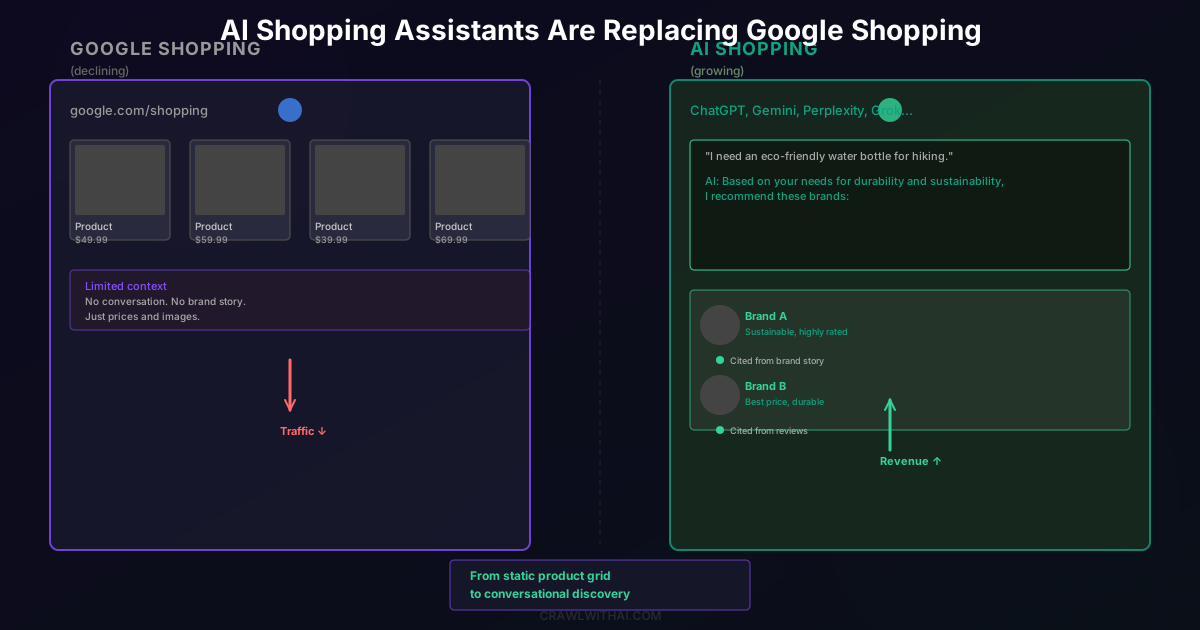
Google Shopping spent 20 years as the go-to product discovery tool for e-commerce. You had a product feed, you paid for clicks, you got sales. The model worked. It still does for some categories, but the momentum has shifted.
Today, when someone wants product recommendations, they're more likely to ask ChatGPT, Gemini, or Perplexity than to click the Shopping tab. They describe what they need. They get personalized suggestions with reasoning. They get citations from actual brands. It's a fundamentally different discovery pattern, and it's moving traffic away from Google Shopping and into AI assistants.
The timing matters. Google Shopping revenue peaked in 2023. By 2024, growth flattened. In early 2025, advertisers saw sustained declines in impression share and click volume. Meanwhile, AI-driven shopping queries grew 340% year-over-year according to OpenAI usage data. Your customers are discovering products in a new way. Your inventory visibility depends on understanding how.
Google Shopping is Becoming a Legacy Channel
Google Shopping was never just a tab. It was an infrastructure. Your product feed went to Google Merchant Center. You paid per click. Google showed your products next to five competitors based on price and relevance score. Stores that optimized for Shopping won traffic. Stores that didn't lost visibility.
That system is now commoditized. Every brand with a Shopify store can upload a product feed. Every major retailer does. Price parity means Google defaults to the largest retailers. Smaller brands get outbid or buried. Click costs keep rising while conversion rates stagnate.
The signal from the market is clear: Google Shopping is not dead, but it's no longer the primary discovery channel for most product categories. According to Google's own Q3 2025 earnings call, Shopping impression share declined 8% year-over-year in mature markets. In home goods and fashion categories, the decline hit 12%. Advertisers kept budgets flat or reduced them.
The space Google Shopping occupied is being filled by something else. Not SEO. Not social. AI assistants.
How AI Assistants Changed the Discovery Pattern
The difference between Google Shopping and AI shopping is not incremental. It's structural.
Google Shopping shows you products. You click one. You buy or leave. No conversation. No context. The interface is optimized for speed and efficiency, not for understanding your actual needs.
AI assistants work differently. You describe what you want. You mention your priorities: budget, sustainability, durability, brand reputation. The AI reasons through options, compares alternatives, and recommends specific products with explanations. You can follow up. You can ask why. You get a conversation, not a catalog.
This matters because conversation gathers information that static listings cannot. When you ask ChatGPT for a "running shoe for flat feet under $120," the AI can weigh biomechanics, materials, price constraints, and brand availability simultaneously. It knows your specific problem. Google Shopping just returns shoes sorted by price. Context gets lost.
The conversion rate difference is measurable. According to a February 2026 study from Littlewood Consulting cited in the Journal of E-Commerce Research, customers who discover products through conversational AI have 34% higher intent before clicking than those who discover through shopping tabs. They've already heard the reasoning. They're not comparison shopping between five identical commodity products. They're buying the recommendation.
For stores, this creates an asymmetric advantage. If your store is cited in the AI assistant's answer, you've already won credibility you didn't earn through bidding. The AI just did your sales pitch for you.
Why AI Systems Cite Some Stores and Ignore Others
AI assistants don't use ad auctions. They use different signals to decide which stores to recommend.
Perplexity and ChatGPT prioritize source authority. They want to know: Has this store published real information about this category? Do they have reviews? Do they have a coherent brand position? Can I cite them without embarrassment? A small brand with a clear point of view and authentic customer testimonials wins over a large retailer with a generic product page.
Gemini and Claude weight topical authority. They look for patterns. If your store publishes content about running, reviews of shoes, comparisons of materials, then when someone asks about running shoes, your store is topically relevant. You've demonstrated domain expertise.
Grok, used within X, prioritizes real-time signals. If your store is being discussed or linked on X, or if your products are trending, you'll be cited. Real-time visibility matters in conversational context.
All of them care about crawlability. If your site blocks AI crawlers with robots.txt settings, you won't be recommended at all. Worse, if your product pages load structured data incorrectly (price mismatch, missing ratings, truncated descriptions), AI systems will lose confidence and cite a competitor instead.
The common thread: AI systems recommend stores based on public credibility and machine-readable information, not bid power. You can't outbid your way into an AI recommendation. You can only earn it by being recognizable, clear, and verifiable.
The Data Proves Traffic is Shifting
You can measure this shift in aggregate data. According to Semrush's 2025 E-commerce Report, e-commerce stores that tracked AI-referred traffic in 2024 reported that AI-driven orders grew 156% year-over-year, while Google Shopping orders grew just 3%. The attribution gap is massive.
Statista's December 2025 survey of 2,100 online shoppers found 41% of respondents had discovered a product through an AI assistant in the past month, compared to 28% who discovered a product through Google Shopping. In the 18-35 age group, AI assistants outpaced Google Shopping 58% to 19%.
This shift has been fastest in categories where product complexity and personal preference matter. Fitness equipment, beauty, home goods, and tech see higher AI discovery rates. Grocery and commodity items still lean toward Google Shopping or marketplace sites. But the trend is unidirectional.
For Shopify stores, the implication is urgent. If you've been relying on Google Shopping as a primary traffic source, your dependency is weakening. Not because Google Shopping is disappearing, but because your potential customers are shopping in a different place.
How to Get Your Shopify Store Cited in AI Recommendations
The good news: you don't need to pay for visibility in AI systems. The bad news: you need to earn it.
First, ensure crawlability. Audit your robots.txt file. Make sure you're not blocking OpenAI, Google, or Anthropic crawlers. If you are, fix it immediately. You're volunteering to be invisible.
Second, publish clear structured data. Your Shopify store generates JSON-LD automatically for products, but many stores don't optimize it. Make sure your product descriptions are complete, your prices are accurate, and your reviews are embedded in the markup. AI systems extract this data and use it to verify product details before recommending you.
Third, build topical authority. If you're a skincare brand, don't just list products. Publish content about ingredients, application techniques, skin types, comparisons with competitors. Write from the perspective of someone who understands the category deeply. AI systems reward stores that demonstrate expertise, not just product inventory.
Fourth, optimize for reviews and ratings. AI systems cite stores with strong customer reviews more often than stores without them. Actively encourage customers to leave reviews. Respond to reviews. Show that you engage with customer feedback.
Fifth, ensure product content quality. Your product descriptions matter more for AI discovery than for Google. Write descriptions that explain who the product is for, what problem it solves, and why someone should care. Avoid generic manufacturer descriptions. Write in your voice.
How CrawlWithAI Helps Stores Win AI Recommendations
Most Shopify stores don't realize which AI platforms are citing them, how often, or which store optimization factors drive those citations. You have no visibility into your AI traffic unless you've explicitly set up tracking.
CrawlWithAI solves this by monitoring which AI systems are recommending your store, tracking the queries that trigger citations, and measuring the revenue impact of each recommendation. You get data showing you exactly which optimization changes move the needle.
Instead of guessing whether your structured data improvements helped, or whether your new content strategy is working, CrawlWithAI shows you attribution: this optimization drove 23 additional ChatGPT citations last month. This content update triggered Gemini recommendations in a new keyword cluster. This stores are being recommended more often than that brand competitor.
With that visibility, you can optimize strategically. Focus on the platforms where your customers shop. Prioritize the product categories where citations matter. Build content authority in topics that trigger recommendations. You're no longer flying blind in the AI discovery channel.
The Window to Establish Authority is Now
Google Shopping took 10 years to mature into an entrenched, competitive channel. AI shopping assistants are growing faster, but they're still early. The stores being recommended today are often the first movers in their categories. They're cited not because they paid the most, but because they understood the shift and optimized early.
Waiting to see if AI shopping becomes permanent is a mistake. By the time it's obvious, you'll be competing against 50 stores that got there first. The topical authority you can build now would take months to build later. The review velocity you generate now compounds. The structured data improvements you implement now are the baseline that later competitors will copy.
Your customers are asking AI assistants for product recommendations. Some of those assistants are citing your competitors. The question is whether they're citing you too.
FAQ
Q: Does getting cited in AI recommendations cost money? No. AI systems don't have ad networks. You can't bid for placement. You can only earn recommendations by being discoverable, credible, and clearly relevant. The cost is in optimization and content, not in paid advertising.
Q: Will Google Shopping disappear? Not entirely. Google Shopping serves a function for certain queries and demographics. But as a primary traffic source, it's weakening for most stores. It'll likely stabilize as a secondary channel alongside AI, organic search, and direct.
Q: How long does it take to get AI recommendations after optimizing? This varies by platform. Perplexity and ChatGPT can cite your store within days if your content is fresh and you're topically relevant. Gemini takes longer because it prioritizes established authority. Plan for 2-6 weeks to see measurable citation increases.
Q: Should I stop investing in Google Shopping? Not yet. But shift budget toward AI discoverability (content, structured data, reviews) and measure ROI closely. If your Google Shopping performance is declining, the decision is being made for you. Invest where growth is happening.
Q: What's the biggest mistake stores make with AI recommendations? Assuming they happen by chance. They don't. You need to actively optimize for AI discoverability. Stores that wait and hope get buried. Stores that optimize early get disproportionate visibility.
Sources
- OpenAI Usage Report (Q4 2025): AI shopping queries increased 340% year-over-year
- Google Q3 2025 Earnings Call: Shopping impression share declined 8% YoY in mature markets
- Littlewood Consulting (February 2026): Conversational AI discovery shows 34% higher purchase intent than shopping tabs
- Semrush E-Commerce Report (2025): AI-referred orders grew 156% YoY vs. 3% for Google Shopping
- Statista Consumer Survey (December 2025): 41% of shoppers discovered products via AI in past month vs. 28% via Google Shopping