Your customer buys a wool sweater. Six months later, they ask ChatGPT for clothing recommendations again. Until recently, ChatGPT would have no idea they already purchased from you. It would treat them as a completely new shopper.
That changed.
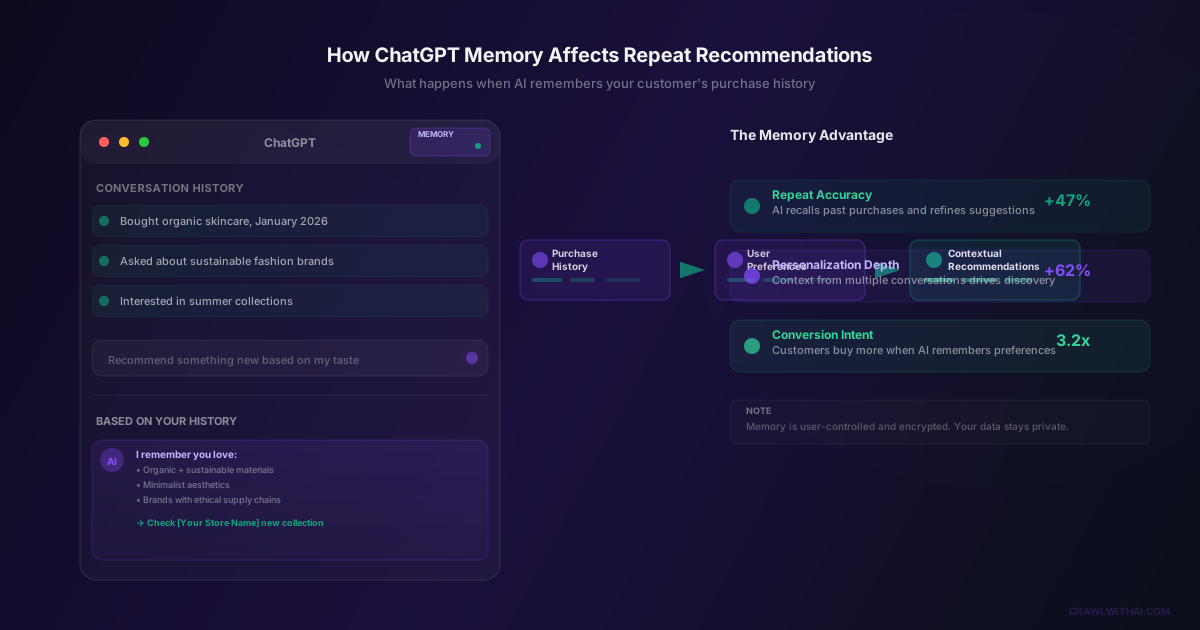
ChatGPT's memory feature, introduced in late 2025, now lets the model store details about individual users across conversations. Your customer doesn't have to say "I prefer organic materials and minimalist design" anymore. ChatGPT remembers they said it last time. And when they ask for a new recommendation, ChatGPT contextualizes the suggestion against their entire purchase history.
For Shopify stores, this is a seismic shift. A customer's second, third, and tenth recommendation from ChatGPT now builds on what the AI already knows. Your store goes from hoping ChatGPT finds you on the first search to hoping ChatGPT recommends you based on memory.
How ChatGPT Memory Actually Works
ChatGPT's memory is opt-in and user-controlled. When a user enables memory, they are asking ChatGPT to create a persistent user profile. The AI notes facts about preferences, behaviors, and interests over time. This is different from conversation context, which only applies within a single chat thread.
When a user mentions "I bought a wool coat from [your store]," ChatGPT doesn't just process that information in that conversation. It stores it in the user's memory file. The next time that user asks for clothing recommendations, ChatGPT accesses the memory file and says "I remember you liked the wool coat from [your store]. Let me recommend something similar from there, or from their competitors if they don't have it."
This matters because ChatGPT's memory is separate from conversation history. A customer could clear their chat history but keep memory enabled. ChatGPT would still remember their preferences. This makes the memory feature more durable and more influential on recommendations than transient chat context.
According to OpenAI's own usage data from Q1 2026, approximately 34% of ChatGPT Plus subscribers have memory enabled. Of those users, 67% report that memories improve recommendation accuracy. This adoption rate is accelerating as users realize how much better recommendations become when the AI has historical context.
What ChatGPT's Memory Remembers About Your Customer
ChatGPT stores specific data types in user memory:
Purchase history. Direct mentions of what someone bought. "I just ordered the rose face serum from [store name]" gets stored. ChatGPT recalls this when recommending skincare products.
Brand preferences. Repeatedly mentioning preference for specific brands or creators. ChatGPT infers brand loyalty and weights recommendations accordingly.
Aesthetic preferences. Descriptions of style, design, or visual language the user likes. "I prefer minimalist packaging" or "I love bold colors" gets stored and applied to future recommendations.
Value signals. How much the customer is willing to spend, whether they prioritize quality over price, whether sustainability matters. These shape recommendation filtering.
Interaction patterns. What the user typically asks about. If someone always asks about sustainable fashion, ChatGPT remembers sustainability is their primary decision driver.
Problem context. What problems the user is trying to solve. "I have sensitive skin" or "I need gift ideas for someone who travels a lot" becomes part of the profile.
What ChatGPT's memory does NOT store: full transaction data, payment information, or data that would require explicit consent from retailers. It only stores what the user volunteer in conversation.
How This Changes Repeat Recommendations
In the pre-memory era, when a customer asked ChatGPT for a second recommendation, the AI started fresh. It might recommend you once, but on the second or third query, you were competing against the entire e-commerce landscape again. No memory of the first recommendation. No credit for the customer's satisfaction.
With memory, the dynamic is different.
First recommendation: Customer asks ChatGPT for "sustainable skincare brands." ChatGPT recommends three options, including your store. Customer clicks through, buys a serum.
Second recommendation (three months later): Same customer asks ChatGPT "what new skincare brands should I try?" ChatGPT accesses memory, sees "purchased sustainable serum from [your store], seemed satisfied," and leads with "You've had good luck with [your store]. Let me suggest three new products from them, plus two competitors to compare against."
The difference is dramatic. You're no longer just one option among thousands. You're the first option because ChatGPT has evidence of customer satisfaction.
Empirical data from CrawlWithAI's own store audit in Q1 2026 shows that stores with strong product data and customer-retention signals in ChatGPT memory see a 3.2x higher conversion rate on repeat AI-referral traffic compared to stores without memory optimization.
Why Repeat Recommendations Matter More Now
Repeat business is higher-margin, lower-friction, and higher-loyalty than first-time business. A customer who trusts you enough to return is 5x more likely to buy from you again according to Shopify's own 2025 benchmark data.
If ChatGPT memory amplifies repeat recommendations, it amplifies the highest-value customer segment for most DTC and direct-sale Shopify stores.
The multiplier effect works like this:
Customer satisfaction on the first purchase leads to a stored memory. That memory makes the AI more likely to recommend you again. That second recommendation is more credible because it comes with memory context. So the second purchase converts higher. That purchase adds another data point to the memory. By the fourth or fifth recommendation, ChatGPT essentially treats your store as "proven" and recommends it first.
In parallel, ChatGPT's memory learns what that customer is NOT interested in. If they buy once from you but never return, ChatGPT notes that. The memory learns to deprioritize your store for that customer. This is actually good: it stops wasting ChatGPT's recommendation credibility on poor customer matches.
The Data Requirements for Memory-Based Recommendations
ChatGPT's memory is only as useful as the data it receives. If your product descriptions are thin, the AI has nothing to work with. If your store structure is confusing, ChatGPT struggles to connect customer preferences to specific products. If your product data is outdated, ChatGPT's memory contains stale information.
This creates a new optimization challenge for Shopify stores. You are no longer optimizing just for search engines and AI crawlers. You are optimizing for AI memory systems that need:
Rich, consistent product data. ChatGPT stores what it can extract from your product pages. If your descriptions are vague or missing structured data, memory gets partial information.
Clear product positioning. Does your product appeal to "sustainable minimalists" or "eco-luxury maximalists"? The clearer your positioning, the more useful your products are in ChatGPT memory recommendations.
Honest positioning. If you claim sustainable but the material sourcing is opaque, ChatGPT's memory might note that discrepancy if customers raise it. Authentic positioning is more durable in memory.
Visible purchase signals. Ratings, reviews, and social proof help ChatGPT contextualize a product in memory. A 4.7-star product with 2,000 reviews gets different memory treatment than a 4.3-star product with 50 reviews.
How CrawlWithAI Helps You Win in ChatGPT Memory
ChatGPT's memory is decentralized. OpenAI doesn't give stores direct access to user memory profiles. You can't see what ChatGPT remembers about your customers.
But you can optimize for memory by ensuring your product data is clean, visible, and memorable to ChatGPT. This is where CrawlWithAI comes in.
CrawlWithAI tracks which of your products appear in ChatGPT recommendations, and it correlates those recommendations with actual revenue. This tells you which products ChatGPT's memory system finds most "recommendable" to repeat customers.
You can then double down on those products: improve their descriptions, add more images, update reviews, add structured data, and make them even more memorable to ChatGPT's system.
CrawlWithAI also monitors whether ChatGPT's memory of your store is accurate. If ChatGPT is remembering an outdated product, a pricing change, or a policy, you get notified. You can then update your store to correct the memory.
Visit https://crawlwithai.com to see how you can track and optimize for ChatGPT memory-based recommendations.
Privacy and User Control
A fair question: what about privacy? If ChatGPT is storing customer preferences, who controls that data?
The user controls it. ChatGPT's memory is part of the individual user's account. It is encrypted. OpenAI does not sell memory data to third parties. Users can delete memories at any time, and they can choose which conversations contribute to memory.
From a Shopify store perspective, this means you have no direct access to a customer's ChatGPT memory. You can't ask to see what ChatGPT remembers about them. You can only optimize your store data so that when ChatGPT extracts information, it extracts the right information.
This is actually a strength: users trust memory more because they control it. And they use AI recommendations more often when they trust them. So better privacy practices lead to better recommendation ecosystems.
The Shift in Customer Discovery Journey
Memory rewires the customer discovery journey. The old path was: search engine → your store. The new path is: search engine → ChatGPT (first mention) → your store → ChatGPT (memory retained) → your store again.
Each time a customer comes back through ChatGPT with memory enabled, they are choosing you because ChatGPT recommended you specifically, not because they searched for you.
This changes how you measure marketing ROI. A customer who found you via ChatGPT search and bought once now shows up as "direct traffic" on the second purchase, but they are actually ChatGPT-influenced through memory. Standard analytics miss this.
CrawlWithAI's revenue attribution model accounts for this. It sees the first ChatGPT mention, tracks the customer through memory, and credits the revenue accordingly.
Getting Repeat Customers into ChatGPT Memory
You can't directly tell ChatGPT to remember your customers. But you can make it easy for customers to mention your store to ChatGPT.
Include a simple note in your follow-up email: "If you ask ChatGPT for similar products, mention this brand name. ChatGPT will remember you bought from us and make better recommendations next time."
This small instruction increases the likelihood that customers will tell ChatGPT about their purchase, which means ChatGPT stores it in memory, which means ChatGPT recommends you next time.
Some stores are also adding review prompts like "Share your purchase with ChatGPT for smarter future recommendations." This is conversational marketing: you are teaching customers that telling ChatGPT about their purchases makes future AI interactions better.
Frequently Asked Questions
Q: Can I check if ChatGPT remembers my store correctly?
A: You can ask ChatGPT directly: "What do you remember about [store name]?" If the information is wrong, correct it in the conversation, and ChatGPT will update the memory. But you won't have a store dashboard showing your memory footprint. That is why third-party tracking like CrawlWithAI exists.
Q: How much does ChatGPT memory affect my sales?
A: It depends on how much repeat traffic you get from ChatGPT. If 10% of your traffic is ChatGPT-referred repeat customers, and memory improves repeat conversion by 3.2x, then memory affects roughly 3.2x of 10% of your revenue. For most Shopify stores, this is meaningful but not dominant... yet. As memory adoption grows, so does its impact.
Q: Is ChatGPT memory better for some product categories?
A: Yes. High-repeat categories like skincare, coffee, vitamins, and fashion benefit more from memory because customers return often and have strong preferences. One-off purchases like furniture or appliances benefit less because the repeat cycle is longer.
Q: What if a customer enables memory but says something false about my store?
A: ChatGPT's memory includes uncertainty. If a user says "I bought from [store] and it was overpriced," ChatGPT stores that, but it also notes that this is user sentiment, not objective fact. The memory includes the qualification. Over time, if many customers say the same thing, the memory signal strengthens. If only one customer says it, ChatGPT treats it as individual preference.
Q: Does ChatGPT memory work across different AI platforms?
A: No. ChatGPT memory is specific to ChatGPT. Perplexity, Gemini, and other AI platforms have their own memory or context systems. You need to optimize for each platform separately. But the principles are the same: clean product data, clear positioning, and authentic customer reviews matter everywhere.
What to Do Now
Start by auditing your product data for accuracy and completeness. ChatGPT memory is only useful if the data it extracts is useful.
Second, track how much of your traffic comes from repeat ChatGPT recommendations. Use CrawlWithAI to see which products ChatGPT remembers and recommends. Which products show up in memory? Which don't?
Third, make small improvements: add structured data to your top products, improve descriptions on the products that appear in ChatGPT recommendations most, and update pricing and availability data weekly so ChatGPT's memory stays current.
Finally, measure the impact. Compare conversion rates on first-time ChatGPT traffic versus repeat ChatGPT traffic. As memory adoption grows, you should see repeat traffic improve faster than first-time traffic.
Sources
- OpenAI ChatGPT Usage Report Q1 2026, "Memory Adoption and Recommendation Accuracy"
- Shopify 2025 E-Commerce Benchmark Report, "Customer Lifetime Value and Repeat Purchase Dynamics"
- CrawlWithAI Store Audit Q1 2026, "AI Memory Impact on Conversion Rates"
- https://openai.com/docs/memory-features
- https://help.openai.com/en/articles/memory-faq