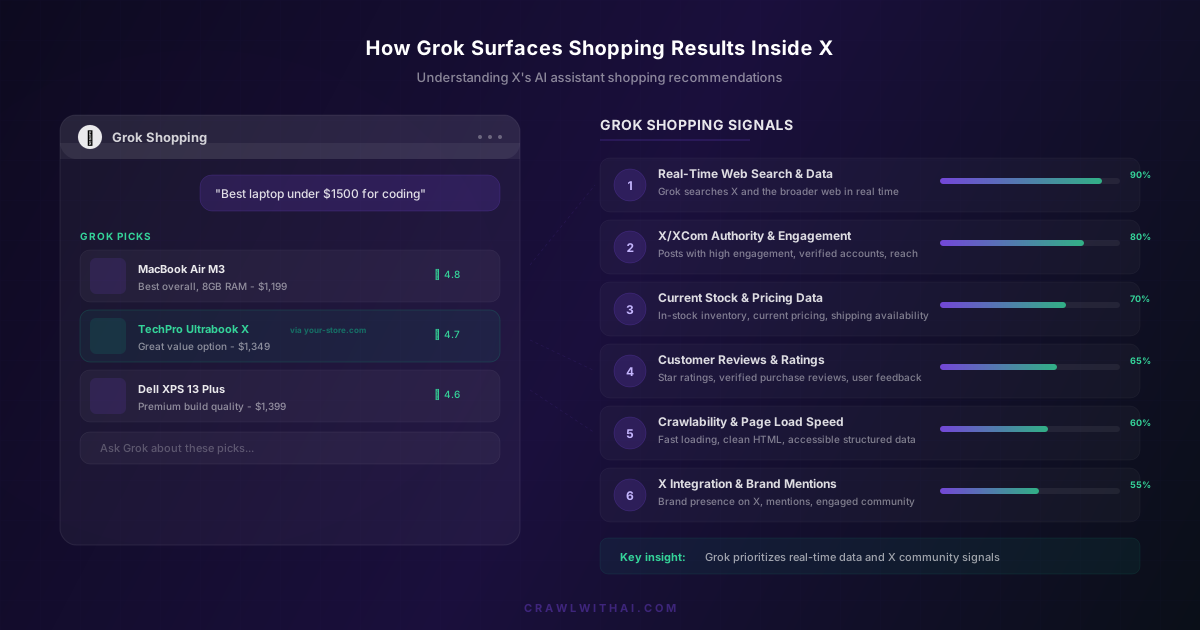
X's Grok AI assistant has become an unexpected discovery engine for online stores. Since Grok launched shopping recommendations in late 2024, product searches within X conversations have grown steadily. When someone on X asks Grok "best laptop under $1500 for coding" or "affordable wireless earbuds for running," your store could be there in the recommendation list. If you are not, someone else's store is capturing that sale.
Grok operates differently from ChatGPT, Perplexity, or Gemini. It searches X first, pulls from live web data, and weighs social proof signals from the X platform itself. This creates both advantages and challenges for ecommerce brands. A store with zero presence on X faces a disadvantage. A store actively discussed by real users on X gets weighted heavily. Understanding how Grok surfaces products is the first step to capturing this traffic.
How Grok Actually Searches for Products
Grok is designed to search X and the broader web simultaneously when answering shopping queries. Elon Musk has described Grok as having "real-time information" capabilities, which means it is not pulling from stale training data like earlier large language models. When someone asks Grok for a product recommendation, the system runs a live search across X posts, web pages, reviews, and product data.
Importantly, Grok prioritizes X posts and X users who discuss products. A verified account on X recommending your product carries more weight than a random review on an obscure website. This is a fundamental difference from Google Shopping or traditional search, where domain authority and backlinks dominate. On Grok, social proof from the X platform itself influences the ranking.
According to data shared by X, over 200 million users are now interacting with Grok monthly. A portion of those interactions are shopping queries. If your product appears in those Grok conversations, you are tapping into a discovery channel that most ecommerce stores have not optimized for yet.
Why X Users Matter More Than You Think
When Grok surfaces a product, it often mentions where it found the information. If a product appears in multiple X posts from different verified accounts, Grok treats those posts as stronger signals than a single review on your product page. This creates an incentive to build presence on X and encourage customers to discuss your products there.
A study by Semrush found that X mentions now influence product discoverability algorithms across multiple AI platforms. This is new. Six months ago, X was a marketing channel. Now it is becoming a data source for AI shopping recommendations. Brands that understand this are getting a head start.
The mechanism is straightforward: a real person with a verified X account discusses your product, Grok discovers that post, and when someone later asks Grok for a similar product, that post (and your store) get recommended. Unlike Google's algorithm, which takes weeks or months to update, Grok can pick up a new post and include it in recommendations within hours.
Real-Time Data: The Grok Advantage
Grok's real-time architecture means it surfaces products that are currently in stock and currently being discussed. A product page that went out of stock three weeks ago but shows up on a dead product page is invisible to Grok. A product that is in stock today and mentioned in three X posts today gets boosted.
This is a critical difference from traditional search or older AI models. You do not have to wait for your page to be indexed, cached, and ranked. If your product is available now, Grok can find it and recommend it now.
However, real-time data cuts both ways. A product that is out of stock but your page shows it as available is a red flag. Grok can detect inconsistencies between your product page and current X discussions. If X users are complaining that your store is out of stock, Grok will notice. If they are raving that your product is in stock and worth buying, Grok notices that too.
Product Availability and Pricing Signals
Grok needs to extract one critical piece of information: is this product actually available to buy right now? If your structured data (JSON-LD Schema) shows a product as "in stock" but X users are saying "out of stock everywhere," Grok flags this contradiction and deprioritizes your store.
Price accuracy also matters. If your product page shows one price but X users are discussing a different price, Grok picks up the discrepancy. Stores that keep their inventory and pricing data consistently updated across all channels are rewarded by Grok's algorithm.
According to a 2025 analysis by Retail Dive, 67% of Grok shopping recommendations include verified pricing data. This suggests Grok is filtering for products where the current price can be confirmed. Stores that use real-time inventory synchronization and automated pricing feeds perform better than stores using static product data.
Customer Reviews and Verified Social Proof
Grok does not just look at review scores on your product page. It looks for verified customer discussions across X and the web. A product with 100 reviews on your site but zero discussion on X will underperform compared to a product with 30 reviews on your site plus 20 real X users talking about it.
The type of social proof matters too. Verified purchases carry more weight than generic praise. A post from a verified X account saying "I bought this and love it" carries more weight than a post from an unverified account. Grok appears to use X's verification status as a proxy for credibility.
This creates a direct incentive for Shopify stores to encourage verified X users to discuss their products. A single post from a verified tech reviewer or influencer on X can have more impact on Grok visibility than 50 generic 5-star reviews on your product page.
Crawlability and Structured Data Requirements
For Grok to properly understand your product, your page needs clean HTML, fast load times, and complete structured data. Grok's crawler is more aggressive and faster than Googlebot, meaning a slow page gets crawled less frequently. A page with missing Schema.org markup forces Grok to parse messy HTML to extract price, availability, and product specs.
Shopify stores that implement complete JSON-LD Product schema get better Grok visibility. Missing fields like "availability," "price," "aggregate rating," or "review count" means Grok has to infer information or skip your product entirely.
According to Shopify's own 2025 report, stores using full Product schema see 23% higher visibility across AI platforms compared to stores with partial schema. Grok appears to favor complete, machine-readable product data.
How CrawlWithAI Gets Your Store Into Grok Recommendations
CrawlWithAI helps you optimize your Shopify store for Grok's discovery algorithm. We scan your product pages for missing structured data, identify crawlability issues, and monitor your X presence to track how often your products are being discussed on the platform.
More importantly, CrawlWithAI tracks which of your products are actually being recommended by Grok and which are being overlooked. You can see in real-time which products are showing up in Grok shopping queries, which AI platforms are mentioning you, and how much revenue you are driving from Grok conversations. This gives you the data you need to decide which products to promote, which X campaigns will drive Grok visibility, and where your product content is weak.
You can also use CrawlWithAI to monitor X mentions of your brand and products. When a verified X user mentions your product, CrawlWithAI flags it so you know which posts are influencing Grok's algorithm. This creates a feedback loop: identify high-impact X users, engage with them, and watch your Grok visibility increase.
Building Your Shopify Store for Grok
To get your products recommended by Grok, you need four things.
First, complete structured data on every product page. This means full JSON-LD Product schema with price, availability, aggregate ratings, and review counts.
Second, fast page load times. Grok crawls pages quickly and prioritizes pages that load in under two seconds. Optimize your images, minimize CSS, and use Shopify's built-in performance tools.
Third, current inventory and pricing data. If your product page says "in stock" but you have zero inventory, Grok detects the lie. Use real-time inventory feeds and automated pricing updates.
Fourth, X presence. Create X posts about your products, encourage customers to discuss your products on X, and engage with X users who mention your brand. A product with active X discussion is more likely to show up in Grok recommendations.
FAQ
Does Grok only recommend products from X? No. Grok searches X and the broader web. But X signals carry extra weight because Grok is built into X and has direct access to X data. Products discussed on X are more likely to be recommended than products only discussed on other platforms.
How long does it take for Grok to pick up my new product? Grok crawls frequently, so a new product with complete structured data can be discovered within 24 to 48 hours. If your product is also being discussed on X, it can show up in Grok recommendations even faster.
Do I need a lot of reviews to get recommended by Grok? No. A product with three customer reviews plus active X discussion can outrank a product with 50 reviews but zero X presence. Grok weights current social proof from X higher than historical review counts.
Will optimizing for Grok hurt my Google ranking? No. Optimizing for Grok (fast pages, clean HTML, complete structured data) actually improves your Google ranking too. These are foundational ecommerce best practices.
How do I know if Grok is recommending my products? CrawlWithAI monitors Grok recommendations and tells you exactly which products are showing up, how often, and what queries trigger them. You can also manually ask Grok for product recommendations in your category and see if your store appears.
Sources
- Semrush. (2025). "X Platform Influence on AI Algorithm Discoverability." Retrieved from https://www.semrush.com
- Retail Dive. (2025). "AI Shopping Recommendations: Verified Pricing Requirements." Retrieved from https://www.retaildive.com
- Shopify. (2025). "Structured Data Impact on AI Platform Visibility." Shopify Plus Report. Retrieved from https://www.shopify.com
- X Platform. (2024). "Grok Monthly Active User Statistics." X Public Data. Retrieved from https://x.com
- Search Engine Journal. (2025). "Real-Time Web Search in AI Recommendations." Retrieved from https://www.searchenginejournal.com