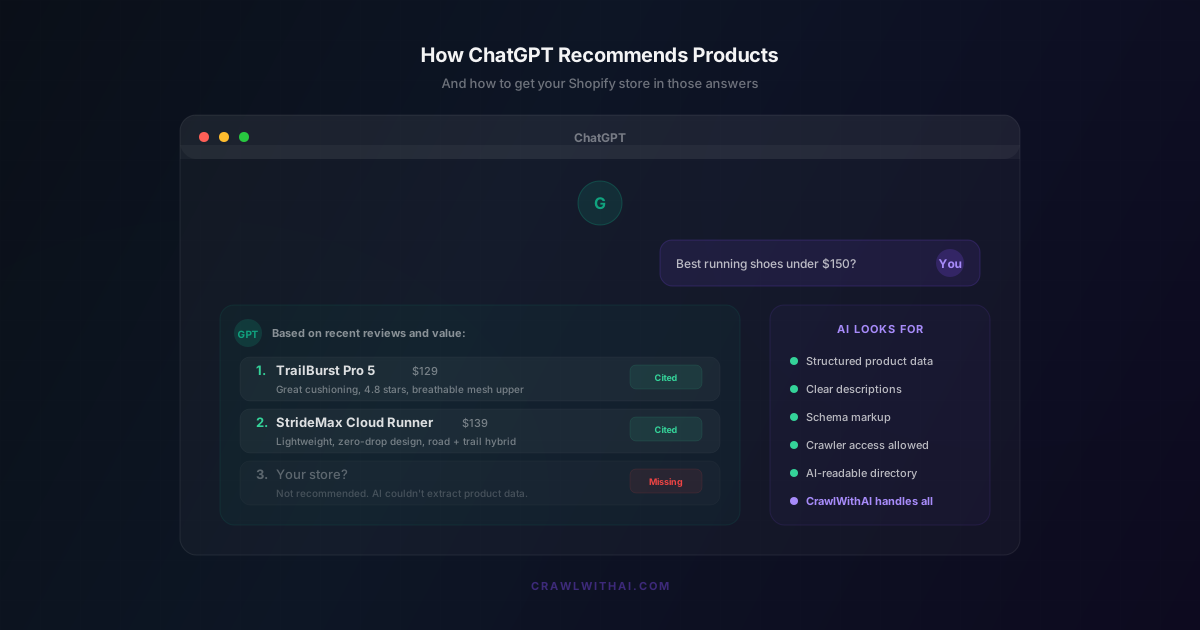
AI is changing where buyers start their search
A few years ago, the question was: "How do I rank on Google?" Today there's a second question worth asking: "Does ChatGPT know my store exists?"
Roughly 64% of consumers plan to shop using AI chatbots in 2026, and 34% of frequent shoppers already use ChatGPT when starting a product search (Incremys, 2026). That's a meaningful chunk of buyers who may never see your Google ranking at all.
The frustrating part is that ChatGPT's recommendation logic isn't obvious. You can't just check a box. This post explains how it actually works, and what you can do about it.
Quick summary
- ChatGPT recommendations convert 31% higher than non-branded organic search (First Page Sage, 2025)
- ChatGPT learned about products during training, not by crawling your store live
- Four signals drive whether ChatGPT recommends you: structured data, content that matches buyer intent, third-party reviews, and clear pricing
- AI-referred shoppers bounce 27% less and stay 32% longer than other visitors
How ChatGPT actually learns about products
ChatGPT doesn't browse your Shopify store. It built its product knowledge during training on a large snapshot of the web captured before April 2024, then uses a live search tool to fill in current prices and availability when someone asks a shopping question.
During training, it processed millions of pages: product review sites, Reddit threads, blogs, YouTube transcripts, brand websites, and more (Trysight, 2026). So when a user asks "what's a good standing desk for a home office under $500?", ChatGPT isn't running a search in the way you'd imagine. It's drawing on patterns it absorbed during training, then checking live sources to confirm availability and pricing.
What this means practically: stores that had a web presence before April 2024, with reviews and mentions across multiple sites, have a head start. Stores that launched recently, or that exist mostly on their own domain without much external coverage, start with close to zero signal. That's the gap worth closing.
The four things ChatGPT looks at
1. Structured data on your product pages
Schema markup is machine-readable information embedded in your page code. It tells AI systems exactly what you sell, at what price, with what ratings. Without it, ChatGPT has to guess from your page copy, and it often gets it wrong or skips you.
The schemas that matter most for Shopify stores are Product, Offer, and AggregateRating. These tell ChatGPT:
- What the product is and what category it belongs to
- Whether it's in stock and what it costs
- How many people have reviewed it and what they said
Shopify includes basic schema out of the box, but many themes leave review data and breadcrumb markup incomplete. Running your product pages through Google's Rich Results Test is a quick way to see what's missing.
Action: Pick 10 of your best-selling products and run each one through the Rich Results Test. Fix any gaps in your product template.
2. Content that speaks to buyer intent
Keyword stuffing won't help here. ChatGPT understands context and intent, not just phrase matching.
If someone asks "best CRM for a solo consultant who hates complexity," the model isn't scanning for pages that contain those exact words. It's looking for pages that show genuine understanding of that buyer's situation. A product description saying "built for freelancers who want to track clients without enterprise overhead, set up in 5 minutes" will beat "works for businesses of all sizes" every time.
This is why product descriptions written as vague feature lists underperform. ChatGPT learned from review sites and Reddit, where people describe products in terms of problems solved and for whom. Your copy should speak the same way.
Action: Rewrite the short descriptions on your top 5-10 products. Lead with who the product is for and what problem it solves, not a list of features.
3. Reviews on third-party platforms
ChatGPT weighs third-party reviews heavily, because they carry independent authority that your own site can't provide.
Brands that appeared in review ecosystems like Trustpilot, G2, or Capterra were recommended with 99.3% consistency in one study, compared to just 6.2% for brands with no external review presence (Index Dev, 2026). That's not a small difference.
Your own on-site reviews help a bit, but they carry less weight than verified reviews on independent platforms. The reasoning makes sense: ChatGPT is trying to give its user a trustworthy answer, and it treats third-party validation as a stronger signal than self-reported ratings.
Action: Identify the review platforms that matter for your category and start actively requesting reviews from happy customers. For consumer products, Trustpilot is a solid starting point. For software or B2B, G2 and Capterra.
4. Clear pricing and availability
ChatGPT's live search feature retrieves current product data when users ask shopping questions. If your pricing is hidden, your inventory isn't tracked, or your pages regularly show "out of stock," ChatGPT may skip you in favour of a store with cleaner signals.
This is simple to fix. Make sure your prices are clearly displayed, inventory tracking is turned on for important products, and your most popular items stay in stock. When someone asks "where can I buy X right now?", ChatGPT needs to give a confident answer. Ambiguous or outdated data makes that harder.
Action: Audit your top product pages. Check that pricing is prominent, inventory is tracked, and availability is accurate.
Why visitors from ChatGPT convert better
ChatGPT visitors convert 31% higher than non-branded organic search traffic (Search Engine Land, 2025), and it's not hard to see why.
When someone arrives at your store from Google, they might be early in their research. When they arrive from ChatGPT, they've already been through a reasoning process. The AI assessed their question, understood what they need, and decided your store was a good match. That's meaningful qualification before the visitor even lands on your page.
AI-referred shoppers also bounce 27% less and spend 32% longer on site than visitors from other channels (Euromonitor International, 2025). The quality of the traffic is genuinely different.
Perplexity and Google AI Overviews are part of this too
ChatGPT gets the most attention, but Perplexity and Google's AI Overviews are sending meaningful traffic to e-commerce stores as well.
Perplexity launched its Shopping Hub in late 2024 and mentions brands in shopping recommendations 85.7% of the time (Index Dev, 2026). It pulls from live sources more aggressively than ChatGPT, so freshness and availability matter even more. Google AI Overviews are more conservative with product recommendations for now, but the share of shopping queries showing AI answers is growing.
The good news is that the same four signals work across all three platforms. Structured data, intent-matching content, third-party reviews, and pricing clarity cover the bases for ChatGPT, Perplexity, and Google AI Overviews alike.
The scale of what's already happening
AI traffic to US retail sites grew 4,700% year over year by July 2025 (Adobe Analytics via Shopify, 2025). During Amazon Prime Day 2025, AI-referred traffic spiked 3,300% compared to the year before.
This isn't niche traffic anymore. The AI e-commerce market hit $8.65 billion in 2025 and is on track to reach $22.6 billion by 2032 (Triple Whale, 2026).
Most Shopify stores haven't done anything specific to optimise for AI recommendations yet. That's actually a window right now. The signals that get you recommended by ChatGPT today are the same ones your competitors will be scrambling to build in two years.
Three things to do this week
Fix your structured data first. It's the most direct signal and the easiest to audit. Pull 10 product pages through Google's Rich Results Test and fix anything flagged.
Rewrite your best product descriptions. Pick your top sellers and lead each one with the specific buyer and problem it solves. This doesn't need to be long, just specific.
Start collecting third-party reviews. Send a message to your most recent happy customers and ask them to leave a review on Trustpilot or whichever platform fits your category. Aim for 20-30 reviews on at least two external platforms.
FAQs
Can I pay to get my products recommended by ChatGPT?
No. ChatGPT doesn't sell ad placements the way Google does. Recommendations come from the model's training data and live search signals. The only way in is through the organic signals described above: structured data, content quality, reviews, and pricing.
How long before I start seeing results?
New stores without much web history face a slower start since ChatGPT's training data cuts off at April 2024. That said, ChatGPT's real-time search feature does pick up fresh signals, particularly for Plus and Team users. If you implement structured data and start building reviews in the next 30-60 days, expect to see some movement in ChatGPT's live search results within 60-90 days.
Does regular SEO help with ChatGPT too?
Partly. Clean URLs, fast load times, and strong backlinks all contribute to authority signals. But ChatGPT cares more about semantic clarity and third-party validation than it cares about your Google ranking. A mid-ranking product page with thorough schema and 50 Trustpilot reviews will outperform a top-ranking page with none.
Why is ChatGPT recommending competitors instead of me?
Usually one of four reasons: they have more external reviews, their product descriptions address buyer use cases more specifically, their pricing is clearer, or they've had more web coverage over a longer period. Auditing a competitor's product pages and review profiles will usually show you where the gap is.
Will AI search replace Google for shopping?
Not entirely, but the share of shopping journeys that start with an AI query is growing fast. Most projections put AI-powered discovery at 15-25% of e-commerce traffic by 2027. Google search isn't going away, but treating AI recommendations as a secondary channel you can ignore is becoming a riskier call every quarter.
Sources
- Incremys - ChatGPT statistics 2026
- First Page Sage - ChatGPT Usage Statistics
- Search Engine Land - ChatGPT ecommerce conversions
- Trysight - How AI Recommends Products
- Index Dev - Perplexity vs Google AI Overviews
- Adobe Analytics via Shopify - AI Statistics
- Triple Whale - AI in Ecommerce Statistics
- Euromonitor International via Triple Whale