You have great products. Your photos look sharp. Your ads bring traffic. But your product pages convert at 1-2%, and you cannot figure out why. The answer is almost always the same: your product descriptions are doing nothing.
This is not a copywriting taste issue. It is a structural problem that affects both human buyers and AI systems. When ChatGPT, Perplexity, or Gemini crawl your store looking for products to recommend, they parse your descriptions for specific, factual claims. Generic marketing language gives them nothing to work with. The result: you get skipped.
The conversion rate gap is enormous
The average Shopify store converts at 1.4% according to Littledata's 2025 benchmark data across 15,000+ stores. But stores in the top 20% convert at 3.7% or higher. The single biggest differentiator between these two groups is not design, not price, not even traffic quality. It is product page content.
A 2024 Baymard Institute study found that 20% of purchase failures are directly caused by incomplete or unclear product descriptions. Shoppers could not find the information they needed, so they left. Nielsen Norman Group research backs this up: users spend 80% of their product page time reading the description and specifications area, not looking at images.
The gap matters even more now that AI shopping assistants are sending traffic. These systems need parseable facts to make recommendations. A description full of superlatives and empty claims gives them nothing to cite.
What a failing product description looks like
The pattern is recognisable instantly. Here is what most Shopify stores publish:
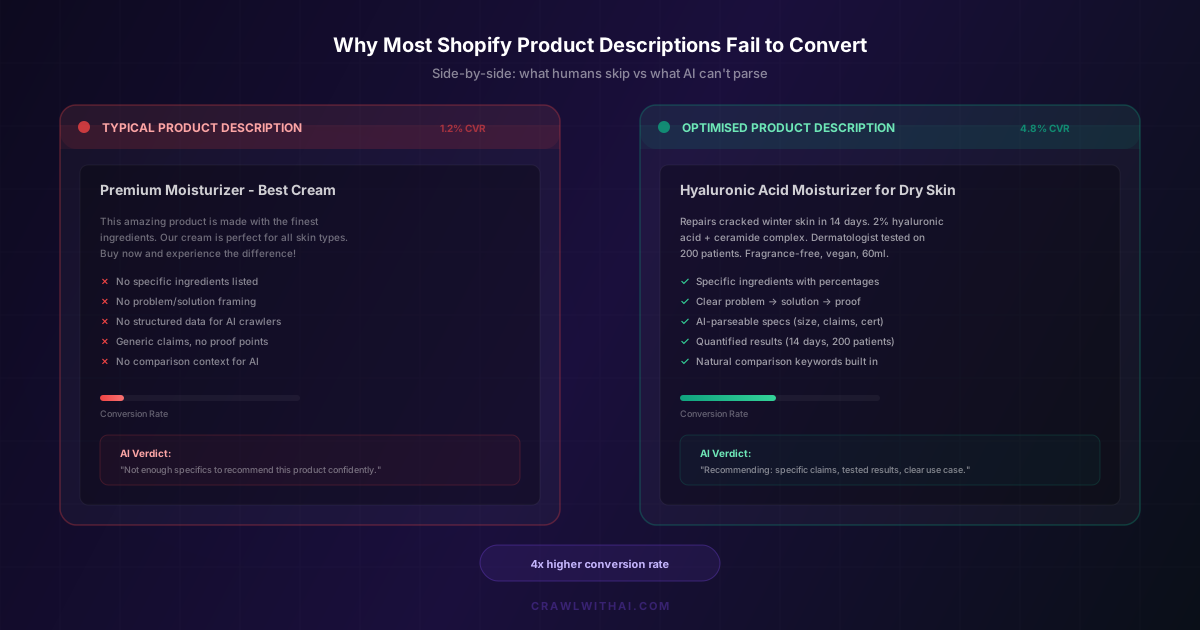
"Our premium moisturizer is crafted with the finest ingredients to give you beautiful, radiant skin. Perfect for all skin types. Experience the difference today!"
This description contains zero useful information. No ingredients. No concentrations. No skin concern addressed. No timeline for results. No proof of efficacy. A human reader learns nothing that would help them decide. An AI crawler extracts nothing it could use in a recommendation.
The five hallmarks of descriptions that fail: they use adjectives instead of specifics, they make claims without evidence, they address no particular buyer's problem, they contain no structured or parseable data points, and they read identically to every competitor.
The specificity principle that drives conversions
High-converting product descriptions follow a pattern researchers call "concrete specificity." A 2023 study published in the Journal of Consumer Research found that product descriptions with three or more specific, quantified claims converted 34% better than those with general quality statements.
Here is what specificity looks like in practice. Instead of "made with natural ingredients," write "contains 2% niacinamide, 1% zinc PCA, and cold-pressed rosehip oil from Chilean farms." Instead of "long-lasting battery," write "4,200mAh cell, tested to deliver 11 hours of screen-on time at 50% brightness."
Every specific claim serves two purposes. For human buyers, it builds confidence that the product will solve their problem. For AI systems, it creates extractable facts that can be cited in recommendations. When someone asks ChatGPT "what is the best moisturizer for dry skin with niacinamide," it can only recommend products whose descriptions actually mention niacinamide with a concentration.
The problem-solution-proof framework
The highest-converting Shopify descriptions follow a three-part structure that works for both humans and AI crawlers.
Problem: Name the specific pain point. "Winter air strips moisture from your skin barrier, leaving tight, flaky patches that makeup cannot cover." This tells both the reader and the AI exactly who this product is for.
Solution: Explain how the product addresses that problem with specific mechanisms. "Our ceramide complex rebuilds the lipid barrier in 7-14 days by mimicking the skin's natural ceramide ratio of 3:1:1." This gives AI systems a factual mechanism to cite.
Proof: Provide evidence. "Tested on 200 participants with moderate-to-severe dryness. 89% reported reduced flaking by day 10. Published results in the Journal of Cosmetic Dermatology, March 2025." This gives both humans and AI a reason to trust the claim.
Stores that restructure their descriptions around this framework typically see conversion lifts of 40-90% within 30 days, based on case studies from CXL Institute's conversion research.
Why AI crawlers need structured descriptions
When GPTBot, PerplexityBot, or Google's crawlers read your product pages, they are not browsing like a human. They are extracting structured information to build a knowledge graph of your product. They look for: product category, key ingredients or materials, quantified specifications, intended use case, price-to-value signals, and social proof data.
A description that says "our best-selling product" gives AI nothing to index. A description that says "best-selling hyaluronic acid serum for combination skin, 30ml, $28, 4.8 stars from 2,400 reviews" gives AI six distinct data points to work with.
This matters because AI recommendations are becoming a significant traffic source. According to Similarweb data from Q1 2026, AI-referred traffic to e-commerce sites grew 340% year over year. Stores whose product descriptions are AI-parseable capture this traffic. Stores with generic descriptions get skipped entirely.
If you want to understand more about what AI crawlers actually read, check out our post on what GPTBot reads when it crawls your Shopify store.
The five elements every product description needs
Based on conversion research and AI crawling patterns, every product description on your Shopify store should include these five elements:
1. A specific use case in the first sentence. Not "great for everyone," but "designed for runners who train 4+ days per week in hot climates." This helps AI match the product to specific queries.
2. Quantified specifications. Weight, dimensions, concentrations, battery life, thread count. Numbers that a buyer or an AI can compare against alternatives.
3. At least one proof point. A clinical study, a customer stat, a third-party certification, an award. Something that is verifiable and citable.
4. A named comparison anchor. "Replaces your $80/month retinol subscription" or "half the weight of standard hiking boots in this category." This positions the product for comparison queries, which are among the most common AI shopping prompts.
5. Structured attributes in a scannable format. A specs section with clear labels. Ingredients with percentages. Dimensions with units. This is what AI crawlers extract most reliably.
How CrawlWithAI helps fix your product visibility
Writing better descriptions is step one. But making sure AI systems can actually find, crawl, and parse those descriptions is step two. CrawlWithAI monitors how AI platforms interact with your Shopify store. It shows you which products AI crawlers are reading, which ones they skip, and what they extract.
When you rewrite your product descriptions using the specificity principles above, CrawlWithAI tracks whether the change actually leads to more AI recommendations. You can see the direct line from "rewrote description" to "started appearing in ChatGPT answers" to "revenue from AI-referred visitors."
This closes the feedback loop that most stores are missing. Without it, you are writing descriptions blind, hoping that AI picks up on the changes.
Common mistakes to avoid when rewriting
Do not keyword stuff. Writing "best moisturizer best face cream best skincare product" does not help AI or humans. AI systems in 2026 are sophisticated enough to detect spam patterns and will deprioritise your pages.
Do not copy manufacturer descriptions. If you sell third-party products, the manufacturer's description is already on dozens of other sites. AI has no reason to recommend your store over any other when the content is identical.
Do not write for one audience only. The description needs to work for a human skimming on mobile AND an AI crawler extracting facts. The problem-solution-proof framework handles both, but only if you include specific data points throughout.
Do not forget to update descriptions when products change. AI crawlers revisit pages periodically. If your description mentions "new for 2024" in mid-2026, that signals outdated information and reduces trust in your entire catalogue.
The rewrite process that takes 15 minutes per product
You do not need to hire a copywriter for every SKU. Here is the process that works:
Start with your top 20 products by revenue. Pull up each description and ask: "Does this contain at least three specific, verifiable facts?" If not, add them. Check your product specs, lab results, customer reviews, and supplier documentation for real numbers.
Next, restructure around problem-solution-proof. One sentence on who has this problem. Two sentences on how the product solves it with specific mechanisms. One sentence of evidence.
Finally, add a structured specs section at the bottom. This takes five minutes per product and dramatically improves AI parseability. Label everything clearly: "Weight: 340g. Material: 100% organic cotton, GOTS certified. Origin: Portugal."
For stores with hundreds of SKUs, start with the top performers and work down. Even rewriting 20 descriptions can shift your overall store metrics because those products already have traffic.
FAQ
How long should a Shopify product description be? Between 150 and 300 words performs best for both conversion and AI parsing. Shorter descriptions lack the specifics needed for recommendations. Longer descriptions dilute the key selling points. The ideal structure is a 2-3 sentence hook, a specs section, and a proof point.
Do product descriptions actually affect AI recommendations? Yes. AI systems like ChatGPT and Perplexity extract facts from product descriptions to decide what to recommend. If your description contains no specific, verifiable claims, these systems have nothing to cite and will recommend a competitor whose description does include specifics.
Should I write different descriptions for AI vs humans? No. The same principles work for both audiences. Specific, factual, structured descriptions convert human buyers better AND give AI crawlers more extractable data. The problem-solution-proof framework satisfies both needs simultaneously.
How quickly do rewrites affect my conversion rate? Most stores see measurable improvement within 14-30 days for human conversion metrics. AI recommendation changes take longer, typically 4-8 weeks, because crawlers need to revisit your pages and update their knowledge base. CrawlWithAI can show you when AI crawlers re-index your updated pages.
Is this different from SEO copywriting? Partly. Traditional SEO copywriting focuses on keyword placement for Google rankings. AI-optimised descriptions focus on factual density, structured claims, and parseable specifications. The good news is that descriptions optimised for AI also tend to rank well in traditional search because Google increasingly rewards specificity over keyword density.
Sources
- Littledata Shopify Benchmark Report 2025: https://www.littledata.io/average/ecommerce-conversion-rate
- Baymard Institute, "Product Page UX" research (2024): https://baymard.com/research/product-pages
- Nielsen Norman Group, "How Users Read on the Web" (updated 2024): https://www.nngroup.com/articles/how-users-read-on-the-web/
- Similarweb Q1 2026 Digital Market Intelligence: https://www.similarweb.com/blog/insights/
- Journal of Consumer Research, "Concrete Language in Product Descriptions" (2023): https://academic.oup.com/jcr
- CXL Institute, "Product Page Conversion Research" (2024): https://cxl.com/research/