If you run a Shopify store, you probably have some relationship with SEO. You have written product descriptions, added alt text to images, maybe installed a plugin that turns your title tags green. That work matters and it still does.
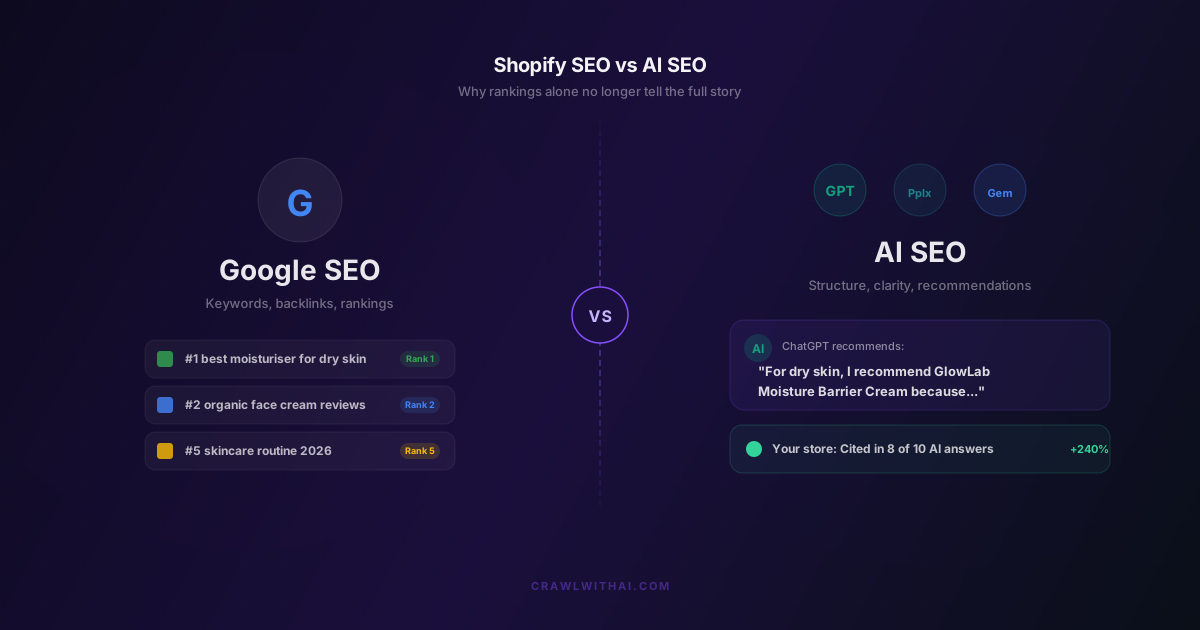
But something shifted in 2025. A portion of your potential customers stopped searching Google the way they used to. They started asking ChatGPT, Perplexity, and Gemini instead. And the rules for appearing in those answers are almost nothing like the rules for Google.
This post breaks down the real difference between traditional Shopify SEO and AI SEO, where most stores fall short, and what you can do about it.
What Shopify SEO actually optimises for
Traditional SEO for Shopify is built around one goal: convincing Google's crawlers that your pages are relevant and trustworthy enough to rank.
The signals Google uses are well understood at this point:
- Page titles and meta descriptions that match what people search for
- Product descriptions with relevant keywords and enough detail
- Backlinks from other websites signalling authority
- Site speed and Core Web Vitals scores
- Schema markup to help Google parse your content
- Internal linking to distribute authority across pages
When you do all of this well, Google surfaces your store in organic results. People click, they land on your site, they (hopefully) buy.
This system has worked for over two decades. It still works. According to BrightEdge, organic search drives 53% of all website traffic globally as of 2025.
But that number is under pressure.
What changed when AI search arrived
In May 2025, Google launched AI Mode publicly in 180+ countries. Unlike AI Overviews (which appear above organic results as a snippet), AI Mode is a fully conversational search experience with no blue links at all. You either get cited in the AI answer or you are invisible.
ChatGPT added Shopping features that let users ask for product recommendations directly. Perplexity built a shopping tab that surfaces products with links and pricing. Gemini is integrated into Google Shopping in a way that increasingly bypasses traditional search results.
Adobe Analytics reported that traffic from AI-powered sources grew 1,300% between early 2024 and early 2025 for the retailers they tracked.
The buyers are there. The question is whether your store shows up when they ask.
How AI search engines find and recommend products
Here is where things get specific, and where most Shopify stores have a real gap.
AI systems like ChatGPT and Perplexity do not rely purely on Google's index. They use their own crawlers. GPTBot crawls the web for OpenAI. PerplexityBot crawls for Perplexity. ClaudeBot crawls for Anthropic.
These bots visit your Shopify store, try to extract structured information about what you sell, and decide whether your store is worth citing in a future answer.
What they are looking for is different from what Google looks for.
Google rewards pages with strong keyword signals, authority, and technical hygiene.
AI crawlers are looking for something more like clarity: can I extract a clear, accurate description of this product? Does this store have a structured way to understand what it sells? Is there enough context to recommend this to a buyer asking a specific question?
When an AI crawler lands on a typical Shopify store, it often finds:
- Product descriptions written for keyword stuffing rather than genuine product clarity
- No structured AI directory or sitemap that organises products meaningfully
- Missing or incomplete schema markup that would help AI systems parse product attributes
- No signal about who the store serves, what it specialises in, or why it should be trusted for a given category
The bot indexes what it can, moves on, and your store does not make it into recommendations.
The gap most Shopify stores fall into
Let us be direct about the gap.
You can have a Shopify store with excellent Google SEO. Strong backlink profile, optimised titles, good Core Web Vitals. And that same store can be almost completely invisible in AI recommendations.
The reason is that the two systems are optimising for different things.
Google is a relevance and authority engine. It asks: is this page the most relevant result for this keyword, and can we trust the site?
AI recommendation engines are extraction and context engines. They ask: can I understand this product clearly enough to recommend it when someone asks me a question? Is there enough structure for me to surface it confidently?
A 2025 study from First Page Sage found that AI-powered channels already drive between 5% and 12% of e-commerce traffic for stores that have optimised for them. For stores that have not, that number is close to zero.
That gap is only going to widen.
What AI SEO actually requires
Getting into AI recommendations is not about tricking a system. It is about making your store genuinely easy for AI systems to understand.
The core requirements are:
1. An AI-readable directory of your store AI crawlers perform better when they have a structured, organised view of what your store sells. This is different from a standard XML sitemap. An AI directory describes your products, collections, and pages in a way that is designed for machine extraction, not just indexing.
2. Structured schema markup done properly Product schema, Organisation schema, and FAQ schema all help AI systems extract and attribute information correctly. Most Shopify stores have basic schema from their theme, but it is often incomplete or missing the attributes AI systems rely on.
3. Product descriptions written for comprehension, not keywords When someone asks ChatGPT for the best moisturiser for dry skin, ChatGPT needs to understand from your product pages what your moisturiser does, who it is for, what makes it different. Keyword-dense descriptions often fail this test because they are written for ranking, not comprehension.
4. Crawler access confirmed and monitored Many Shopify stores accidentally block AI crawlers through their robots.txt or through Cloudflare settings. If GPTBot cannot access your store, you cannot be recommended by ChatGPT. Full stop.
5. Attribution tracking for AI-referred orders Once AI systems start sending customers to your store, you need a way to know. Standard UTM tracking often does not capture AI referrals correctly. You need attribution that specifically handles AI traffic sources so you can measure what is working.
How CrawlWithAI bridges the gap
CrawlWithAI was built specifically for Shopify stores that want to show up in AI recommendations and prove that it is generating revenue.
The platform works across three layers:
AI Directory. CrawlWithAI creates a structured, AI-readable directory of your store, covering every product, collection, and page. It is formatted specifically for GPTBot, PerplexityBot, ClaudeBot, and other AI crawlers to extract cleanly.
AI Readiness Score. Once you connect your store, CrawlWithAI analyses what is blocking you from appearing in AI answers. It produces a prioritised fix list so you know exactly what to change, with no guessing and no developer required for most fixes.
AI Revenue Attribution. When AI platforms send customers to your store, CrawlWithAI tracks every referral back to the specific platform and conversation that drove it. Every AI-attributed order gets a confidence score so you know what is generating real revenue, not just traffic.
The result is that you stop guessing whether your store is visible to AI, and you start knowing what it is worth.
What to do right now
You do not need to choose between Google SEO and AI SEO. They are both worth pursuing, and most of the foundational work overlaps, including good product descriptions, proper schema, and fast pages.
But AI visibility requires specific steps that traditional SEO tools do not cover:
- Check that your robots.txt allows GPTBot, PerplexityBot, and ClaudeBot
- Review your schema markup for completeness, not just presence
- Rewrite at least your top 20 product descriptions for clarity and context, not just keywords
- Set up attribution that specifically captures AI-referred sessions
If you want a faster path, CrawlWithAI does the heavy lifting. It audits your store's AI readiness, fixes the structural gaps, and tracks every sale that AI sends your way.
The stores getting recommended by AI today are not lucky. They are set up for it. That setup is not complicated, but you do have to do it.
Frequently Asked Questions
Does good Google SEO automatically help with AI recommendations? Partially. Clean site structure, good schema, and quality content all help AI crawlers understand your store. But Google SEO does not optimise for AI crawler access, structured extraction, or the specific formats AI systems use to parse product data. You need both.
Which AI platforms should I focus on first? GPTBot (ChatGPT) and PerplexityBot drive the most AI-referred shopping traffic as of early 2026. Google-Extended (Gemini) is also significant given Google's user base. Start with those three and expand from there.
How do I know if AI is already sending customers to my store? Standard analytics often miss AI referrals or categorise them as direct traffic. CrawlWithAI provides specific AI attribution so you can see which platforms are sending sessions and which are converting to orders.
How long does it take to see results after optimising for AI? Most stores see AI crawlers re-index within 2 to 4 weeks of structural changes. Appearing in actual recommendations takes longer because it depends on AI systems building confidence in your content. Stores that use CrawlWithAI typically see their first attributed AI sales within 30 to 60 days.
Is AI SEO going to replace Google SEO? Not replace, but complement. Google remains the dominant source of organic traffic. AI recommendations are an additional channel that is growing fast. The smart play is to optimise for both.