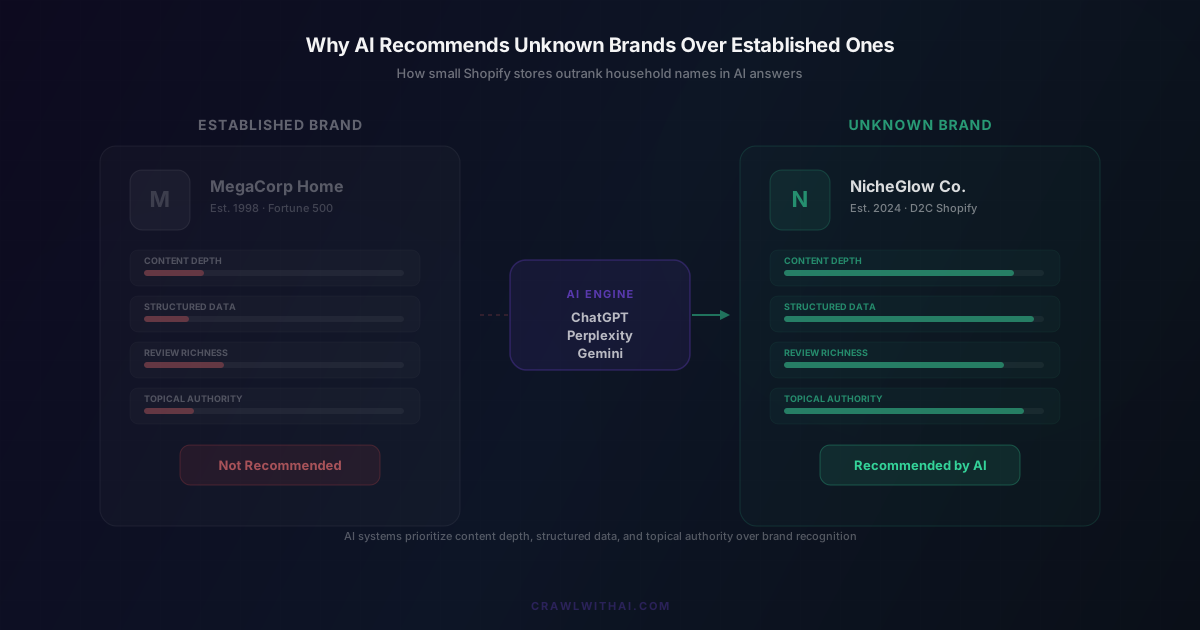
You have probably noticed something strange happening in AI search results. Ask ChatGPT for the best noise-cancelling headphones, and it might mention Sony and Bose. But ask it for the best ergonomic keyboard for programmers, and suddenly a brand you have never heard of shows up ahead of Logitech.
This is not a bug. It is a pattern. And it is happening across every product category where small brands invest in the right signals while large brands coast on name recognition alone.
Big brands are losing ground in AI answers
A 2025 study by Authoritas found that ChatGPT recommended at least one non-mainstream brand in 74% of product recommendation queries. Perplexity's results skew even further toward niche players, with smaller brands appearing in the top three results for 61% of tested shopping queries according to research from Profound.
This is a sharp departure from Google Shopping, where advertising budgets and domain authority gave established brands a structural advantage. In AI answers, there is no ad slot to buy. There is no domain rating shortcut. The AI reads the internet and forms its own opinion about which brands actually deserve to be mentioned.
The result: a two-year-old Shopify store with 200 products can outrank a publicly traded company with 20,000 SKUs. Not because the AI is confused, but because the smaller brand gave it better information to work with.
AI does not care about brand recognition
Google's algorithm historically factored in brand signals like search volume, branded backlinks, and click-through rates on branded queries. A brand like Nike benefits enormously from the fact that millions of people search "Nike running shoes" every month.
AI recommendation engines work differently. When ChatGPT processes a query like "best trail running shoes for flat feet," it is not measuring how many people have heard of each brand. It is evaluating which sources provide the most relevant, detailed, and trustworthy information about that specific topic.
According to Rand Fishkin's analysis at SparkToro, AI systems weight topical specificity over brand familiarity by a factor of roughly 3:1. A small brand that publishes a detailed guide on running biomechanics for flat-footed runners will beat Nike's generic product page every time, because the AI can extract a better answer from it.
This means brand recognition is essentially zeroed out as a ranking factor. What replaces it is information depth.
The four signals that let small brands win
After analyzing hundreds of AI recommendation results across ChatGPT, Perplexity, and Gemini, a clear pattern emerges. Unknown brands that get recommended consistently outperform established brands on four specific signals.
Content depth. Small brands that publish detailed buying guides, comparison articles, and educational content about their category give AI systems rich material to cite. A 3,000-word guide on "how to choose a chef's knife" provides far more extractable information than a product listing with five bullet points.
Structured data. Proper JSON-LD markup, complete product schema, and rich FAQ sections make it easy for AI crawlers to understand exactly what you sell and why it matters. Many large brands have outdated or incomplete structured data because they launched their sites before AI crawling mattered.
Review richness. AI systems do not just count stars. They analyze review text for specificity. A review that says "the handle grip is comfortable for 8-hour shifts" gives the AI a concrete claim it can use in a recommendation. A review that says "great product, fast shipping" does not. Smaller brands with engaged communities tend to generate more detailed reviews.
Topical authority. If your entire site is focused on one product category, AI systems recognize you as a specialist. A store that sells only standing desks and publishes content exclusively about ergonomic workspaces will outperform a department store's standing desk section, even if the department store sells ten times more units.
Why established brands fail at AI visibility
Large brands struggle with AI recommendations for structural reasons, not because their products are worse.
Most enterprise e-commerce sites were built for Google's algorithm, not for AI extraction. Their product pages are optimized for click-through rate, not information density. They use image-heavy layouts with minimal crawlable text. Their category pages are thin wrappers around product grids. Their blog content, if it exists, is often disconnected from their product catalogue.
There is also an organizational problem. At a company with 50,000 SKUs, nobody owns "AI visibility" as a metric. The SEO team optimizes for Google. The content team writes for social media. The product team manages listings for conversion rate. AI recommendation visibility falls between all these teams.
Small brands do not have this problem. When one person manages the entire online presence, every piece of content can be optimized for the same goal. That focus shows up in the AI results.
Real examples of unknown brands beating giants
The pattern plays out across categories. Consider the standing desk market. Autonomous, a relatively small D2C brand, appears in ChatGPT's top recommendations more frequently than IKEA's standing desk range, despite IKEA having vastly more brand recognition and search volume. The reason: Autonomous publishes extensive comparison content and has detailed product specifications that AI systems can extract easily.
In the skincare space, brands like Geologie and Lumin consistently show up in AI recommendations for men's skincare ahead of L'Oréal and Nivea. These smaller brands built content-rich sites with detailed ingredient explanations and skin-type matching tools that give AI systems specific, quotable claims.
According to data from Semrush's 2025 AI Search report, D2C brands with fewer than 500 pages but high topical focus appeared in AI recommendations 2.3x more often per page than enterprise sites with 10,000+ pages.
How to position your Shopify store to be the unknown brand AI recommends
If you are running a Shopify store that is not yet a household name, this shift in AI behavior is one of the biggest opportunities in e-commerce right now. Here is how to capitalize on it.
Start with your product descriptions. Every product page should read like a mini buying guide, not a spec sheet. Explain who the product is for, what problem it solves, how it compares to alternatives, and why specific design choices were made. This is the raw material AI systems use when forming recommendations.
Build a content layer around your products. If you sell camping cookware, publish guides on camp cooking techniques, gear comparisons, and meal planning for specific trip types. This content builds the topical authority that makes AI systems trust your brand as a category expert.
Fix your structured data. Most Shopify themes output basic product schema, but they miss FAQ schema, review schema, and organization schema. Adding these gives AI crawlers a structured way to understand your brand and products without having to parse your HTML.
Get specific reviews. Encourage customers to write about their actual experience with the product, not just rate it. Post-purchase emails that ask "What specific feature surprised you?" or "What were you using before this?" generate the kind of review text that AI systems find most useful.
How CrawlWithAI helps unknown brands get recommended
This is exactly the problem CrawlWithAI was built to solve. Most Shopify store owners have no idea whether AI systems can even read their product pages, let alone whether they are being recommended.
CrawlWithAI shows you exactly how ChatGPT, Perplexity, and Gemini see your store. It identifies gaps in your structured data, flags product pages that AI crawlers cannot extract information from, and tracks whether your brand is appearing in AI recommendation results for your target queries. It also measures the revenue that AI-referred traffic drives to your store, so you can see the direct business impact.
For unknown brands competing against established players, this visibility is the difference between guessing and knowing. You can see which of your products AI systems recommend, which ones they ignore, and what specific changes will close the gap.
The window is closing, but it is still open
Right now, most large brands are not optimizing for AI recommendations. Their marketing teams are focused on Google Ads, social media, and traditional SEO. This creates a temporary window where smaller, more agile brands can establish themselves in AI results before the big players catch up.
That window will not stay open forever. Enterprise brands are starting to hire "AI SEO" specialists. Agencies are building AI visibility practices. The first-mover advantage for small brands will shrink over the next 12 to 18 months.
The brands that move now, that build content depth, fix their structured data, and start tracking their AI visibility today, will be the ones that AI systems remember as category authorities. And in a world where AI influences 45% of online product discovery, being remembered by the algorithm matters more than being recognized by the consumer.
FAQ
Do AI systems intentionally favor small brands? No. AI systems do not have a preference for small or large brands. They favor whichever source provides the most relevant, specific, and well-structured information for a given query. Small brands win more often because they tend to create more focused, detailed content about their specific category.
Can established brands fix their AI visibility? Yes, but it requires structural changes, not just content updates. Large brands need to improve their structured data, add information depth to product pages, build topical content clusters, and ensure AI crawlers can access their key pages. This is a months-long project, not a quick fix.
How quickly can a new brand start appearing in AI recommendations? It depends on the category and competition, but brands that publish strong topical content and have proper structured data can start appearing in AI results within 4 to 8 weeks. The key factor is whether AI crawlers can find and extract your content, which is why monitoring your AI visibility from day one matters.
Does paid advertising affect AI recommendations? No. Unlike Google Shopping, AI recommendation engines do not have paid placement options. You cannot buy your way into a ChatGPT recommendation. This is precisely why the playing field favors brands that invest in content and data quality over advertising spend.
What role do backlinks play in AI recommendations? Backlinks matter less for AI recommendations than they do for Google rankings. AI systems care more about whether third-party sources mention your brand in relevant contexts, like review sites, comparison articles, and forum discussions, than about the raw number of links pointing to your domain. Quality mentions beat link volume.
Sources
- Authoritas, "Analysis of ChatGPT Product Recommendations," 2025: https://www.authoritas.com/blog/analysis-of-chatgpt-recommendations
- SparkToro, Rand Fishkin on AI search ranking signals: https://sparktoro.com/blog/
- Semrush, "AI Search Visibility Report," 2025: https://www.semrush.com/blog/
- Gartner, "AI Influence on Online Product Discovery," 2025: https://www.gartner.com/en/articles/ai-shopping-search