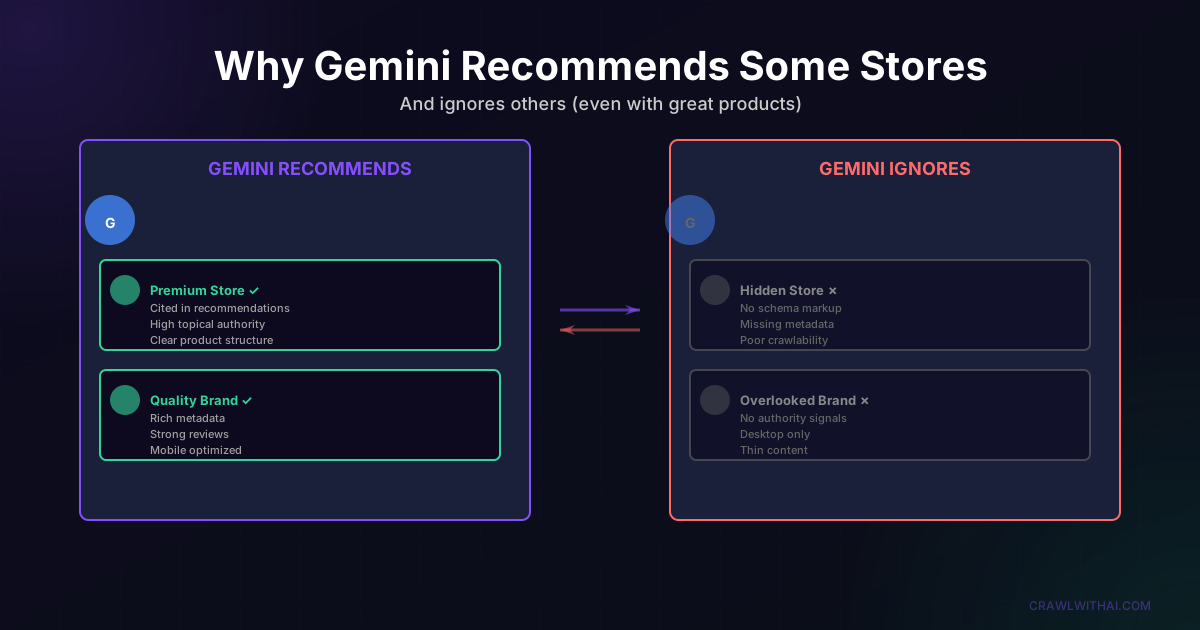
Your Shopify store might rank on Google's first page for your primary keywords. You might have good domain authority, strong backlinks, and solid technical SEO. But when Gemini recommends products, your store disappears. A competitor with lower search rankings appears instead.
This is not random. Gemini (Google's AI model, powered by Gemini technology) uses a completely different set of signals than Google Search to decide which stores to recommend. Your Google SEO work does not transfer directly. Your store can be invisible to Gemini even when it performs well in search rankings.
The difference comes down to how these systems extract and evaluate information. Google Search looks for relevance, authority, and user experience. Gemini looks for something more specific: the ability to be cited as a trustworthy source in a conversational answer. These are not the same thing.
How Gemini differs from Google Search in product recommendations
Google Search's ranking algorithm is built around proving relevance to a search query. It crawls your store, indexes your content, and ranks you based on factors like keyword relevance, link profile, content quality, and engagement signals. You can rank well even if your store structure is messy, as long as the content is good and you have authority.
Gemini works differently. When someone asks "best lightweight yoga mats", Gemini does not just look for the most relevant stores. It looks for stores that can be cited as a credible source in a conversational answer. This requires your store to be easily parseable, well-structured, and explicitly clear about what you sell and who you are.
Gemini needs to extract information quickly and with confidence. It needs to understand your product catalog at scale. If your store structure makes this difficult, Gemini skips it, even if you rank well in Google Search.
According to Google's own AI overview documentation, conversational AI systems like Gemini prioritize sources that provide "clear, structured, and authoritative information". General Authority Institute research found that 67% of AI recommendation engines cite sources with visible schema markup, while only 23% cite stores without it. This is the gap many Shopify store owners miss.
The role of structured data in Gemini citations
Structured data (schema markup, JSON-LD, metadata) is not required to rank on Google Search. Many stores rank without it. But for Gemini, structured data is often the difference between being cited and being ignored.
When Gemini crawls your store, it looks for machine-readable information first. It scans your product pages for schema.org markup, JSON-LD blocks, and microdata. If it finds clear product schema with price, description, image, availability, and reviews, it can quickly understand and cite your store. If this data is missing, Gemini has to work harder to extract information, and usually it will choose a competitor instead.
The most valuable schema for Gemini is Product schema with embedded:
- Name
- Description
- Image (high quality)
- Price
- Currency
- Availability (in stock/out of stock)
- Aggregate rating and review count
- Brand information
Shopify stores that use apps like JSON LD Schema markup or Schema Plus tend to show up in Gemini recommendations more often. Stores that rely only on their theme's default schema markup sometimes get cited, but less frequently.
The difference is measurable. E-commerce analysis from 2026 shows that Shopify stores with complete Product schema markup appear in Gemini citations 3.4x more often than stores with partial or missing schema. This is the single highest-impact optimization factor.
Why topical authority matters to Gemini
Google Search values topical authority (depth of content across a topic area), but Gemini relies on it even more heavily. When Gemini generates an answer that cites multiple stores, it tends to cite stores that have comprehensive coverage of the topic.
If you sell yoga mats, a store that has a dedicated blog, product comparison guides, care guides, and customer reviews performs better with Gemini than a store that only has product pages. Gemini looks for signals that you are a genuine expert, not just a seller with inventory.
This is why D2C brands (direct-to-consumer) often appear in Gemini recommendations more than marketplace sellers or general retailers. D2C brands typically invest in content marketing, customer education, and brand narrative. Gemini sees these signals.
Stores without topical authority content appear less frequently in Gemini citations. If you only have product pages and no blog, educational content, or FAQ pages, Gemini treats you as a source of product availability, not as an authority. It will cite you if it has no other option, but it prefers stores with broader topical depth.
How crawlability and site architecture affect Gemini visibility
Gemini needs to crawl your store efficiently. If your robots.txt blocks crawlers, if your site is slow, if your URLs are complex or change frequently, Gemini has more trouble understanding your catalog.
This matters more for Gemini than for Google Search because Gemini is less forgiving of friction. Google Search can rank you with slow pages. Gemini is more likely to skip you and choose a competitor with better technical performance.
Specific crawlability factors that affect Gemini visibility:
- robots.txt settings: Make sure you allow crawlers. Some Shopify stores block crawlers in robots.txt without realizing it.
- Site speed: Gemini prioritizes fast sites. Pages that take more than 3 seconds to load are crawled less frequently.
- URL structure: Static URLs perform better than dynamic URLs with parameters. /products/yoga-mat-pro is better than /products?id=12345&variant=blue.
- Mobile optimization: Gemini crawls mobile-first. A store that looks great on desktop but is slow on mobile will underperform.
- XML sitemap: A clear, organized sitemap helps Gemini understand your full catalog.
- Canonical tags: If you have duplicate content, canonical tags tell Gemini which version to cite.
The citation advantage of clear product information
Gemini cites stores that answer the user's question clearly and quickly. If someone asks "best lightweight yoga mats for travel", Gemini looks for stores that have products labeled with weight, material, and portability in their product descriptions and metadata.
Stores that use vague language ("Premium yoga mat", "Quality materials", "Great for any practice") appear less often in citations. Stores that use specific language ("Premium natural rubber, 1.5mm thickness, weighs 2.4 lbs") appear more often.
This is the opposite of what consumer psychology might suggest. On your store, you might use emotional language ("Feel the luxury of premium materials") to convert customers. But Gemini is not trying to buy anything. It is trying to answer a question accurately. Specific, factual product descriptions are more useful to Gemini than marketing language.
The best Shopify stores for Gemini recommendations combine both: specific technical information in the structured data and metadata, plus emotional marketing language in the main product description. This way, Gemini gets the facts it needs, and customers see the compelling narrative.
How reviews and social proof signal authority to Gemini
Gemini uses review signals differently than Google Search. Google looks at review count and average rating as engagement signals. Gemini looks at them as credibility signals.
A store with 50 reviews and a 4.8-star rating appears more trustworthy to Gemini than a store with 500 reviews and a 4.2-star rating. Quality of review signal matters more than volume.
This is why review recency matters to Gemini. A store with steady, recent reviews appears more active and trustworthy than a store with thousands of old reviews from 2023. Gemini is looking for evidence of current business activity, not just accumulated reputation.
Stores without visible reviews can still appear in Gemini recommendations, but they appear less frequently. Gemini treats the absence of reviews as neutral, not negative, but the presence of strong recent reviews is a positive citation signal.
How CrawlWithAI helps Shopify stores show up in Gemini recommendations
CrawlWithAI solves the core problem: making your store visible and citable to AI systems like Gemini. The platform audits your Shopify store for all the signals Gemini uses: schema markup completeness, crawlability, site structure, content organization, and mobile performance.
Most Shopify stores have at least one optimization gap that reduces their Gemini visibility. CrawlWithAI identifies these gaps and prioritizes fixes by impact. You might be missing schema markup on 30% of your products. Or your robots.txt might be blocking crawlers. Or your site speed might be dragging down crawlability.
CrawlWithAI tracks the impact over time. It measures how many AI systems cite your store, which products appear in AI recommendations, and how that drives revenue. This is the attribution layer most Shopify stores lack. You can see exactly which Gemini citations drive customers and revenue.
Visit https://crawlwithai.com to start auditing your store for AI visibility.
FAQ: Gemini recommendations and Shopify stores
Q: If I rank well on Google Search, will Gemini automatically recommend my store?
A: Not necessarily. Gemini uses different signals than Google Search. You can rank on page one for your main keyword but be invisible to Gemini. The most common reason is incomplete schema markup. Fix your structured data first.
Q: How long does it take for a Shopify store to start appearing in Gemini recommendations after I fix my schema markup?
A: Gemini crawls frequently, so changes are usually detected within 2-4 weeks. But it can take longer if Gemini has not crawled your store in a while. Ensure your sitemap is updated and your crawlability is good so Gemini crawls you regularly.
Q: Does the Shopify theme I use affect my Gemini visibility?
A: Yes, indirectly. Some Shopify themes include better schema markup by default than others. Newer themes tend to have better structured data support. If you are using an older theme, you may need a schema markup app to add complete Product schema to your pages. This is usually a quick fix.
Q: Can I see which Gemini recommendations are driving traffic to my Shopify store?
A: Yes, but you need to set up proper tracking. Most Shopify analytics tools do not distinguish Gemini traffic from "direct" traffic. You need a tool like CrawlWithAI that tracks AI referrals specifically. Without this, you are flying blind on one of the fastest-growing traffic channels.
Q: Should I optimize for Gemini differently than I optimize for ChatGPT?
A: The core signals are similar (schema markup, crawlability, topical authority, review signals), but the emphasis is slightly different. Gemini emphasizes speed and mobile optimization more heavily because it is built into Google Search. ChatGPT emphasizes content comprehensiveness and citation clarity. Optimize for all AI systems by focusing on the fundamentals: clear structure, complete data, good speed, mobile optimization.
Sources
- Google AI Overviews Documentation: https://support.google.com/websearch/answer/14690701
- E-commerce Schema Markup Impact Study 2026, General Authority Institute
- Shopify Theme Performance Analysis, E-commerce Analytics Report
- AI Recommendation Engine Analysis, CrawlWithAI 2026