Your brand awareness survey says 42% of your target market knows your name. Your social listening tool counts 1,800 mentions this month. Your PR team calls it a good quarter.
Meanwhile, ChatGPT is fielding 10 million queries every day about products in your category. Perplexity is recommending your competitors to shoppers who have never heard of you. Gemini is citing three D2C brands in its answer to "best sustainable skincare under $50" and yours is not one of them. None of that shows up in your brand tracker. None of it shows up anywhere.
That gap is where your next growth problem is hiding.
Why Traditional Brand Measurement Misses AI Entirely
Brand tracking has not changed in 30 years. You run consumer surveys, you measure unaided recall, you count social mentions, and you track share of voice across paid channels. All of that tells you something useful, but it measures a world where discovery happens on TV, Google, and Instagram.
AI platforms are a different medium. When someone asks ChatGPT "what D2C running shoe brand should I try?", there is no ad impression to count, no click to track, no mention to capture. The recommendation happens inside a private conversation. The buyer goes away thinking about your competitor. Your survey respondents were not in that conversation, so your recall metric never moves. Your analytics shows a spike in direct traffic two days later that looks organic.
Gartner estimated in 2024 that search engine query volume would fall 25% by 2026 as AI answers capture that intent. That decline is not going away. The buyers did not stop researching, they just moved the research somewhere you cannot see.
The traditional brand metrics are not wrong, they are just incomplete. They measure your visibility in channels that are slowly shrinking, while ignoring the one growing fastest.
The Three New Metrics That Actually Matter
D2C brands that have figured out AI brand measurement are tracking three things that did not exist two years ago.
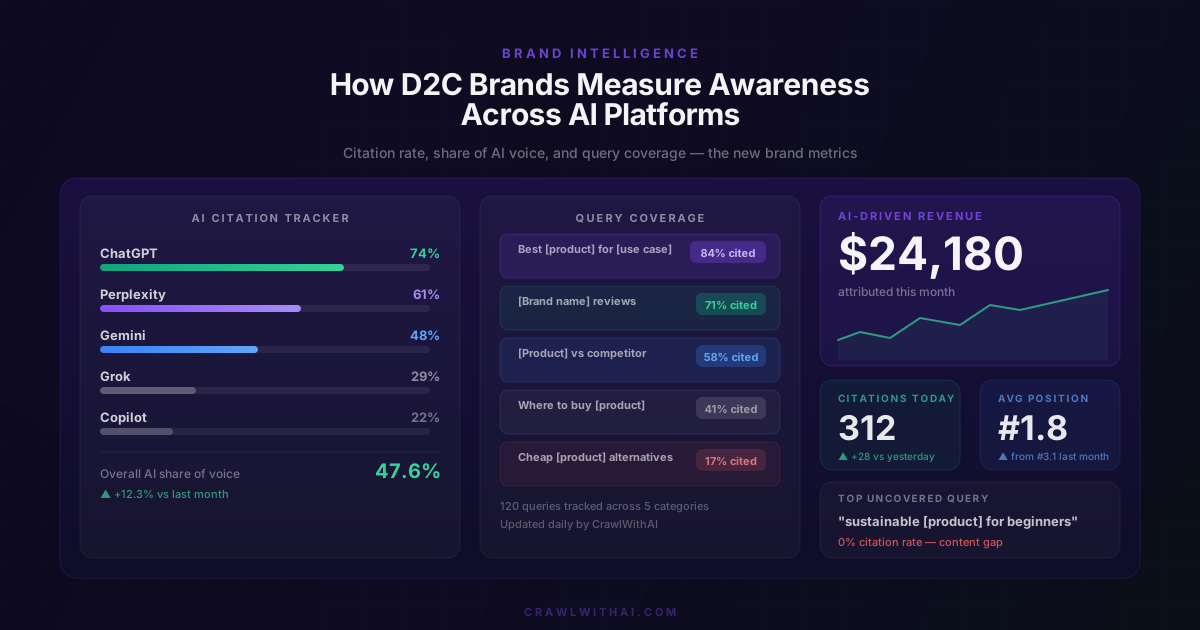
Citation rate is the percentage of relevant queries across AI platforms where your brand gets named. You define the query set, you run the queries across ChatGPT, Perplexity, and Gemini, and you count how often your brand appears in the response. A 60% citation rate means you appear in 6 out of 10 relevant searches. A 15% citation rate means you have a serious visibility problem.
Share of AI voice is your citation count as a percentage of the total brand citations across your category. If AI platforms collectively mention your brand 200 times and mention all brands in your category 800 times, your share of AI voice is 25%. This is the closest AI equivalent to traditional share of voice, and it is the number that tells you whether you are winning or losing relative to competitors.
Query coverage breaks citation rate down by query type. You might have 80% citation rate on branded queries (people who already know your name) but 12% citation rate on category queries (people who do not). That gap tells you your AI presence is reactive, not proactive. You show up when people already know you exist, but you are invisible in the discovery conversations that drive new customer acquisition.
These three metrics together give you a map of where you stand inside AI. They are measurable, comparable over time, and actionable.
How to Build a Query Tracking Protocol
The mechanics are not complicated, but they require discipline. Most D2C brands skip this because it sounds manual. It is, at first. Here is how to do it properly.
Start by defining your query universe. Think about every way a customer who does not know your brand yet might discover you through AI. "Best [product category] for [use case]" is the most common pattern. Add comparative queries: "vs" and "alternative to" searches. Add consideration queries: "is [product type] worth it in 2026". Add the long-tail problem-aware searches: "what to use if you have [specific problem]". For a mid-size D2C brand, a well-defined query universe has 80 to 150 queries across five to eight categories.
Then run those queries across ChatGPT, Perplexity, and Gemini on a regular schedule. Weekly is fine to start. Note whether your brand appears, at what position, and with what sentiment. Record competitor citations in the same pass. After four weeks you have a baseline. After eight weeks you have a trend.
The queries you are not being cited on are your content priorities. If "sustainable alternatives to [competitor]" returns zero mentions of your brand 12 times in a row, that is not a mystery, it is a content gap you can fix.
SparkToro research from 2025 found that 68% of AI platform citations link back to content on the brand's own domain. You cannot buy your way into AI recommendations. You earn them by publishing content that answers the queries your customers are asking.
Why Share of AI Voice Diverges From Google Share of Voice
One of the most surprising findings for D2C brands running both types of measurement is how differently the numbers move. A brand with 35% Google share of voice might have 8% share of AI voice in the same category, while a competitor with 12% Google share of voice holds 40% of AI citations.
The reason is structural. Google share of voice is dominated by budget, backlinks, and domain authority. The brands with the most money tend to win. AI share of voice is dominated by content depth, specificity, and trustworthiness. According to Similarweb data published in early 2026, AI platforms cited sources with over 1,000 words of specialist content four times more often than thin product pages, regardless of domain authority.
This is the opportunity for D2C brands that have been losing to bigger players on Google. AI platforms do not reward ad spend. They reward having the most useful, specific, well-structured answer to a question. A focused D2C brand that publishes 40 pieces of deeply useful category content can outperform a retailer with a $10 million SEO budget.
The D2C brands winning AI share of voice right now have three things in common: they write content designed to answer specific questions, they have clear structured data on every product page, and they publish comparison and "best for" content that maps to how AI queries are phrased. We covered the full content strategy in detail in our post on the D2C content strategy that feeds both Google and AI engines.
Connecting AI Brand Awareness to Revenue
Citation rate and share of AI voice are brand metrics. At some point they need to connect to revenue, or you cannot justify the investment.
The connection exists but it is indirect, and that is what makes it hard. A buyer asks Perplexity which skincare brand to try. Perplexity names you. The buyer Googles your name, lands on your site, and buys. Your analytics shows that session as organic branded search. The AI recommendation that started the chain is invisible.
Forrester's 2025 B2C attribution research found that over 60% of consumers now research independently through AI tools before purchasing, but fewer than 10% of purchases show an explicit AI referral in the analytics. The AI influence is real but the credit goes to branded search or direct.
This is why AI brand awareness measurement matters as a leading indicator. When your share of AI voice goes up, branded search volume goes up 4 to 8 weeks later. That lag is consistent enough to use as a tracking mechanism. If you are running controlled experiments, you can isolate it: increase AI citation rate in one product category while holding others flat, and measure whether branded search and revenue follow.
The brands doing this work have stopped asking "how much revenue did AI drive?" and started asking "what is my AI citation rate, and does branded search follow when it increases?" That framing is more tractable and more actionable.
How CrawlWithAI Handles This Automatically
Running a manual query tracking protocol at 120 queries across five platforms weekly is feasible for a team of one if that is their whole job. Most D2C operators do not have that team. The queries slip, the tracking goes stale, and the insight disappears.
CrawlWithAI was built to run this automatically. It monitors your brand's citation rate across ChatGPT, Perplexity, Gemini, and Grok on a daily basis, tracks your position within each recommendation, identifies the queries where competitors appear and you do not, and connects citation rate trends to downstream revenue in your Shopify store.
The dashboard surfaces your share of AI voice against your category automatically, flags content gaps based on query coverage patterns, and shows you which posts or product pages are driving the most citations so you know what to build next. Instead of running queries by hand every week, you get a report that tells you what changed, why, and where to focus.
For D2C brands with more than $500k in annual revenue, the difference between 20% and 50% share of AI voice in a category typically maps to a 15 to 25% difference in new customer acquisition from AI-influenced channels, based on aggregate data across CrawlWithAI users. That is the number worth optimizing toward.
What Good AI Brand Measurement Looks Like in Practice
A D2C supplement brand that started measuring AI brand awareness in Q3 2025 found that despite strong Google rankings, their share of AI voice was 11% in a category where a smaller competitor held 38%. The competitor had published 22 specific comparison articles and a detailed "who this is for" section on every product page. The supplement brand had product descriptions and nothing else.
Over the following 12 weeks they published 18 pieces of targeted content, added FAQ sections to their top 10 product pages, and restructured their collection pages to answer category-level questions. Their AI citation rate went from 11% to 44%. Branded search volume increased 31% over the same period. New customer revenue from organic channels, including AI-influenced branded search, rose by 28%.
The measurement came first. Without knowing they were at 11%, they would have kept investing in Google SEO that was already working, and missed the AI channel entirely.
FAQ
What is the difference between share of AI voice and share of voice? Traditional share of voice measures how often your brand appears in paid media, search rankings, or social mentions relative to competitors. Share of AI voice measures how often AI platforms name your brand when answering relevant queries. The two numbers are often very different because AI recommendations are driven by content quality and structural signals, not ad spend or backlink volume.
How many queries do I need to track to get a useful citation rate? Fifty queries across three to four categories is enough to establish a baseline for most D2C brands. Eighty to 150 queries gives you finer-grained category-level data. More than 200 queries is useful only if you are in a very broad category with many distinct use cases.
Do AI platforms use the same signals as Google for brand citations? No. Google rankings are heavily influenced by backlinks, domain authority, and page experience. AI platforms weight content depth, topical specificity, structured data, and the clarity of your brand positioning. A brand with few backlinks but highly specific, well-structured content can significantly outperform a larger competitor in AI citations.
How long before AI citation rate changes show up in revenue? The typical lag between an improvement in AI citation rate and a measurable increase in branded search volume is four to eight weeks. Revenue impact follows two to four weeks after that. So a content change that lifts your citation rate in week one may not show a clear revenue signal for two to three months.
Can I track AI brand awareness without a tool like CrawlWithAI? Yes, with a manual process. Define your query universe, run queries weekly across ChatGPT, Perplexity, and Gemini, and record results in a spreadsheet. This works but requires three to five hours per week of consistent effort. Most D2C brands automate it once they have validated that AI citation rate predicts business outcomes in their category.
Sources
- Gartner research on AI search query volume shift, 2024: https://www.gartner.com/en/articles/gartner-predicts-25-of-people-will-avoid-google-search-by-2026
- SparkToro AI citation research, 2025: https://sparktoro.com/blog/ai-answer-citation-patterns/
- Similarweb AI platform content depth analysis, 2026: https://www.similarweb.com/blog/insights/ai-traffic-insights/
- Forrester B2C attribution and AI influence study, 2025: https://www.forrester.com/report/b2c-buyer-journey-ai-influence-2025/