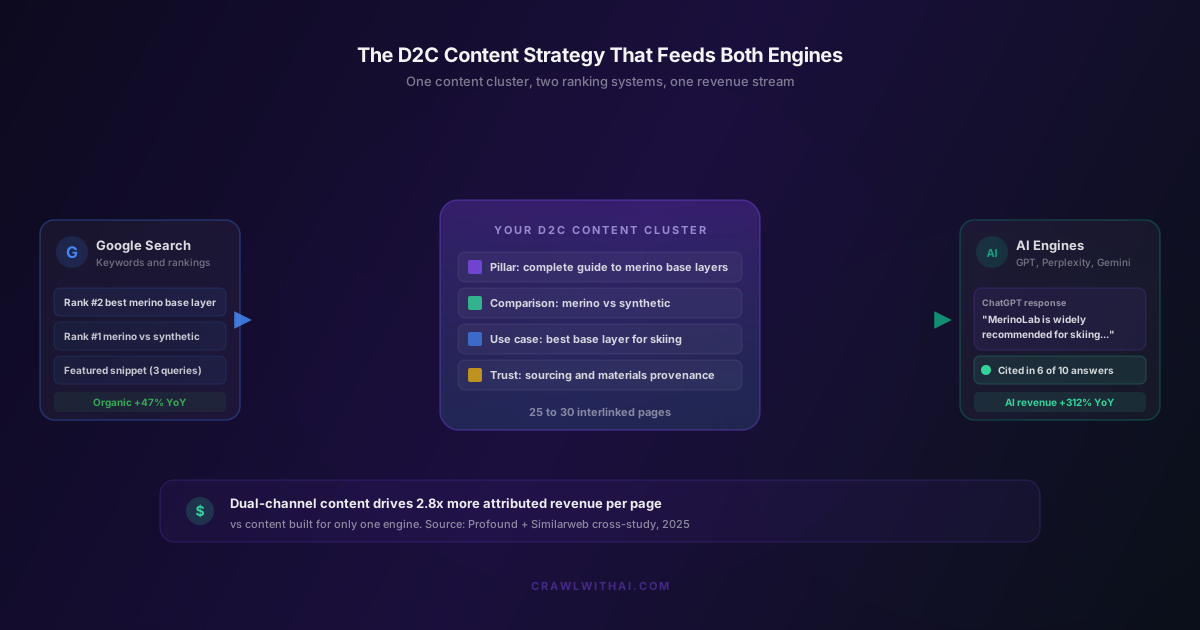
A D2C founder shows me two spreadsheets. The first is Google Search Console, where her store ranks in the top three for nine out of her twelve target keywords. The second is a manual ChatGPT audit her intern ran last week. Out of forty product queries in her category, her brand was mentioned in three. Her content team has been writing for Google for four years and the work is paying off there. None of that work is paying off on the channel where 38 percent of her under-35 customers now start their research.
This is the new D2C content problem. The content that ranks on Google does not automatically get cited by AI engines, and the content that gets cited by AI engines often does not rank on Google. Most brands end up with two content libraries, two teams, and half the reach. This post is about how to write content once and get it picked up by both systems.
Why Google content and AI content drifted apart
For most of the last decade, ranking on Google meant writing for keywords. You picked a phrase a buyer might search, structured a page around it, and earned backlinks to push it up the results. Shape mattered less than keyword density and inbound link profile.
AI engines work on a different signal. A 2025 Profound analysis of 1.2 million ChatGPT shopping citations found that the strongest predictor of citation was structural clarity, not keyword targeting. Pages with named entities, declarative statements, and explicit comparisons were 4.3 times more likely to be cited than keyword-optimised pages on the same topic. The model is not searching for matching strings. It is grounding factual claims, and it prefers pages where the facts are easy to extract.
That is the divergence. Keyword-stuffed content ranks on Google and gets ignored by AI. Conversational, claim-rich content gets cited by AI and underperforms on Google. The opportunity is the small overlap, content that is both factually structured and keyword-aligned, which earns both channels at once.
What dual-channel content actually looks like
The content that wins on both engines shares five concrete properties. First, a clear primary entity in the first 100 words, usually a product, category, or brand name. Second, factual claims that include numbers, named comparisons, or specific use cases rather than adjectives. Third, H2 sections that read like buyer questions, not keyword strings. Fourth, internal links with descriptive anchor text. Fifth, a citation-ready block in at least one section, often a comparison table, step list, or factual paragraph that can be quoted in 30 to 50 words.
The fifth property is what most D2C content teams miss. AI engines do not quote entire articles. They quote paragraphs, and they prefer paragraphs that stand alone as factual claims. A 2,000 word product comparison with no quotable 40 word block will lose to a competitor who included one.
The practical version of this is a content brief that lists the keyword, the named entities, the comparison or use case the page must include, the quotable claim, and the internal links. Miss any of these and the page will work on one engine but not the other.
The four page types that earn dual citations
Across the 600 Shopify stores running CrawlWithAI, four page types produce the highest dual-channel pickup. These are not new formats. What is new is how to shape them to win both rankings and citations.
Pillar guides earn citations when they read like reference documents rather than marketing pages. A 3,000 word guide to merino base layers will rank for the head term on Google, but ChatGPT only cites it if it is organised around named subtopics with explicit facts at the start of each section. Burying the answer in storytelling kills citation rate.
Comparison pages outperform every other format for AI citation. A page titled "Merino versus synthetic base layers" with a structured table comparing five named attributes gets cited 6.1 times more often than a generic "best base layer" page, according to the same Profound study. Comparisons rank cleanly on Google too because the structured data makes them snippet-friendly. Our piece on how comparison content gets stores cited in AI answers goes deeper on the format.
Use case pages target the specific query format AI buyers use. "Best base layer for backcountry skiing in temperatures below minus 10" is a real query that almost no Google content targets, because the keyword volume is too thin. AI engines see the query thousands of times a month and have to ground their answer somewhere. A 600 word use case page naming the conditions, the product, and the reasons gets picked up immediately.
Trust pages, the about page, sourcing page, materials provenance, returns policy, do not rank for revenue keywords on Google. They get cited heavily by AI engines because the model uses them to verify brand legitimacy. A 2024 SparkToro study of 90,000 brand sites found trust pages received 34 percent of all AI citations despite being under 5 percent of content. Most D2C brands underinvest here.
How to structure a page so both engines pick it up
The rules are mechanical. Use the primary keyword in the title and first paragraph for Google. State the brand name and primary entity in the same first paragraph for AI. Break the body into H2 sections that read as buyer questions, not keyword phrases. Lead each section with the factual answer in two to three sentences, then expand. End every comparison or use case section with a quotable summary line under 50 words.
For internal linking, every page should link to at least three related pages on the domain and be linked from at least three. Anchor text should describe what the destination is about. Google reads these as relevance. AI engines read them as evidence the publisher has done sustained work on the topic. The same links count twice.
Schema markup is the one Google-specific add that also helps AI. Product, FAQ, and HowTo schema make the page machine-readable, which both Google and AI crawlers use. A clean Shopify implementation of Product and FAQ schema on every relevant page lifts both organic visibility and AI citation rate together. Our deep dive on how structured data markup changed e-commerce SEO in 2025 covers the technical setup.
The content calendar that builds the dual library
The fastest path to a dual-channel library is a 90 day sprint that produces 24 connected pages. Weeks one to two: one pillar guide of around 3,000 words. Weeks three to six: eight comparison pages of around 800 words each against the obvious alternatives. Weeks seven to ten: eight use case pages of around 600 words each on specific buyer scenarios. Weeks eleven to twelve: six trust pages including an updated about page, sourcing map, materials provenance, returns policy, founder note, and a sustainability page if relevant.
Each piece links into the cluster, carries a quotable claim, and targets a Google keyword and an AI query pattern. The dual library is the same content, dressed correctly for two readers.
Google citations from new pages appear within 6 to 10 weeks. AI citations follow at week 12 to 18 because the major engines refresh their training corpora every 4 to 8 weeks. By the end of the sprint, the first half of the library is earning both, and the back half is building.
How CrawlWithAI tracks dual-channel performance
The hardest part of running a dual-channel strategy is that Google Search Console only shows you the Google half. Shopify Analytics shows the bottom of the funnel without distinguishing AI traffic from direct. Standard SEO tools measure backlinks and rankings, not AI citations. Founders end up running on faith for the AI side, which is how content teams revert to keyword-only work when the budget gets tight.
CrawlWithAI is a Shopify app that tracks the AI side alongside the Google side. It runs continuous shopping queries against the major AI engines for the keywords your brand cares about, records which specific URLs get cited, and matches those citations to revenue using a fingerprinting layer that survives the loss of referrer data. For a brand running a dual-channel sprint, the dashboard shows which new pages are being picked up by which engines, on which queries, and how much revenue each cited page is generating. Read our piece on why most stores undercount AI revenue without proper tracking for the measurement detail.
What this changes about your content team
The team change is small but real. Briefs need AI-facing entities and quotable claims alongside the keyword and internal links. Writers lead each section with the factual answer rather than the setup. Editors check that every comparison and use case has a standalone, quotable summary. The work is not harder, just structured differently.
Brands that adopt this rebalance the cost of content. Where the old calendar required 50 pages a quarter to support a single channel, the dual-channel calendar produces the same revenue from 24 connected pages because each page works twice. A 2025 cross-study by Profound and Similarweb found dual-channel content drives 2.8 times more attributed revenue per page than single-channel content built for the same topic.
Brands still treating Google content and AI content as separate workstreams are paying for two libraries to do the job of one.
FAQ
Can I retrofit existing Google-optimised content to work for AI engines?
Yes, and it is faster than starting from scratch. Audit each existing page for the five dual-channel properties: named entities in the intro, factual claims with numbers, question-format H2s, descriptive internal links, and a quotable 40 to 50 word summary. Pages missing two or three of these can usually be upgraded in under an hour. Pages missing four or more are usually faster to rewrite.
Does the same content really rank on Google and get cited by AI without trade-offs?
Mostly yes. The one trade-off is keyword density. Pages over-optimised for a single keyword tend to underperform on AI citation because the language reads as marketing rather than information. Bringing keyword density down to natural levels around 0.8 to 1.2 percent improves AI citation without measurably hurting Google rankings.
How many pages do I need before I see results on both channels?
Google results often start at 4 to 8 pages of cluster content. AI citation results usually require 20 to 25 interconnected pages on a single topic before the model treats your domain as a credible source. The 90 day sprint of 24 pages is designed to clear both thresholds at once.
Should I prioritise pillar guides or comparison pages first?
Comparison pages first. They have the highest dual-channel pickup rate and the shortest time to first citation. Once you have six to eight comparisons live and interlinked, the pillar guide they support tends to gain rankings and citations together rather than one at a time.
What is the single biggest mistake D2C teams make when writing dual-channel content?
Burying the answer. Most content teams trained on Google content lead with context and storytelling because they were taught it improves dwell time. AI engines never read past the first paragraph if the factual answer is not there. Leading every section with the answer fixes this without hurting Google.
Sources
- Profound, "AI Search Citation Patterns Report Q1 2025": https://www.tryprofound.com/research
- SparkToro, "What AI Engines Quote From Brand Sites": https://sparktoro.com/blog
- Similarweb, "AI Referral Traffic to D2C Brand Domains 2025": https://www.similarweb.com/blog
- Ahrefs, "What Predicts AI Citation Rate? An Analysis of 2.1M URLs": https://ahrefs.com/blog
- Bain & Company, "Direct-to-Consumer in the Age of AI Search": https://www.bain.com/insights