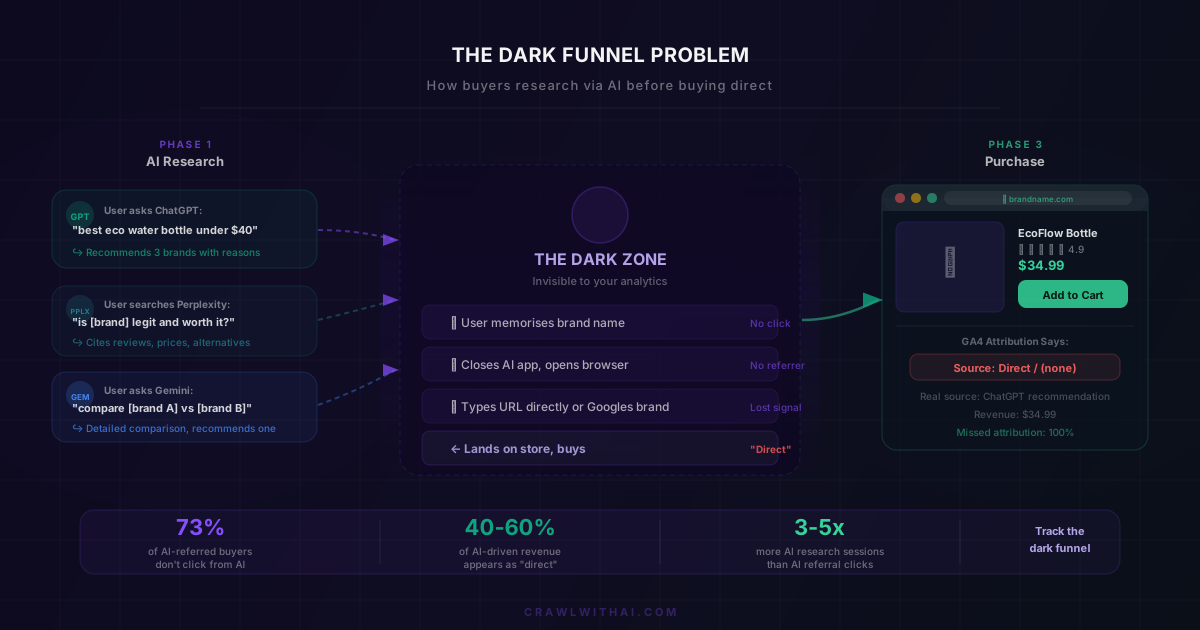
Your analytics says "Direct / (none)." Your instinct says you just ran a great product. Both might be right, but neither tells you what actually happened. Somewhere between a user typing "best eco water bottle under $40" into ChatGPT and that same user landing on your product page twenty minutes later, the trail went cold. That gap has a name: the dark funnel.
The dark funnel isn't new, but AI platforms have made it much bigger. When a buyer used to research on Reddit or a review blog, there was at least a chance of a referral header passing through. When they research on ChatGPT or Perplexity, there is no click, no cookie, no UTM parameter, no referral. They close the app, open Chrome, and type your domain. Your GA4 event fires. It says "Direct." You have no idea you're looking at the downstream result of an AI recommendation.
What the Dark Funnel Actually Looks Like
Picture a real buying session. A user opens ChatGPT on their phone and asks for the best insulated water bottles under $40 that ship to Australia. ChatGPT returns three brands with short explanations of why each one fits the brief. Your brand is one of them. The user reads the recommendation, notes your name, and closes ChatGPT.
They don't click a link, because there often isn't one. They open a new tab, type your brand name, land on your homepage, browse for three minutes, and buy. According to every standard analytics tool you own, that sale came from Direct traffic.
This pattern repeats billions of times per month across ChatGPT, Perplexity, Gemini, and Grok. A study by SparkToro and Datos in early 2026 found that AI-driven browsing sessions generate roughly three to five times as many zero-click exits as referral clicks. Buyers leave to act on what they found, they don't follow a link. The research happens in the AI. The purchase happens somewhere the AI never touches.
Why Standard Analytics Can't See It
Google Analytics 4, Shopify's built-in analytics, and most third-party attribution tools work on the same assumption: if we can't read a referring URL, the session is Direct. That was a reasonable assumption in 2018. In 2026, it produces a systematic blind spot.
When a user navigates from ChatGPT's web interface, the referral header is stripped or blocked at the browser level. When they use the ChatGPT iOS app, there is no browser referral chain at all. Perplexity's mobile app behaves the same way. Gemini on Android routes searches through Google infrastructure that frequently overwrites the original referral context.
The result is that a substantial chunk of your "Direct" bucket is AI-influenced revenue you are crediting to nothing. A 2025 analysis by Measured, the incrementality platform, estimated that brands operating without AI attribution correction were undercounting AI-influenced orders by between 40 and 60 percent. That isn't a rounding error. That's a missing channel in your budget.
The Compounding Effect on Marketing Decisions
Here's where the dark funnel becomes expensive beyond just the attribution error itself. If you don't know AI is driving purchases, you will never invest in the things that make AI platforms recommend you. You won't optimize your product descriptions for how GPTBot reads them. You won't build the structured content that gives Perplexity something to cite. You won't track whether your Shopify metadata is being parsed correctly by AI crawlers.
Worse, you will misread the performance of other channels. Your paid search might look extremely efficient because it's being credit with conversions that AI actually influenced earlier in the journey. When you scale paid search on that data, you'll spend more on a channel that was capturing intent, not creating it.
A 2025 survey by Rockerbox, the marketing measurement platform, found that e-commerce brands using multi-touch attribution models that included AI channels saw their paid search efficiency scores drop by an average of 18 percent compared to last-click models, because multi-touch correctly assigned credit upstream to the AI platform. The money wasn't wasted on paid search, it just wasn't the source. The dark funnel was.
How Buyers Move Through the AI Dark Funnel
The pattern varies slightly by product category, but the structure is consistent. Research happens in AI. Validation happens in AI. The decision is often made in AI, before the buyer ever opens your website. Then the buyer takes the action in your store.
For considered purchases above about $50, buyers typically run two or three separate AI queries over several days. They might ask ChatGPT for a category recommendation, then ask Perplexity to compare two specific brands, then ask Gemini whether a particular brand has quality issues. Each of those sessions is a touchpoint on your behalf, none of them generate a trackable referral, and the final landing on your site after the last query looks completely organic.
For impulse purchases under $30, the cycle is tighter, sometimes a single ChatGPT query followed by an immediate purchase, but the dark funnel effect is the same. The referral header is gone by the time the transaction fires.
This is why looking at "branded direct" traffic as a proxy for brand health in 2026 requires more nuance than it used to. Branded direct grew substantially for most Shopify stores in 2025, and a meaningful share of that growth was AI recommendation traffic wearing a Direct traffic label.
What Signals You Can Actually Measure
The dark funnel can't be fully illuminated with standard tools, but it isn't completely invisible. There are several practical signals you can use to size it.
First, monitor your direct traffic volume against periods where you know you've been recommended. If you run a campaign that boosts your visibility on AI platforms and your direct traffic grows, that's a leading indicator of dark funnel activity. The correlation isn't clean, but it's real.
Second, segment new versus returning customers in your direct traffic. Dark funnel buyers are usually first-time customers who navigated directly. A spike in new-customer direct sessions is a strong signal of AI recommendation activity.
Third, post-purchase surveys remain one of the most reliable tools for this. A simple "How did you hear about us?" question that includes "AI assistant (ChatGPT, Perplexity, etc.)" as an option consistently surfaces dark funnel buyers who analytics would have labeled Direct. Kno Commerce, the post-purchase survey platform, found in a 2025 report that stores adding this option to their surveys saw between 8 and 22 percent of respondents selecting it, almost all of whom would have appeared as Direct in GA4.
How CrawlWithAI Addresses the Dark Funnel
CrawlWithAI is built specifically for stores that want to understand their relationship with AI platforms, including revenue that arrives through the dark funnel. Rather than trying to retrofit standard analytics to catch AI referrals that will never carry a referral header, CrawlWithAI approaches the problem from the supply side.
By monitoring which AI platforms are crawling your store, how often your products are being surfaced in AI responses, and how your content is being interpreted by AI systems, CrawlWithAI lets you track your AI visibility directly rather than inferring it from downstream traffic anomalies. When your AI visibility score rises and your direct new-customer traffic rises in parallel, you have a model for the dark funnel's contribution to your revenue, even without a referral click.
CrawlWithAI also provides the content and technical optimization layer that increases the probability of AI platforms recommending you in the first place, because knowing the dark funnel exists isn't useful if you can't grow it intentionally.
If you're interested in the technical side of how AI crawlers read your store, the post on what GPTBot actually reads when it crawls your Shopify store walks through the mechanics in detail.
What to Do With This Information
The immediate action is to add AI attribution options to your post-purchase survey. This takes an afternoon and starts producing data immediately. You don't need to wait for better tooling.
The second action is to segment your direct traffic by new versus returning visitors and look at the trend over the past 18 months. If you see a meaningful, unexplained uptick in new-customer direct sessions, you're almost certainly looking at AI dark funnel traffic.
The third action is to treat AI platform optimization as a top-of-funnel investment, even though it produces zero trackable clicks. Your product descriptions, structured data, FAQ content, and store metadata are what determines whether AI platforms recommend you or a competitor. The buyer who never clicks a link from ChatGPT but lands on your store and converts because of what ChatGPT said is worth exactly as much as any other buyer. They're just invisible in your current reporting.
The dark funnel will only grow. As AI shopping becomes the default starting point for product research, the gap between AI influence and measurable attribution will widen. The stores that build infrastructure for understanding and growing their AI presence now will have a significant data advantage over those who are still treating direct traffic as a mystery.
FAQ
What is the dark funnel in e-commerce? The dark funnel refers to the research and discovery touchpoints in a buyer's journey that analytics tools cannot track. Traditionally this included word of mouth and podcast mentions. In 2026, AI platforms like ChatGPT and Perplexity are the largest source of dark funnel traffic, because buyers research products there but the resulting website visits carry no referral attribution.
Why does AI traffic show up as Direct in Google Analytics? When a user researches a product on ChatGPT or Perplexity and then navigates to a store by typing the URL or searching for the brand name, there is no HTTP referrer header passed to the store's analytics. GA4 and most other analytics tools classify sessions with no referrer as Direct, even if they resulted directly from an AI recommendation.
How can I estimate how much revenue the dark funnel is driving? The most reliable method is a post-purchase survey that explicitly asks customers whether they used an AI assistant during their research. Correlating survey results with direct traffic segments gives you a reasonable estimate. Tools like CrawlWithAI can complement this by tracking your AI visibility directly and helping you correlate visibility changes with direct traffic movements.
Does fixing AI attribution require changing my Shopify setup? Not necessarily. Post-purchase surveys and traffic segmentation can be implemented without any changes to your store's technical setup. For deeper attribution, you may want to explore CrawlWithAI's tracking capabilities, which operate at the AI platform visibility level rather than requiring changes to your Shopify analytics configuration.
Is the dark funnel the same as direct traffic? No, but direct traffic is where most dark funnel revenue ends up being classified. Direct traffic also includes people who genuinely navigated directly (returning customers, saved bookmarks) and branded search clicks. The dark funnel is the subset of direct traffic that was actually AI-influenced. Post-purchase surveys are the most practical way to separate these.
Sources
- SparkToro and Datos: "Zero-Click Internet" research report, Q1 2026. https://sparktoro.com
- Measured: "AI Attribution Gap" analysis report, 2025. https://measured.com
- Rockerbox: "2025 Marketing Attribution Benchmarks for E-Commerce." https://rockerbox.com
- Kno Commerce: "Post-Purchase Survey Benchmarks 2025." https://knocommerce.com