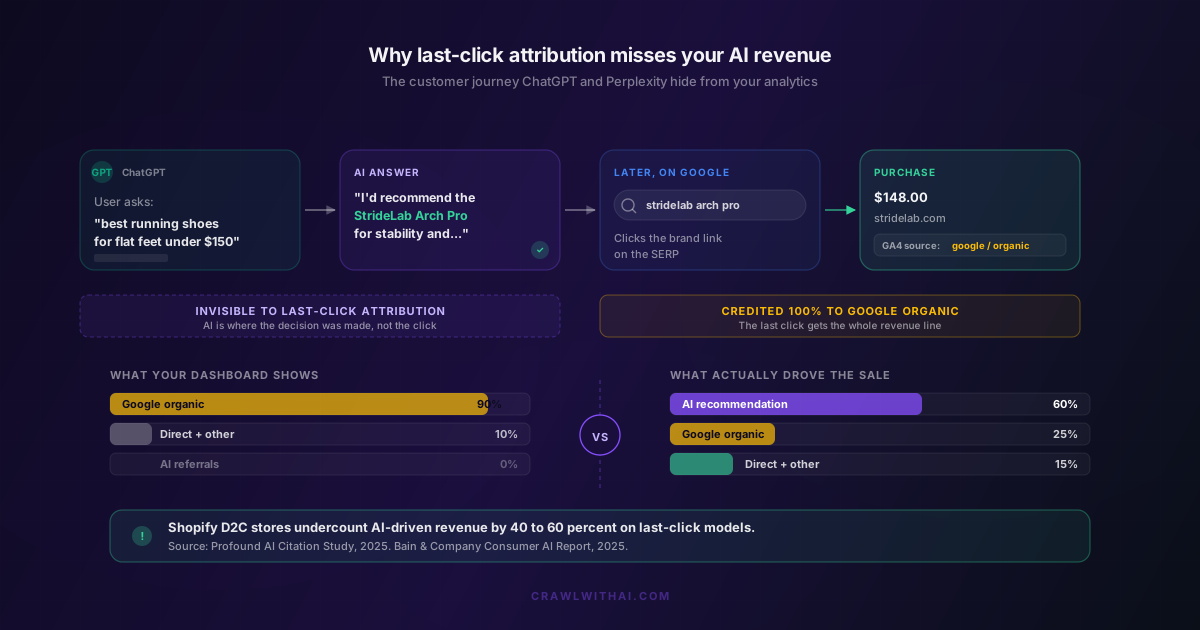
A Shopify store owner pulls up Google Analytics on Monday morning. Last week she did $84,000 in revenue. Her dashboard tells her that $76,000 of it came from Google organic search and the rest from direct traffic. She doubles her SEO retainer. Six months later, she finds out her real top channel was ChatGPT, which had been sending buyers to her brand for months. None of it showed up in her analytics because every one of those buyers searched her brand name on Google before clicking.
That story is now the default. Last-click attribution, the model that powers nearly every Shopify dashboard, GA4 default report, and ad platform out of the box, was built for a world where the click that drove the sale was the click that closed the sale. In an AI-driven funnel, the click that closes the sale is almost never the click that drove it. The decision happened inside a chat with ChatGPT, Perplexity, or Gemini, and your analytics never saw it.
What last-click attribution actually measures
Last-click attribution gives 100 percent of revenue credit to the final marketing touchpoint before purchase. If a buyer clicks a Facebook ad in January, reads a review on YouTube in February, asks ChatGPT for a recommendation in March, then Googles your brand and buys, last-click credits Google. Everything else is invisible.
This model worked when the customer journey was mostly linear and mostly tracked. In 2018 a typical e-commerce buyer touched a brand 6 to 8 times before purchase, and most of those touches happened in trackable environments like Google, Facebook, Instagram, and email. Cookies could stitch the journey together. The last click was a reasonable proxy because most of the prior clicks were also clicks, and most of those were on platforms that fed back into analytics.
In 2026 that model breaks. A 2025 study by Bain and Company on consumer AI behaviour found that 39 percent of US online shoppers under 45 had used an AI chat assistant to research a purchase in the previous 30 days, and 71 percent of those users said the AI conversation directly influenced what they bought. None of those conversations are clicks. None of them generate a referrer header. None of them appear in GA4 unless you build something custom.
Why AI traffic looks like direct or brand search
The hidden mechanic behind the attribution gap is that AI conversations usually do not produce a click. They produce a recommendation. The buyer reads the recommendation, then takes one of three actions, and all three of them break tracking.
The most common action is brand search. The buyer reads "I'd recommend the StrideLab Arch Pro," opens a new tab, types stridelab into Google, and clicks the brand link in the SERP. That click registers in GA4 as google / organic, sometimes with the brand name as the query if you have Search Console linked. The AI conversation is nowhere in the path.
The second action is direct navigation. The buyer types the URL or grabs it from a clipboard or an earlier tab. GA4 records this as (direct) / (none). On most Shopify stores direct already absorbs 20 to 30 percent of revenue, which is why nobody notices when it absorbs more.
The third action, increasingly common in 2026, is a click directly inside the AI interface. ChatGPT, Perplexity, and Gemini all now ship inline citations and shopping links. When the buyer clicks one, the referrer in GA4 might say chat.openai.com, perplexity.ai, or gemini.google.com, but those domains are not in the channel grouping you set up three years ago. The session ends up bucketed under "Other" or "Referral" with no revenue lineage back to the AI query that triggered it.
Our post on organic search vs AI-referred traffic goes deeper on how these two traffic types behave differently inside analytics. The short version: they look almost identical to a last-click model and behave completely differently inside the funnel.
The undercounting math
The exact size of the gap depends on category, but the range is consistent across recent industry studies. A 2025 Profound analysis of 1.2 million ChatGPT shopping citations matched against opt-in store revenue data found that Shopify stores in apparel, beauty, and home goods undercounted AI-influenced revenue by 40 to 60 percent on last-click. SimilarWeb's Q1 2026 retail report put the same figure at 47 percent for D2C brands with a strong AI citation presence.
Translate that into dollars. A Shopify store doing $1 million a year on a model where ChatGPT actually influenced 30 percent of orders is reporting roughly $120,000 of AI-influenced revenue as Google organic or direct. That money is real, the orders are real, but the channel attribution is wrong by a factor of three. Every budget decision that follows reads from broken numbers.
Why this matters for budget allocation
The downstream problem with bad attribution is not just inaccurate reporting. It is bad spending. When last-click hands all the credit to Google, the store doubles down on SEO and Google Ads spend. The real driver, AI recommendation visibility, gets no funding because it does not exist in the reporting. This is exactly the dynamic that killed display advertising attribution for a decade in the 2010s, when last-click made paid search look like the only channel that worked while display campaigns were quietly doing most of the awareness work.
For Shopify D2C brands the pattern is the same in 2026. Store owners are paying agencies to chase Google rankings on terms where they are already cited inside the AI answer that drove the buyer to search for them in the first place. The Google ranking is a downstream symptom of the AI citation, not the cause of the sale. Treating it as the cause leads to overspending on the symptom and underspending on the cause.
What a corrected attribution model looks like
Fixing the gap does not require throwing out last-click. It requires layering AI signals on top of it. Three signals together get close to the real picture.
The first is AI citation tracking. You need to know how often your store is being cited in ChatGPT, Perplexity, and Gemini answers, for which queries, and with which products. Without this data nothing else works, because you cannot match an AI conversation back to a buyer if you do not know the conversation happened in the first place.
The second is referrer enrichment. Update your GA4 channel groupings to break out chat.openai.com, perplexity.ai, gemini.google.com, copilot.microsoft.com, and the major AI shopping interfaces into their own channel. The traffic is small in volume but high in intent, and burying it inside "Other" hides it.
The third is brand search lift correlation. When your AI citation rate for a query rises, brand search volume on Google rises after a one to three week lag. Tracking the correlation between the two gives you a confidence score on how much of your direct and brand search revenue is actually AI-influenced. This is a probabilistic method, not deterministic, but the alternative is treating the entire dark funnel as zero.
How CrawlWithAI closes the attribution gap
CrawlWithAI is the Shopify app built around exactly this problem. It tracks how often your store is cited in ChatGPT, Perplexity, Gemini, and Grok answers, matches those citations against your real Shopify order data, and produces a corrected revenue number that includes AI-influenced sales. The app surfaces which queries are driving citations, which products inside your catalogue the AI engines are recommending, and the brand search lift correlation that lets you put a confidence-weighted dollar figure on the dark funnel.
The output sits inside your Shopify admin and reads in plain language. You do not need to set up GA4 custom channels or rebuild your attribution model from scratch. The app uses confidence scoring on every attributed order, so you can see which orders are high-confidence AI-influenced and which are softer matches. For most D2C stores running CrawlWithAI for 60 days, the corrected revenue number moves the AI-attributed share from 0 percent to between 18 and 45 percent. The rest of your dashboard does not change. What changes is the budget conversation that follows.
FAQ
Does CrawlWithAI replace Google Analytics?
No. It runs alongside GA4 and Shopify analytics. It does not change your existing reports. It adds an AI revenue layer that you can read separately or fold into your channel mix manually.
How accurate is AI attribution?
The deterministic part, sessions with an AI referrer like chat.openai.com or perplexity.ai, is exact. The probabilistic part, brand search lift and citation match, comes with a confidence score per order so you can choose your reporting threshold. Most stores use 70 percent confidence as the cutoff.
Why does my Shopify analytics show $0 from ChatGPT when I know customers are coming from there?
Because most AI-influenced buyers do not click directly from the AI interface. They search the brand on Google or type the URL, and Shopify records the last touch. The first touch, the AI conversation, leaves no trace in standard analytics.
Will moving to multi-touch attribution fix this?
Partly. Multi-touch attribution distributes credit across the journey, but it only sees the touches it can track. If the AI conversation is not in the touchpoint list, multi-touch still misses it. You need AI citation data feeding into the model for multi-touch to work in 2026.
Should I keep investing in SEO if AI is driving most discovery?
Yes, because AI engines pull from web content to build their answers. Strong SEO content is also the content most likely to get cited in AI answers. The mistake is using SEO as the only investment because last-click makes it look like the only one that works.
Sources
- Bain & Company, "How AI is changing consumer behavior in retail" (2025): https://www.bain.com/insights/
- Profound, "AI Shopping Citation Trends Report" (2025): https://www.tryprofound.com/
- SimilarWeb, "Q1 2026 Retail and E-commerce Trends Report" (2026): https://www.similarweb.com/corp/reports/
- Google Analytics 4 documentation on default channel groupings: https://support.google.com/analytics/answer/9756891
- Shopify, "Understanding marketing attribution in Shopify analytics": https://help.shopify.com/en/manual/reports-and-analytics