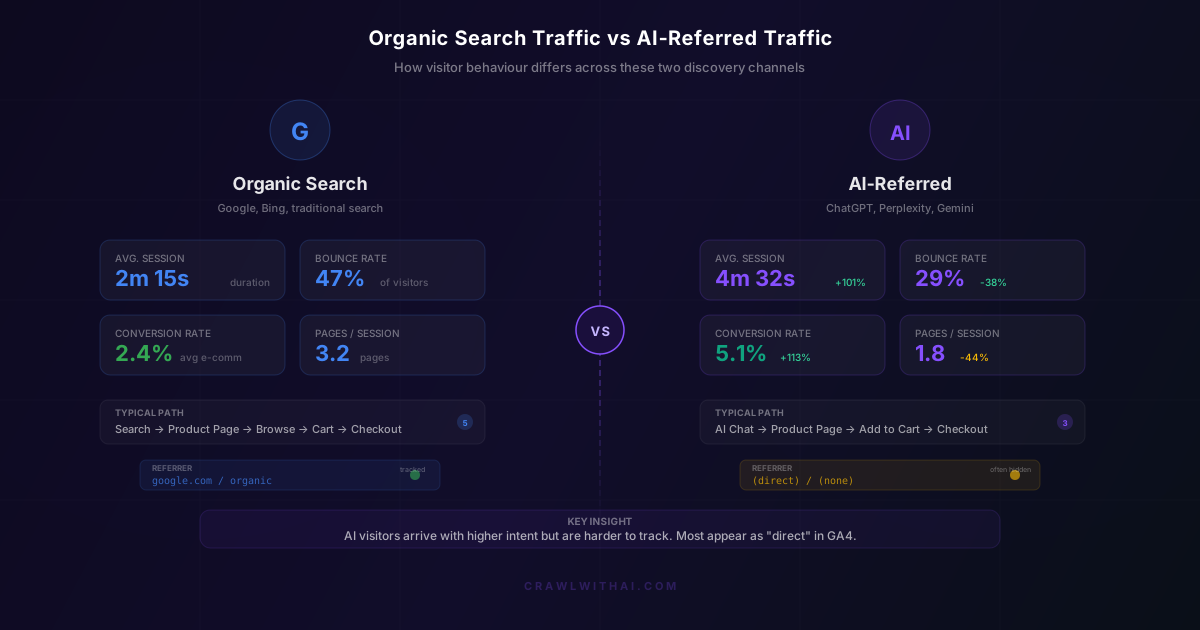
Your analytics dashboard tells you most of your traffic comes from Google. That might be true today. But it is hiding a second channel that is growing fast, converting better, and showing up in your reports as "direct" traffic.
That channel is AI-referred traffic. Visitors who found your store because ChatGPT, Perplexity, or Gemini recommended it during a conversation. These visitors behave differently from organic search visitors in almost every measurable way. And if you are treating both channels the same, you are making decisions with incomplete data.
What Organic Search Traffic Actually Looks Like
Organic search traffic is the channel most Shopify store owners understand best. Someone types a query into Google, scans the results, clicks a blue link, and lands on your site. The behaviour pattern is well documented.
According to Contentsquare's 2024 Digital Experience Benchmark report, the average e-commerce session from organic search lasts around 2 minutes 15 seconds. Visitors view roughly 3.2 pages per session. They browse, compare, and often leave to check competitors before returning later to buy.
The conversion rate for organic search traffic sits around 2.4% for e-commerce stores, based on data from Ruler Analytics' 2024 conversion benchmark study. That number varies by category, but it is the ballpark most stores operate in.
Organic visitors are explorers. They arrive on a product page, click through to a category, look at related items, read reviews, then maybe add something to cart. The path is long and winding. Google Analytics tracks it cleanly because Google passes referrer data reliably.
How AI-Referred Traffic Behaves Differently
AI-referred visitors arrive in a completely different state of mind. They have already done their research inside the AI conversation. They have asked follow-up questions, narrowed their options, and received a specific recommendation before they ever click through to your store.
The result is a visitor who knows what they want. Data from Lily AI's 2024 retail study found that visitors referred by AI platforms had session durations averaging over 4 minutes, roughly double that of traditional search visitors. But they viewed fewer pages per session, typically 1.8 compared to 3.2 for organic search.
This makes sense when you think about it. An AI-referred visitor does not need to browse your entire catalogue. The AI already did that work. They land on the specific product page, read the details, and either buy or leave. There is less wandering.
The conversion rate tells the bigger story. SparkToro's 2025 zero-click search analysis, combined with early data from stores tracking AI referrals, suggests that AI-referred visitors convert at 2x to 3x the rate of organic search visitors. Some stores report AI-referred conversion rates above 5%.
The Attribution Problem That Hides AI Traffic
Here is where things get messy. Most AI-referred traffic does not show up as AI-referred traffic in your analytics. It shows up as "direct."
When ChatGPT recommends your store and a user clicks the link, the referrer header is often stripped or passed inconsistently. Google Analytics 4 classifies these visits as direct traffic because it cannot identify the source. Perplexity sometimes passes referrer data, but ChatGPT and Gemini frequently do not.
Rand Fishkin's SparkToro research in 2025 estimated that 60% of AI-referred visits get misclassified as direct in standard analytics setups. That means the "direct" traffic bucket in your GA4 dashboard is likely a mix of bookmarks, typed URLs, and AI recommendations, all blended together with no way to tell them apart using default settings.
This creates a real problem for store owners. You cannot optimise a channel you cannot see. And you cannot justify investment in AI visibility if the revenue looks like it is coming from "direct" visits.
If you are already tracking AI referrals, you might notice that your existing SEO and AI SEO strategies need different measurement approaches for each channel.
Session Depth vs. Session Intent
One of the most interesting differences is the relationship between pages viewed and purchase intent. In organic search, more pages viewed generally correlates with higher purchase likelihood. A visitor who views 5 pages is more likely to buy than one who views 2.
AI-referred traffic flips this. Fewer pages viewed can actually indicate higher intent. The visitor already completed their evaluation in the AI conversation. They do not need your comparison pages, your "best sellers" collection, or your blog content. They need the product page to confirm what the AI told them, and then they need a smooth checkout.
This has implications for how you design landing pages. For organic traffic, you want navigation, cross-sells, and category links. For AI-referred traffic, you want a clean product page with clear pricing, fast load times, and minimal friction to checkout.
Your product page structure matters for both channels, but for different reasons. Organic visitors need persuasion. AI-referred visitors need confirmation.
The Referrer Data Gap in Practice
Let's look at what this means in a real GA4 setup. A typical Shopify store might see traffic sources broken down roughly like this: 40% organic search, 25% direct, 15% paid, 10% social, 10% other.
That 25% direct number is where AI traffic hides. Before AI recommendations became common, direct traffic was mostly bookmarks and typed URLs, people who already knew your brand. Now it includes a growing number of first-time visitors who discovered you through an AI conversation.
You can spot this shift by looking at the behaviour of your "direct" traffic over time. If your direct traffic segment is showing increasing numbers of new users (not returning visitors), landing on product pages (not your homepage), and converting at a higher rate than historical direct traffic, there is a good chance some of that is AI-referred.
Some stores use UTM parameters appended through specific landing pages or JavaScript-based referrer detection to separate AI traffic from true direct. But these methods are imperfect and require technical setup that most Shopify store owners do not have in place.
Why AI-Referred Traffic Has Higher Conversion Rates
The conversion rate gap between organic and AI-referred traffic is not random. Three specific factors drive it.
First, pre-qualification. The AI has already filtered options based on the buyer's specific needs. When ChatGPT recommends your store for "waterproof hiking boots under $150 with good ankle support," the visitor arriving on your product page matches that exact profile. Organic search does some of this, but the matching is rougher.
Second, trust transfer. When an AI recommends your product, some of the trust the user has in the AI transfers to your brand. A 2024 Salesforce survey found that 53% of consumers said they trust product recommendations from AI assistants. That trust carries into the buying decision. The visitor is not starting from zero the way a cold Google searcher might be.
Third, reduced comparison shopping. Organic search visitors often open 3 to 5 tabs and compare products across stores. AI-referred visitors typically click through to 1 or 2 recommended options. They are already past the comparison phase. This compresses the purchase funnel and reduces the chances of losing the sale to a competitor.
How to Identify AI Traffic in Your Analytics
You cannot perfectly separate AI traffic with default GA4 settings, but you can get closer. Start by creating a segment for "direct" traffic that lands on product pages from new users. Compare this segment's behaviour to your known direct traffic (homepage visits from returning users).
Look at user agent strings in your server logs. Some AI platforms use identifiable user agents when users click through from their interfaces. Perplexity, for example, sometimes passes referrer data that you can capture.
Set up event tracking for landing page patterns. If new visitors are landing directly on deep product pages, with no prior session history, and converting at rates above your organic average, flag those sessions. They are likely AI-referred.
You should also be checking whether your store is actually appearing in AI recommendations in the first place. Understanding what AI crawlers read on your site helps you know whether AI platforms can even recommend your products.
How CrawlWithAI Solves the Visibility and Tracking Problem
This is exactly the problem CrawlWithAI was built to address. CrawlWithAI helps Shopify stores get recommended by AI platforms like ChatGPT, Perplexity, and Gemini, and then tracks the revenue those recommendations drive back to your store.
Instead of guessing how much of your "direct" traffic is actually AI-referred, CrawlWithAI uses confidence-scored attribution to identify AI-driven sessions and tie them to actual orders. You can see which products are being recommended, which AI platforms are sending traffic, and how much revenue each one generates.
The platform also optimises your store's content and structure so AI crawlers can understand and recommend your products more effectively. It closes both sides of the gap: getting you into AI recommendations, and proving the ROI once you are there.
The Shift Is Already Happening
The balance between organic search and AI-referred traffic is not going to stay where it is. Gartner predicted in their 2024 report that organic search traffic to e-commerce sites would decline 25% by 2026 as AI-powered discovery grows. We are in the middle of that shift right now.
Stores that understand the behavioural differences between these two traffic types, and set up proper tracking for both, will have a significant advantage. They will know where to invest, how to optimise, and which channel is actually driving revenue growth.
The stores that keep treating all traffic the same will keep making decisions based on incomplete data. And in a market where AI recommendations are growing at 30% year over year, that is a gap that compounds fast.
Frequently Asked Questions
Does AI-referred traffic really convert better than organic search?
Yes. Early data from multiple sources shows AI-referred visitors converting at 2x to 3x the rate of organic search visitors. This is because AI pre-qualifies buyers during the conversation before they click through to your store.
Why does AI traffic show up as "direct" in Google Analytics?
Most AI platforms strip or inconsistently pass referrer headers when users click through to external sites. GA4 cannot identify the source, so it classifies these visits as direct traffic, the same bucket as bookmarks and typed URLs.
Can I track AI-referred traffic without special tools?
You can get rough estimates by analysing your "direct" traffic segment for anomalies, such as new users landing on product pages with high conversion rates. But accurate AI traffic attribution requires specialised tracking like CrawlWithAI provides.
Should I optimise differently for AI traffic vs organic search traffic?
Yes. Organic visitors need navigation and comparison tools. AI-referred visitors need clean product pages with fast load times and frictionless checkout. The content that gets you recommended by AI also differs from traditional SEO content.
How fast is AI-referred traffic growing?
Industry estimates vary, but most data points to 25-35% year-over-year growth in AI-referred e-commerce traffic. Gartner's 2024 prediction of a 25% decline in organic search traffic by 2026 reflects the same shift from the other side.
Sources
- Contentsquare 2024 Digital Experience Benchmark: https://contentsquare.com/insights/digital-experience-benchmark/
- Ruler Analytics Conversion Benchmark Report 2024: https://www.ruleranalytics.com/blog/insight/conversion-rate-by-industry/
- SparkToro 2025 Zero-Click Search Study: https://sparktoro.com/blog/
- Salesforce State of the Connected Customer 2024: https://www.salesforce.com/resources/research-reports/state-of-the-connected-customer/
- Lily AI Retail Consumer Study 2024: https://www.lily.ai/resources/
- Gartner Predicts 2024 - Search and AI: https://www.gartner.com/en/articles/gartner-predicts-organic-search-traffic-decline