Most Shopify store owners are running attribution models designed in 2015 to track a 2015 buying journey. A customer sees a Facebook ad, clicks it, buys. One touch, one credit, done. That world is gone.
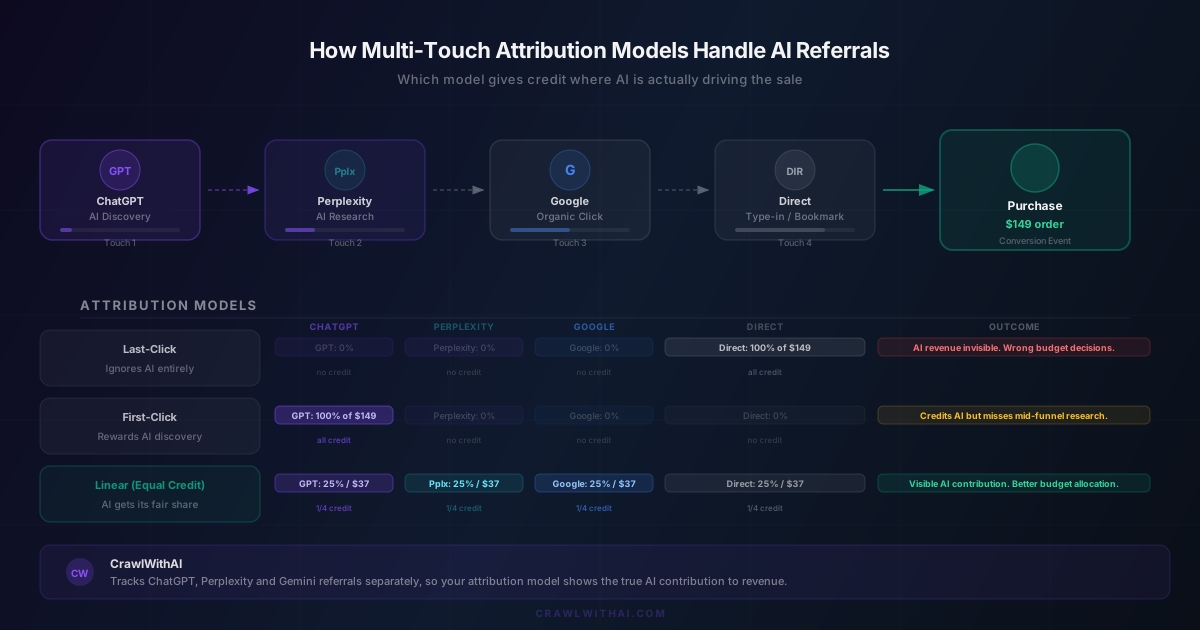
Today, a customer asks ChatGPT which running shoes are best for flat feet, reads a Perplexity comparison of the top three brands, clicks through to your Google Shopping result, closes the tab, then types your domain directly into the browser three days later. Your analytics records: one direct session, one order. The AI that started the whole journey gets nothing. You cut your AI content budget. The cycle repeats.
What Multi-Touch Attribution Actually Means
Attribution is how you assign revenue credit to the marketing touchpoints a customer encountered before buying. Single-touch models (first-click, last-click) pick one winner. Multi-touch models spread the credit across every touchpoint.
The challenge for Shopify stores in 2026 is that AI platforms, ChatGPT, Perplexity, Gemini and Grok, are now regularly the first or second touchpoint in a buying journey. And most attribution setups cannot see them at all.
According to Salesforce's 2025 State of Commerce report, 17% of consumers used an AI assistant to help them research a product purchase in the previous 30 days. That number was under 5% in 2023. Your attribution model probably has not caught up.
How Last-Click Attribution Fails AI Channels
Last-click is the default in most analytics platforms and in Shopify's built-in reporting. The rule is simple: the channel that brought the customer's final session before conversion gets 100% of the revenue credit.
In the scenario above, that means Direct gets full credit. The customer typed your URL. Case closed.
But the customer only knew your URL because ChatGPT mentioned your brand by name. Without that first AI touchpoint, the direct session would never have happened. Last-click cannot represent this because it is structurally blind to everything that happened before the last click.
For AI channels specifically, this is a disaster. AI referrals often do not use UTM parameters, and many AI platforms, especially ChatGPT on mobile, strip referrer headers entirely. So even when a customer does click a link from an AI chat, the session frequently arrives labelled as Direct in Google Analytics 4. The channel gets no credit either way.
Research from Rockerbox published in early 2026 found that stores using last-click attribution underestimated AI-influenced revenue by an average of 52% compared to data from server-side tracking that could actually identify AI platform referrals.
How First-Click Attribution Handles AI Better (But Imperfectly)
First-click flips the logic. Whoever introduced the customer to the brand gets full credit. In the example above, ChatGPT would take 100% of the $149 order value.
This is directionally better. It rewards the AI channel that started the journey and gives you a reason to invest in AI visibility. But it has its own distortions.
First, it ignores every touchpoint after the first one, including organic search and retargeting that may have been essential to closing the sale. A customer might have discovered you via ChatGPT but only converted after reading a detailed Google review. First-click says the review contributed nothing.
Second, first-click does not work if you cannot actually identify the AI referral in the first place. If the ChatGPT session arrives as Direct, first-click still credits Direct. You need a way to identify AI traffic before any attribution model can work correctly.
Linear Attribution: The Model That Treats AI Fairly
Linear attribution splits revenue credit equally across every touchpoint in the path. Four touches, 25% each. This is the model that makes AI channels visible without overstating them.
In the example: ChatGPT gets $37.25, Perplexity gets $37.25, Google Organic gets $37.25, Direct gets $37.25. Every channel that played a role gets recognised.
For Shopify stores that are investing in AI visibility, this matters enormously. If you are creating structured content, writing product descriptions that AI crawlers can parse, and making sure your store appears in ChatGPT answers, you need to see that investment reflected in your revenue reports. Linear attribution shows it. Last-click buries it.
A 2025 analysis by Triple Whale, which processes attribution data for over 15,000 Shopify merchants, found that switching from last-click to linear attribution increased apparent AI channel revenue contribution by 3.8x on average for stores that had AI referral tracking properly set up.
Time-Decay Attribution: Why It Tends to Hurt AI Channels
Time-decay is another multi-touch model that gives more credit to touchpoints closer to the conversion. A session that happened 10 days ago gets less credit than one that happened yesterday.
For AI channels, this model has a structural problem. AI discovery almost always happens early in the journey, often days or weeks before purchase. Time-decay consistently undervalues it. The model rewards retargeting and branded search precisely because they happen close to conversion, not because they were more influential.
If you are building AI visibility for your store, time-decay will make your results look worse than they are. It is worth knowing this before you present attribution data to stakeholders and ask to justify your AI optimisation spend.
Data-Driven Attribution: The Right Destination, Hard to Reach
Google Analytics 4 now offers data-driven attribution as its default model for conversions. It uses machine learning to assign fractional credit based on which touchpoints actually influenced conversion probability, measured across thousands of journeys.
In theory, this is the gold standard. If ChatGPT referrals genuinely increase conversion probability, data-driven attribution will find that pattern and credit the channel accordingly.
In practice, it has two limitations for AI channels. First, it requires a minimum of 400 conversions per month and 400 touchpoints per channel to generate statistically reliable credit assignments. Most Shopify stores do not have that many AI referral sessions yet. Second, and more fundamentally, data-driven attribution can only analyse touchpoints it can see. If your AI sessions are arriving as Direct, they are invisible to the model.
The model can only be as good as the data fed into it.
The Missing Piece: Identifying AI Traffic Before Attribution Can Work
Every attribution model discussed above fails at the same point: unidentified AI traffic. A multi-touch model cannot credit ChatGPT if the ChatGPT session looks like Direct.
There are three ways AI traffic gets lost in standard analytics setups. First, many AI platforms do not pass referrer headers by default, so the session arrives with no source information. Second, chatbot interfaces are not web pages and do not participate in standard click-tracking ecosystems. Third, the link a customer clicks from an AI recommendation often lacks UTM parameters because the AI platform generated the URL, not a marketing team.
This is why stores that want accurate multi-touch attribution across AI channels need to solve the identification problem separately from the attribution model question. If you cannot tag AI sessions correctly on arrival, the choice of attribution model is almost irrelevant.
How CrawlWithAI Solves the Identification Problem
CrawlWithAI approaches this from the other direction. Rather than trying to intercept and tag sessions after they arrive, it monitors when ChatGPT, Perplexity, Gemini and other AI platforms actually reference your store, tracks which brand mentions and product recommendations are driving clicks, and ties that activity to order data in your Shopify store.
This means the identification happens before the session, based on AI platform activity, not after, based on browser referrer headers that may not survive the journey. The result is a revenue attribution layer that shows you how much of your store's income is genuinely AI-influenced, separate from whatever attribution model your analytics platform is running.
For stores switching to linear or data-driven attribution in GA4, having a clean signal on AI-influenced orders means the multi-touch model actually has the right touchpoints to work with. You get the benefit of a more accurate model and the identification layer that makes it possible.
If you have already read our post on why last-click attribution misses most AI-driven revenue, the logical next step is building out a multi-touch model that can actually represent the full journey, including the AI touchpoints your current setup cannot see.
FAQ
Which attribution model should Shopify stores use in 2026? Linear attribution is the most practical starting point if you are investing in AI visibility. It credits every touchpoint equally and makes AI channels visible without requiring hundreds of conversions to generate statistically meaningful weights. Once your AI referral volume is high enough, data-driven attribution in GA4 can refine the picture further.
Can Google Analytics 4 track ChatGPT referrals automatically? Not reliably. GA4 can identify sessions that carry a referrer header from a known AI domain, but many AI platforms, especially ChatGPT on mobile apps, do not pass referrer headers at all. Those sessions arrive as Direct and are invisible to GA4 regardless of attribution model.
Does multi-touch attribution require more setup than last-click? GA4 offers linear and data-driven models in the Attribution settings panel, so switching models is straightforward. The harder work is ensuring AI traffic is correctly identified before it hits your attribution model, which requires a layer beyond standard analytics.
Why does time-decay attribution consistently undervalue AI channels? AI discovery happens early in the buyer journey, days or weeks before purchase. Time-decay gives less credit to earlier touchpoints. These two facts combine to make AI channels look less valuable than they are in time-decay models, even when AI was the channel that first introduced the customer to the brand.
If my store gets most traffic as Direct, is AI likely a hidden factor? Almost certainly yes for any store that appears in AI recommendations. Customers who discover a brand via ChatGPT or Perplexity often navigate back directly, typing the URL or searching by brand name, which shows up as Direct or Branded Search rather than the AI platform that introduced them.
Sources
- Salesforce State of Commerce Report 2025: https://www.salesforce.com/resources/articles/state-of-commerce/
- Rockerbox AI Attribution Analysis 2026: https://www.rockerbox.com/blog/ai-attribution-shopify
- Triple Whale Multi-Touch Attribution Study 2025: https://www.triplewhale.com/blog/multi-touch-attribution
- Google Analytics 4 Attribution Documentation: https://support.google.com/analytics/answer/10596866