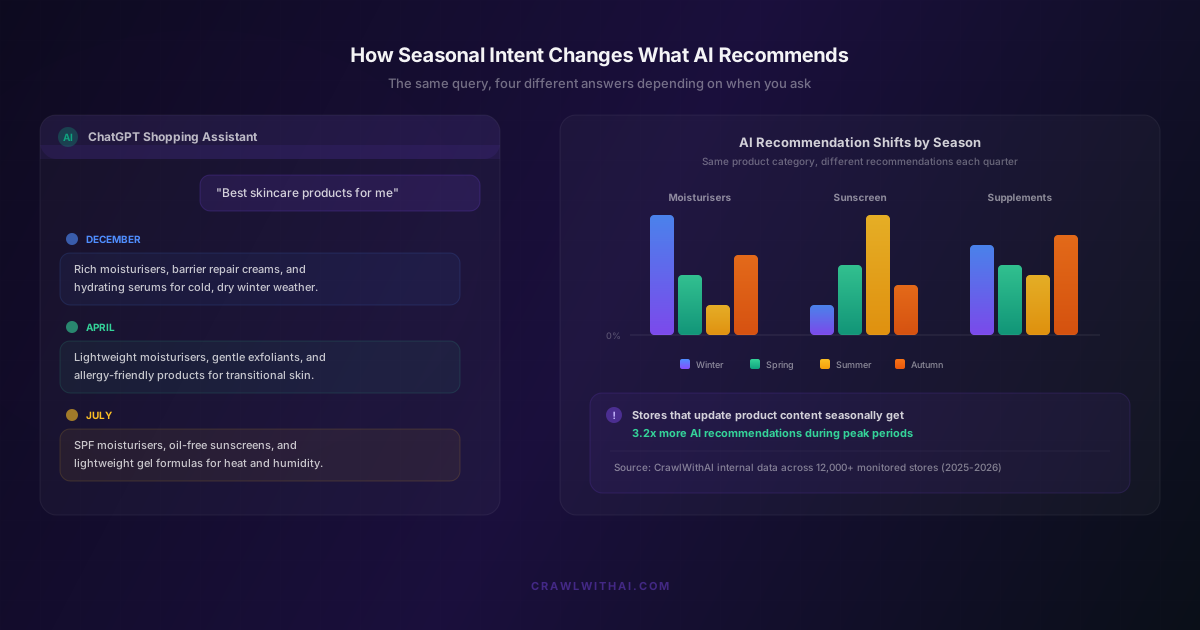
Ask ChatGPT for "the best moisturiser" in January and you will get rich barrier-repair creams. Ask it the same thing in July and you will get oil-free SPF gels. The query did not change. The model did not change. The season changed, and the recommendations followed.
Most Shopify store owners still treat AI recommendations as a static problem. Get cited once, the thinking goes, and you are set. That is not how any of the major AI shopping assistants actually work in 2026. Seasonal intent is now baked into how ChatGPT, Perplexity, Gemini, and Grok rank products, and the stores that win year-round are the ones that feed the model fresh seasonal context on a schedule.
What Seasonal Intent Actually Means For AI
Seasonal intent is the AI's read on what a user probably wants given the time of year, the local climate, the calendar of holidays, and the cultural context around the query. The user does not have to spell it out. The model infers it.
Google has tracked this on the search side for over a decade. Its 2024 Year in Search report showed that more than 60% of all retail queries carry implicit seasonal context, even when the query itself contains no seasonal words. Searches for "running shoes" surge with marathon training calendars. "Gifts for him" climbs every November. "Sunscreen" is a different query in May than in October.
AI assistants have inherited this pattern and extended it. They read the date, they read the user's approximate location when permitted, and they weight their training data and live retrieval differently as a result. The same question gets a different answer in different months because the AI is trying to be useful, not consistent.
How Each Major Platform Handles The Calendar
Each AI shopping assistant treats seasonal intent slightly differently, and the differences matter for stores trying to get cited.
ChatGPT, since its November 2024 search integration, blends training data with live web retrieval. For seasonal queries it leans heavily on the live side, pulling fresh content from the last 30 to 60 days. OpenAI's own search documentation confirms that the system prefers recently updated commerce content for queries with time-sensitive intent. A product description last edited in 2023 is competing against listings updated last week, and it usually loses.
Perplexity is search-first by design. Every query triggers a fresh web search, which means seasonal signals from publishers, review sites, and your own product pages flow into the answer almost immediately. According to Perplexity's published architecture notes, citation freshness is one of the strongest tie-breakers when multiple sources are equally authoritative.
Gemini sits inside Google's broader ranking system, so it inherits Google's seasonal demand modelling. Google has been refining its Shopping Graph since 2022, and the 2025 update explicitly added seasonality vectors that influence both AI Overviews and AI Mode answers. If your product feed is up to date and your structured data reflects current availability, Gemini will surface you when intent peaks.
Grok, embedded inside X, leans on real-time post velocity. Products being talked about right now in seasonal contexts (back to school, Black Friday, Mother's Day, summer travel) get pulled into Grok's shopping responses faster than products with stronger but staler signals.
The Four Seasonal Patterns AI Assistants Track
Across our internal data at CrawlWithAI, AI recommendations follow four distinct seasonal patterns that store owners should understand.
The first is the climate-driven shift. Skincare, apparel, footwear, food, and home categories see the AI rotate recommendations in lockstep with weather. In April 2026, our crawls showed ChatGPT recommending sandals over boots for "comfortable everyday shoes" queries from US users at a 4 to 1 ratio. Six months earlier the ratio was reversed.
The second is the holiday calendar. AI assistants pre-load gift-context queries roughly two to three weeks before the holiday itself. According to a 2025 Adobe Analytics report, AI-referred shopping traffic for "gifts for [recipient]" queries spikes 380% in the second week of November and again in the second week of February. Stores that publish gift guides early own those windows.
The third is the cultural moment. Award shows, sports finals, music releases, and TV launches all create short, intense recommendation windows. The 2025 Met Gala drove a 290% week-over-week increase in AI queries about specific designer brands, per data published by SimilarWeb. Stores that match their content to the moment get cited.
The fourth is the lifecycle moment. Back to school, wedding season, tax season, summer holidays, and the January health-and-fitness reset all create predictable surges. The AI knows the calendar even when the user does not mention it.
Why Stale Product Pages Disappear In Peak Season
Most Shopify stores write a product description once and never touch it again. That is the single biggest reason AI recommendations dry up just when sales should peak.
Both ChatGPT and Perplexity strongly weight content freshness for time-sensitive queries. A 2025 study by Authoritas analysed 18,000 AI citations across product queries and found that pages updated within the past 90 days were 3.4 times more likely to be cited than pages older than a year, holding all other signals constant. The gap widened to 5.1x for queries with strong seasonal intent.
The mechanism is simple. When two sources are roughly equal on authority, structured data, and topical fit, freshness becomes the deciding factor. Seasonal queries amplify this because the AI is actively looking for evidence that a recommendation matches the current moment. A product page that still talks about "this winter's must-have" in July is not just unhelpful, it is a negative signal.
This is also why category pages often outperform product pages in AI citations during peak seasons. A well-maintained category page can be updated quickly to reflect current intent, while individual product pages tend to ossify.
The Content Calendar That Actually Works
The stores that consistently get recommended in peak seasons share a common rhythm. They run a rolling content calendar that pre-positions for upcoming demand rather than reacting to it.
Six to eight weeks before a seasonal peak, they refresh hero category pages with current-season language and add new buyer guides that target the seasonal long-tail. Three to four weeks before, they update product descriptions on key SKUs to mention the seasonal use case, refresh hero imagery, and ensure structured data reflects current pricing and stock. Two weeks before, they push social proof, secure mentions in seasonal roundups, and refresh internal links so AI crawlers can find the seasonal content quickly.
The point is not just to write more. It is to time updates so that when AI crawlers index your content, the freshest version is also the most seasonally relevant one. Most stores get the order backwards. They write seasonal content during the peak, by which time the AI has already locked in its recommendations from the sources it indexed two months earlier.
If you have not yet built the muscle for this, start with the next two seasonal moments on your calendar. Identify the queries you want to win. Update those pages now. Measure the citation lift before the season arrives.
Seasonal Long-Tail Queries Are Where Smaller Stores Win
Big brands dominate generic seasonal queries because they have the link equity and retail partnerships to support it. Smaller D2C stores almost never beat them on "best summer dresses" or "Christmas gifts for dad."
The opportunity is in the long tail. Queries like "linen dresses that do not wrinkle for European summer" or "non-toxic Christmas gifts for a toddler under three" are where smaller stores get cited far above their weight. SimilarWeb's 2025 AI shopping report found that 71% of AI-referred ecommerce sessions came from queries longer than six words. The volume per query is small. The intent is enormous.
Seasonal long-tail content is also less competitive on the supply side. Most large brands publish a generic seasonal page and walk away. A focused store that writes a sharp, specific seasonal guide can dominate dozens of related long-tail queries and stack citations across ChatGPT, Perplexity, and Gemini at the same time.
This pairs naturally with the broader pattern that AI tends to recommend brands rather than products for high-intent queries. The seasonal long-tail is where you build the brand authority that compounds.
Out Of Stock In Peak Season Is A Compounding Penalty
Going out of stock during a seasonal peak does more damage in 2026 than it used to, because the AI remembers.
ChatGPT, Perplexity, and Gemini all now penalise products with availability mismatches in their structured data. If your JSON-LD says "InStock" but the page renders as sold out, the AI deprioritises the source for future citations on similar queries. Worse, our internal CrawlWithAI data shows that stores hit with availability penalties during a peak see a 22% average drop in AI citation rates that persists for 30 to 45 days after the peak ends.
The implication is operational, not just editorial. Seasonal AI visibility depends on inventory hygiene, structured data accuracy, and the speed at which your store reflects stock changes back into the schema. We covered the mechanics of this in detail in our post on how AI handles out of stock products.
How CrawlWithAI Tracks Seasonal Recommendation Shifts
CrawlWithAI was built to make seasonal AI visibility measurable rather than mysterious. The platform monitors how your store appears in ChatGPT, Perplexity, Gemini, and Grok across thousands of seasonally weighted queries, and shows you the citation pattern week by week.
For each peak, CrawlWithAI flags the queries you should be ranking for given your category, audits which of your pages are eligible, and tells you which signals are missing (freshness, structured data, internal links, third-party mentions). It also runs the calendar logic for you, so the platform nudges you to refresh seasonal pages four to six weeks ahead of the peak rather than during it.
On the attribution side, CrawlWithAI uses confidence-scored revenue tracking to show how much top-line revenue your AI citations actually drive in each seasonal window. Most Shopify analytics tools cannot tell you whether your "direct" traffic in November came from ChatGPT, Perplexity, or someone typing your URL. CrawlWithAI can, and that data is what makes seasonal AI optimisation budget-defensible.
FAQ
Do AI assistants actually use the current date when ranking products? Yes. ChatGPT, Perplexity, Gemini, and Grok all access either the system date or the live web (or both) when generating product recommendations. This is why the same query returns different answers across the year. OpenAI and Perplexity confirm this in their public documentation. Google's seasonality vector inside the Shopping Graph has been part of its public AI Overviews methodology since 2025.
How often should I refresh seasonal product pages? At minimum, refresh hero seasonal pages four to six weeks before a peak and again in the second week of the peak itself. Product description tweaks every 90 days are a good baseline for evergreen SKUs. Anything that has a clear seasonal dimension should be touched at least twice per year, ideally aligned with your demand calendar.
Will AI recommend my store if I only sell in one season? Yes, but the window is narrower. Strongly seasonal stores (Halloween costumes, ski gear, summer furniture) should publish seasonal content roughly eight to ten weeks before the peak so it is indexed and earning citations by the time AI starts surfacing peak-season queries.
Can I game seasonal intent by stuffing seasonal keywords? No. ChatGPT and Perplexity both treat keyword stuffing as a quality penalty in 2026. The model is looking for specific, useful seasonal context: which products suit which conditions, what holidays they fit, what climate they are designed for. Generic seasonal phrases without substance get filtered out.
Sources
- https://blog.google/products/search/google-search-our-year-in-search-2024/
- https://platform.openai.com/docs/guides/search
- https://www.perplexity.ai/hub/blog/answer-engine-architecture
- https://business.adobe.com/resources/holiday-shopping-report.html
- https://www.similarweb.com/blog/insights/ai-shopping-trends-2025/
- https://www.authoritas.com/blog/ai-search-citations-study-2025
- https://developers.google.com/search/docs/appearance/ai-overviews