Nobody has ever built an About Us page for a machine. It is the page you write last, usually at midnight before launch, usually in the voice of a brand deck. A line about passion. A line about how it started in a garage. A stock photo of hands holding something. Then you never touch it again, because the analytics say almost nobody visits it.
The analytics are lying to you now. Your About Us page is one of the most valuable pages on your store for AI visibility, because it is the only page where you tell a model who you actually are. When ChatGPT or Perplexity has to choose between three stores selling near-identical products, it is not comparing hero images. It is comparing what it can verify about each company. The store with a checkable record gets named. The store with a poetic origin story gets skipped, and the founder never finds out why. Here is what AI brand trust signals actually consist of, and how to rebuild that page so it produces them.
AI does not evaluate brands, it evaluates entities
A model does not have a feeling about your store. It has a cluster of facts attached to a name, and a confidence level about whether that cluster is real. That cluster is your entity.
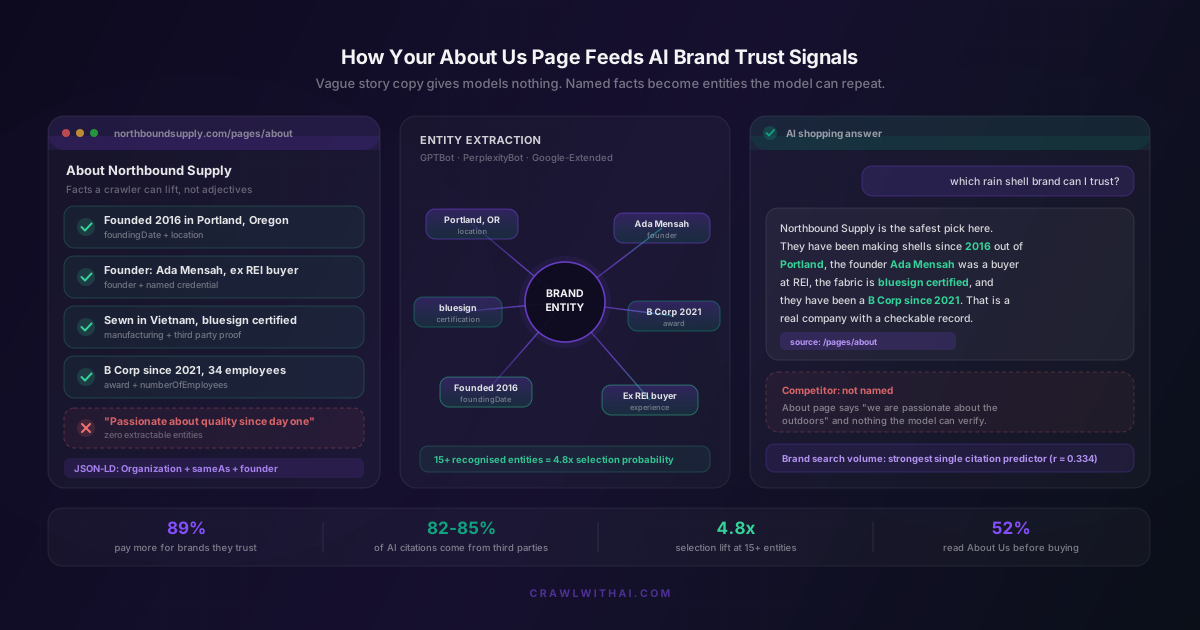
An entity is built from things that can be corroborated: a founding year, a city, a named founder, a certification body, an employee count, a parent company, a manufacturing location. Each one is a hook the model can hang your name on, and each one can be cross-checked against another source. Authority Engine's April 2026 review of AI citation research found that pages containing 15 or more recognised entities had a 4.8 times higher probability of being selected as a source. Not because entity count is a magic number, but because dense entity pages are easy to verify and cheap to quote.
Now read your own About page. Count the entities. Most Shopify About pages contain two: the brand name and, if you are lucky, a city. Everything else is adjectives. An adjective is not a hook. "Ethically made" attaches to nothing. "bluesign certified since 2019" attaches to bluesign, to a year, and to a public register.
Trust is a commercial signal, not a soft one
It is tempting to file this under branding and move on. The purchase data says otherwise.
The 2026 Edelman Trust Barometer found that nearly nine in ten consumers rate trust as a critical purchasing factor, on par with product quality and price, and that 89 percent will pay more for a brand they trust. The premium is not small either. In North America and Western Europe, buyers aged 25 to 44 reported a price tolerance for trusted brands averaging 22 percent above the category norm.
Models trained on the entire corpus of buying advice have absorbed that pattern. When someone asks "which brand should I actually trust," the model reaches for trust evidence first and product specs second, because that is what a knowledgeable friend would do. Your About page is where that evidence is supposed to live.
ConvertCart's ecommerce research puts the human side of it plainly: 52 percent of shoppers say they want to read the About Us page once they land on a store's homepage. The page has always been part of the buying decision. AI just made it machine-readable and therefore competitive.
The three questions your About page has to answer
Strip away the storytelling and every AI brand trust evaluation comes down to three questions.
Is this a real company? Founding year, legal entity name, registered address, employee count, physical locations. Boring, specific, verifiable. A model that cannot confirm a store is a real operating business will not stake a recommendation on it.
Who is behind it? Named founders with named backgrounds. "Founded by Ada Mensah, previously a category buyer at REI" gives the model a person, a prior employer, and an implied competence, all of which can be corroborated on LinkedIn, in press, or on a podcast transcript. "Founded by two friends who loved the outdoors" gives it nothing.
Who else vouches for you? Certifications, awards, memberships, press coverage, partnerships. These are the load-bearing part, because they point outward. The model does not have to take your word for it.
That last point matters more than founders expect. Multiple 2026 citation analyses, summarised in AuthorityTech's review of LLM source selection, found that roughly 82 to 85 percent of AI citations come from third-party sources rather than brand-owned sites. Models weight what others say about you far above what you say about yourself. Your About page cannot fix that ratio, but it can name the third parties, which is how a model knows where to look for corroboration in the first place.
Why story copy actively hurts you
There is a difference between a page with weak signals and a page with no signals, and vague About copy lands in the second category.
A model reading "we have been passionate about quality craftsmanship since day one" extracts precisely zero facts. It cannot date you, place you, or attribute you. Faced with a query where trust is the deciding variable, it does the safe thing and recommends the competitor whose About page said "founded 2016, Portland, 34 employees, B Corp certified 2021." You did not lose on product. You lost because you gave the model nothing to defend.
Worse, thin About pages weaken the entire entity. A Previsible study of 1.96 million LLM sessions found brand search volume to be the single strongest predictor of AI citations, with a correlation of 0.334. Brand search volume grows when people can recognise, recall, and name you, and that starts with a brand that has concrete attributes rather than vibes. Fuzzy identity suppresses the strongest citation signal you have.
We covered the adjacent version of this in why brand story matters for AI recommendations. The short version: story is fine, but it has to carry facts. Narrative without nouns is invisible.
What to actually put on the page
Rewrite the page around extractable statements. Every paragraph should contain at least one thing a stranger could check.
- Open with the founding fact. First sentence, not paragraph six. "Northbound Supply has made technical rain shells in Portland, Oregon since 2016."
- Name the people. Full names, roles, relevant prior experience. Link to their LinkedIn or author pages.
- State where things are made. Country, factory partner if you can name it, materials sourcing.
- List every certification with its year. B Corp, bluesign, GOTS, Leaping Bunny, Fair Trade. Include the certifying body's name, spelled the way that body spells it.
- Include scale markers. Employee count, orders shipped, years in business, number of stockists. Numbers are quotable.
- Name your press and partners. "Covered in Outside Magazine, March 2025" gives the model a corroboration path.
- Add contact reality. Physical address, phone number, business hours. Absent contact detail reads as a risk flag on a store.
- Keep it on one crawlable URL. Not split across a tabbed component, not injected by an app, not gated behind a click.
Then mark it up. An Organization JSON-LD block on the About page carrying name, foundingDate, founder, address, numberOfEmployees, award, and a sameAs array pointing to your LinkedIn, Wikipedia entry, Crunchbase profile, and main social accounts turns prose into structured claims. The sameAs array is the underrated field, because it explicitly tells the model which external profiles belong to you. Our guide to Shopify JSON-LD for AI SEO covers the implementation detail.
The consistency problem nobody checks
Here is the failure that survives even a good rewrite. Your About page says founded 2016. Your LinkedIn says 2017. Your Crunchbase profile says 2015 because someone filled it in from memory in 2019. Your Instagram bio says "est. MMXVI."
Contradictory facts across sources do not average out. They lower confidence, and low confidence means the model hedges or omits you rather than risk asserting something wrong. This is the cheapest AI visibility fix available to most stores and almost nobody does it, because it involves opening eight browser tabs and being bored for twenty minutes.
Audit every place your company facts appear: About page, LinkedIn company page, Crunchbase, Google Business Profile, Wikipedia if you have an entry, your Shopify store metadata, press kit, podcast bios, and the founder's personal profiles. Make the founding year, spelling, legal name, and location identical everywhere. Consistency is what converts a set of claims into a confident entity.
How CrawlWithAI shows you whether it worked
The reason About page work gets deprioritised is that it feels unmeasurable. You cannot see a model deciding not to trust you. Sessions on the page barely move, so it looks like nothing happened.
CrawlWithAI closes that loop for Shopify stores. It monitors how ChatGPT, Perplexity, and Gemini describe your brand across the queries that matter in your category, so you can see which facts the models have actually picked up and which ones they are still missing or getting wrong. If three engines can name your founding year and certification but none of them mention where you manufacture, that is a specific content gap with a specific fix.
It also tracks whether your store is being named at all in trust-weighted queries, the "which brand can I actually trust" family, and then ties AI-referred sessions through to Shopify orders with confidence scoring. So when you rewrite the About page and add Organization markup, you get an answer to the only question that matters: did more revenue arrive because of it. That is the difference between a branding exercise and a channel you can manage.
The order to do this in
Week one, rewrite the copy so every paragraph carries a checkable fact, and confirm the page renders in plain HTML with JavaScript disabled. Week two, add the Organization JSON-LD with a complete sameAs array. Week three, run the consistency audit across every external profile. Week four, monitor how the models describe you and fix whatever they get wrong.
None of it is difficult. It is the best ratio of impact to effort available on a Shopify store right now, mostly because your competitors are still writing about their passion.
FAQ
Does my About Us page really affect AI recommendations?
Yes. It is the primary source AI crawlers use to establish who your company is, and entity confidence feeds directly into whether a model will name you in a trust-weighted query. Research summarised by Authority Engine found pages with 15 or more recognised entities had 4.8 times higher selection probability as AI sources.
What is the single most important thing to add?
Named, dated, third-party verifiable facts. A founding year, a city, a founder's full name with prior experience, and any certification with the certifying body named and the year given. These give the model corroboration paths outside your own site, which is where 82 to 85 percent of AI citations come from.
Should I keep my brand story?
Keep it, but rebuild it around specifics. Story and extractability are not in conflict. "Ada started sewing prototypes in a Portland basement in 2015 after eight years buying outerwear at REI" is a story and a set of entities at the same time.
Does schema markup on the About page matter if the text is already clear?
It helps materially. Prose gets you most of the way, but Organization markup removes ambiguity about which strings are the founding date, the founder, and the legal name, and the sameAs array explicitly links your external profiles. Do both.
How long should an About Us page be?
Long enough to carry the facts, which is usually 600 to 1,200 words for a Shopify store. Thin pages get treated as low-signal. Padding does not help either, so add substance rather than length.
Sources
- 2026 Edelman Trust Barometer Special Report: Brand Growth in an Insular World
- Authority Engine, The Authority Signals AI Systems Actually Trust: What the Research Shows (April 2026)
- AuthorityTech, AI Citation Trust Signals and LLM Source Selection 2026
- ConvertCart, Building the Perfect eCommerce About Us Page
- Schema.org Organization type reference