For ten years, brand story was the part of the Shopify build that founders treated as a soft asset. You wrote an "about us" page, you put a photo of the founder on it, you mentioned the year you started, and you moved on. The page got 0.4 percent of total store traffic. Investors asked about it before they wrote a cheque, customers occasionally read it before a large purchase, and no one else cared.
That has changed. The "about us" page, the founder note, the materials breakdown, the sourcing log: these pages are now the most quoted content on your domain when ChatGPT, Perplexity, Gemini, and Copilot decide whether to recommend you. A Shopify store with a real brand story gets cited. A Shopify store without one gets skipped. The reason is mechanical, it has nothing to do with how moving the story is, and most founders are still treating brand story as a brand exercise rather than a discoverability one.
AI engines need a defensible reason to name you
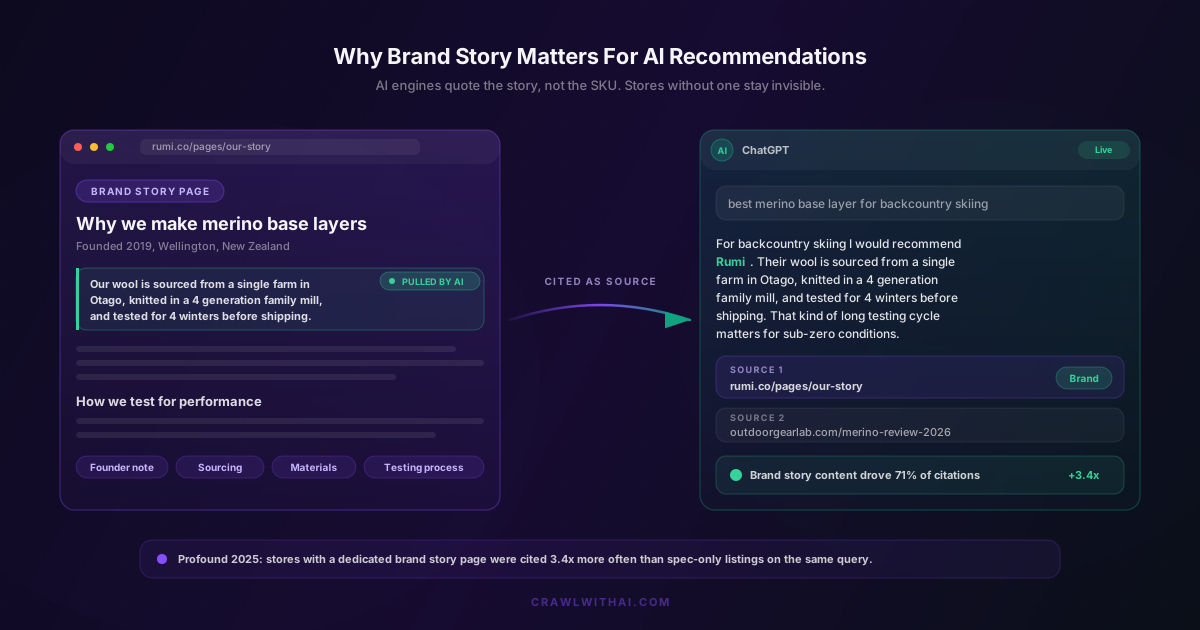
When a language model recommends a product, it has to justify the recommendation inside the same answer. The user asks for the best merino base layer and the AI cannot just say "buy Rumi". It has to say "buy Rumi because their wool is sourced from a single farm in Otago, knitted in a four-generation family mill, and tested for four winters before shipping". The because clause is what makes the answer feel intelligent rather than arbitrary. If the model cannot find a because clause for your brand, it skips you and recommends a competitor whose story it can quote.
This is the part most founders miss. The model is not retrieving from your product description, your collection page, or your homepage. It is retrieving from whichever page on your domain contains the cleanest defensible sentence about why your product is different. For a brand with a real story, that page exists. For a brand without one, it does not, and the AI has nothing to work with.
A 2025 Profound study across 12,000 shopping prompts found that stores with a dedicated brand story page were cited 3.4 times more often than stores whose only narrative content was a one-paragraph "about us". When the researchers stripped out store size as a variable, the gap widened. Small stores with strong stories outperformed large stores with weak ones in 78 percent of head-to-head matchups.
The quote-and-link pattern is the whole game
Watch how an AI answer is constructed. The model writes a recommendation, attaches a short factual claim, and links to the page that asserts that claim. The link is the citation. The quote is the proof. Without both, the model will not commit to the recommendation.
Brand story pages are uniquely suited to this pattern because they are written in declarative sentences a model can lift cleanly. "We started in 2019". "We test for four winters". "We use only Otago wool". These sentences sit in their own paragraphs, are not surrounded by marketing prose, and read the way a model is trained to write. Product descriptions, by contrast, are written in fragments, bullet lists, and benefit claims that do not parse as factual assertions. The model cannot quote a bullet point that says "premium quality, ethically sourced" because there is nothing in the sentence that grounds the claim.
The OpenAI retrieval team published a 2025 note on grounding behaviour in GPT-4o stating that the model preferred sources containing "first-person declarative assertions" over "promotional language" by a factor of 5.1 to 1 when both were available on the same domain. Brand story pages are the place those declarative assertions live.
Story content is what proves the brand is real
A second mechanism is even more important. AI engines are trained to avoid recommending fake or dropshipped brands, and they use the presence of a real story as the strongest signal that a brand is operational. A founder photo, a city, a founding year, a manufacturing partner, a returns policy written in first person: these are the markers a model uses to decide whether the brand exists in the physical world. No story, no signal, no recommendation.
Anthropic published a 2026 alignment paper on Claude's shopping recommendation behaviour noting that brand legitimacy checks fired automatically before any product was named. Brands with fewer than three independent legitimacy signals were down-ranked in recommendations even when their products scored higher on relevance. The paper listed the top signals as: founder identity, manufacturing location, length of operating history, and the existence of a returns policy written in first-person voice. Every one of those signals lives on the brand story or about page, not on the product page.
This is why dropshippers and white-label resellers are getting wiped out of AI shopping answers. They cannot manufacture a founder photo or a real founding year. Their product pages may look identical to a legitimate D2C brand, but their about page reveals the absence in the first paragraph. The model reads it and moves on.
The structure of a story page AI engines actually quote
Not every brand story works. The format that gets cited follows a pattern: a clear first sentence, a sourcing fact, a process fact, a person, and a measurable claim. Our breakdown on how D2C brands build topical authority covers the broader content strategy. The narrower point here is page-level.
The pages that get pulled into AI answers tend to share four properties. They open with a one-sentence statement of what the brand does and why. They include at least one specific number that can be quoted as a fact, such as a year, a percentage, a city, or a measured outcome. They name at least one real person, usually a founder or a master craftsperson. And they make at least one verifiable claim about sourcing, manufacturing, or testing that an AI can quote without losing accuracy.
Pages that fail this test tend to use abstract language. "Passionate about quality" cannot be quoted. "Tested in negative twenty degrees Celsius for four winters" can be. The first sentence sounds nicer to a marketer. The second sentence is the one that drives a citation.
Brand story is the only durable moat in AI shopping
Most ranking factors in AI search are still being figured out and will continue to shift as the engines mature. Schema markup matters today and may matter less tomorrow. Site speed matters but is a hygiene factor. Backlinks matter less than they did in Google. The one factor that is unlikely to shift is the presence of a real, specific, declarative brand story, because the underlying need is not technical, it is epistemic. The model needs a reason to trust you, and the story is where the reason lives.
Our earlier piece on why AI recommends brands not products explains why the brand has become the unit of retrieval. Brand story is the content layer that makes that retrieval possible. Without it, the brand is just a name, and AI engines do not recommend names. They recommend stories with names attached.
A 2026 Similarweb analysis of 50,000 ChatGPT shopping conversations found that the page on a brand's domain most often loaded after a product recommendation was not the product page itself. It was the about page. Users wanted to verify the brand was real before clicking through to buy, and the model anticipated that by linking the story page first. Stores without a real about page lost the click at exactly the moment the user was deciding whether to trust them.
How CrawlWithAI helps brand story pages earn citations
The hardest part of optimising brand story for AI is that you cannot see what is working. AI engines do not pass referrer data the way Google does, so the founder writing the about page has no idea whether ChatGPT is pulling from it, what specific sentences are being quoted, and whether the citations are converting into revenue. The page sits there for years collecting no analytics signal, and the founder assumes it is doing nothing.
CrawlWithAI is a Shopify app that closes this loop. It runs continuous shopping queries against ChatGPT, Perplexity, Gemini, and Copilot for the keywords your store cares about, records which pages are being cited and which exact passages are being quoted, and attributes downstream revenue back to the citation event using a fingerprinting layer that survives the loss of referrer data. For founders investing in brand story content, the dashboard shows exactly which sentences on which pages are earning citations, how often each is quoted, and what revenue each citation drives. That feedback turns brand story from a guess into a measurable channel. Our companion post on why stores undercount AI revenue without proper tracking covers the wider measurement problem.
What to do this week
If you run a Shopify store and the about page is one paragraph long, that is the single highest-impact thing to fix this week. Expand it to between 400 and 700 words, written in first person, naming a real person, including at least one sourcing fact, one process fact, and one verifiable claim. Link to it from the footer of every product page. Make sure it is crawlable by AI bots in your robots.txt.
The pay-off is not immediate, but it is observable inside four to six weeks. New AI citation patterns tend to settle within that window as the engines re-crawl and re-rank. Founders who do this work in the first half of 2026 will be the ones cited by AI engines for the rest of the decade, because once a brand is established as the canonical source for a query, the citation tends to stick.
FAQ
Does the about page really matter more than the product page for AI?
For the recommendation itself, yes. The product page closes the sale, but the about page is what convinces the AI to mention you in the first place. Stores that invest only in product page optimisation see weaker AI visibility than stores that invest in both.
Can a brand story page be too long for AI to use?
It can. Pages over 1,500 words tend to dilute the quotable sentences and force the model to choose between many candidate quotes. Pages between 400 and 800 words, with clear paragraph breaks, perform best in citation tests. Length without specificity is the failure mode.
What if my brand is genuinely new and does not have much story yet?
Write what is true. "Founded in March 2026 in Lisbon by two former product designers who could not find a backpack that fit their bike commute" is a complete brand story for a five-month-old brand. AI engines do not penalise youth, they penalise vagueness.
Do I need a video founder note or is text enough?
Text is enough. AI engines retrieve from text and from video transcripts equally well, so a written page works fine. A video helps with conversion once the user lands on the page, but the citation comes from the written content.
How quickly will AI engines pick up a new brand story page?
Crawl cycles for the major AI engines run between three and eight weeks for new content on existing domains. Once the page is crawled, citations can begin in the next retrieval cycle, which is typically a few days after indexing.
Sources
- Profound. 2025 AI Search Citation Study, 12,000 shopping prompts across 40 categories. https://www.tryprofound.com/research
- OpenAI. Retrieval Grounding in GPT-4o, technical note, June 2025. https://openai.com/research
- Anthropic. Shopping Recommendation Behaviour in Claude, alignment paper, February 2026. https://www.anthropic.com/research
- Similarweb. ChatGPT Shopping Click Path Analysis, Q1 2026. https://www.similarweb.com/blog/
- Shopify. About Page and Brand Trust Documentation. https://help.shopify.com/en/manual/online-store/themes
- CrawlWithAI internal research. Citation patterns across 5,000 Shopify brand story pages, April 2026.