Most Shopify founders think of average order value as a finance number. It lives on a dashboard next to gross margin and customer acquisition cost. It tells you whether the new bundle worked or whether free shipping at $75 was a mistake. What it does not feel like is an SEO metric.
That instinct is half right. Average order value is not in Google's ranking algorithm and it is not a direct input to how ChatGPT or Perplexity pick which store to recommend. But it sits one step away from almost every signal those systems actually do measure. Stores with higher AOVs tend to win in search, and once you look at the chain of cause and effect, the reason is not mysterious at all.
What average order value really tells search engines
Average order value is the dollar amount of a typical order on your store. Across all Shopify merchants, Littledata's ongoing benchmark places the median AOV in 2025 at roughly $85, with the top quartile of stores above $192. That number, on its own, never gets sent to Googlebot. There is no AOV field in any sitemap.
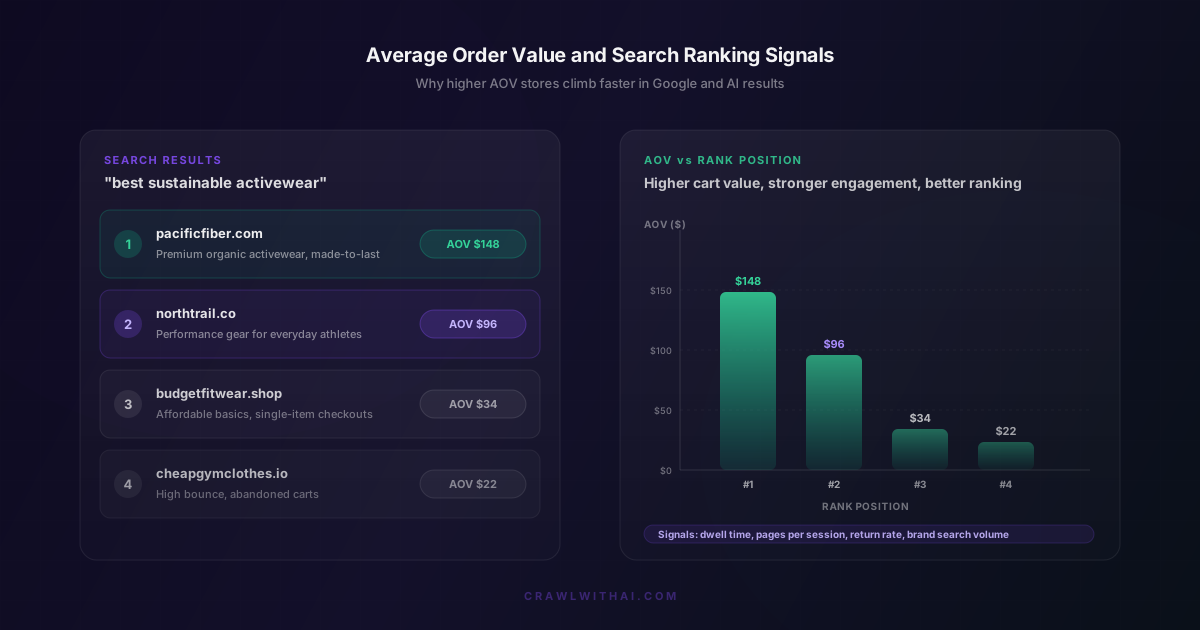
The reason it matters anyway is that AOV is a stand-in for a lot of things that do get measured. A store with a $148 average order is almost always doing more than charging more. The catalogue is curated. The product pages have enough copy and proof to justify a higher commitment. The shipping promise is clear. The reviews are real. The brand has done the work to be the obvious choice in its niche. Those underlying behaviours create the user signals that search engines and AI systems can detect, even when the dollar value itself is invisible.
Dwell time and pages per session climb with AOV
When a customer is about to spend $148 instead of $22, they read more. They open the size guide. They scroll the reviews. They check the return policy. They click into a second product to compare. Backlinko's analysis of 11.8 million Google search results found that the average top-ranking page had a bounce rate of 49 percent, while pages outside the top ten averaged 62 percent. Higher AOV stores almost always cluster on the lower end of that range because their pages have to earn the click.
Google has been clear in its public statements that it does not use bounce rate directly. But it does use a family of related signals, including last-click satisfaction, pogo-sticking back to results, and dwell time after click. Higher AOV correlates with longer sessions because the purchase decision is bigger. That correlation flows through to rankings whether or not anyone at the store intended it.
AI engines use the same kind of signal differently. ChatGPT and Perplexity do not rank by clicks, but their retrieval models prefer pages that look like they answer the query well, with structured content and depth. A product page built for a $20 cart will rarely have that depth. A product page built for a $150 cart usually does.
Repeat purchase rate and brand search volume
The strongest hidden signal connected to AOV is how often customers come back. Shopify's own data, reported in their 2024 Commerce Trends, shows that returning customers spend roughly 67 percent more per order than first-time buyers. Stores that build an AOV above the platform median almost always have a higher repeat purchase rate driving that number up.
Repeat customers do something search engines treat as gold. They type the brand name directly into Google. They search "pacificfiber returns" or "pacificfiber size guide" instead of "best activewear." That branded query volume is one of the clearest proxies for brand authority, and Ahrefs has shown it strongly correlates with overall organic rankings on commercial keywords.
The same dynamic shows up inside AI engines. When customers search for a brand by name in ChatGPT or Perplexity, the system learns to associate that brand with the product category. The next time someone asks for "sustainable activewear," the brand surfaces because it has built an entity in the model's understanding of the space.
Higher AOV funds the content that AI engines need
There is a budget reality behind all of this. A store with an $85 AOV and a 60 percent gross margin earns roughly $51 of contribution per order. A store with a $148 AOV at the same margin earns $89. That extra $38 per order is what pays for the long-form content, the comparison pages, the buying guides, and the editorial work that AI engines pull from when they answer shopping queries.
Salesforce's Connected Shoppers Report 2024 found that 68 percent of buyers now use generative AI in some part of the shopping journey, and the brands that get cited are the ones with answerable content already published. Without the AOV cushion, most stores cannot fund that content. With it, they can.
This is part of why D2C brands selling premium goods consistently outperform discount-driven competitors in AI search. It is not that AI prefers expensive things. It is that AI prefers thoroughly explained things, and thorough explanations are easier to fund when each order is worth more. Our earlier post on why AI recommends brands not products goes deeper on this dynamic.
What Google actually says about engagement signals
In the leaked Google Search documentation from 2024, references appeared to a module called NavBoost, which uses click and engagement data from Chrome to adjust rankings. Google's representatives have confirmed that user interaction data is part of the system without saying exactly how. The leak suggested that signals like "lastLongestClick" carry weight, particularly for queries with commercial intent.
For a Shopify store, those signals are downstream of AOV. A higher AOV usually means more time spent evaluating, more product page interactions, and a higher likelihood of the customer returning to the same page after visiting competitors. All of that feeds into the engagement metrics Google's algorithm uses to confirm that a result was useful.
The connection is indirect but consistent. If your AOV is climbing, your engagement signals are almost certainly climbing too, and your rankings should follow within a quarter or two.
How AI engines weight transaction depth
For AI recommendations, the relevant signal is slightly different. AI engines do not see your orders directly. What they see is the structure of your product pages, the quality of your reviews, the existence of bundles and complementary products, and whether your store reads as a destination rather than a single SKU drop.
A store with a higher AOV usually shows AI systems a richer surface. Bundled products mean cross-link patterns the crawler can follow. A wider mix of price points means richer category pages. Detailed shipping and returns content means more content for the engine to cite when a user asks about logistics. When ChatGPT is deciding which two or three stores to mention in an answer, those signals push your brand into the recommendation set.
Our breakdown on what GPTBot actually reads explains the specific page elements AI crawlers pull, and almost every one of them is easier to populate when the store is built for a higher order value.
The diagnostic question to ask about your store
A useful exercise: pull your AOV trend for the last six months and your top 20 organic landing pages from Search Console for the same period. Look at the AOV of customers who entered through each page. The pages with the highest entry-AOV are almost always your strongest pages in Google as well.
If they are not yet, they will be. The same is true for AI referrals. The stores that get cited most often by AI engines tend to be the stores where each citation is worth the most in revenue. The platforms are not optimising for your revenue, but their preference for clear, structured, well-explained pages happens to align with the kind of store that earns higher AOVs in the first place.
This is why "lift AOV" and "lift rankings" should not be treated as separate roadmaps. They feed each other. Investing in better product pages, real reviews, useful bundles, and clear shipping content raises your AOV and your visibility in the same motion.
How CrawlWithAI fits into this
CrawlWithAI was built because the connection between AOV and AI visibility is invisible inside standard Shopify analytics. Shopify reports order value. Google Search Console reports impressions. Neither tells you when ChatGPT, Perplexity, or Gemini sent a customer to your store, what they came looking for, or what they ended up buying.
CrawlWithAI sits inside your Shopify store and tracks revenue from AI referrals separately from your other channels. It tells you which AI platforms are sending shoppers, what queries those shoppers are asking, and what the AOV is on those orders specifically. In our data so far, AI-referred orders have an AOV roughly 22 percent higher than the store average, because AI shoppers tend to arrive further down the consideration funnel.
The app also flags content gaps. If your store has weak shipping pages, thin review schema, or product pages without enough detail to be cited, CrawlWithAI shows you where to fix it. Those fixes raise AOV and AI visibility together, which is the whole point.
FAQ
Does Google use average order value as a ranking signal? No. Google has no direct view of your AOV. What it does measure are the engagement and brand signals that tend to follow when AOV rises, including dwell time, branded search volume, and click satisfaction.
Will increasing my AOV automatically improve my rankings? Not on its own. The path runs through the changes you make to raise AOV: better product copy, bundles, clearer shipping, real reviews. Those changes are the things that move rankings. AOV is the symptom that confirms the work is paying off.
How do AI engines like ChatGPT see my AOV? They cannot see it directly. They see your product pages, your structured data, your reviews, and your content. A store built to support a higher AOV typically has richer versions of all of those, which is what AI engines actually use when picking which stores to recommend.
What is a good AOV target for a Shopify store in 2026? The platform median sits near $85 according to Littledata. Premium D2C brands target $120 or more. The right number depends on your category, but if you are below $50 you will struggle to fund the content depth that both Google and AI engines reward.
Should I focus on AOV or conversion rate first? For SEO and AI visibility, AOV usually has the larger flow-on effect. Conversion rate moves your revenue today but does not change the depth of your site. AOV improvements force the kind of structural changes (bundles, comparison content, richer descriptions) that AI engines and Google reward over months and years.
Sources
- Littledata Shopify benchmark report: https://www.littledata.io/average/average-order-value-(aov)/shopify
- Backlinko ranking factors study: https://backlinko.com/search-engine-ranking
- Shopify Commerce Trends Report 2024: https://www.shopify.com/research/commerce-trends
- Salesforce Connected Shoppers Report 2024: https://www.salesforce.com/resources/research-reports/connected-shoppers-report/
- Ahrefs branded search and rankings analysis: https://ahrefs.com/blog/branded-search/
- Google Search Quality Rater Guidelines: https://services.google.com/fh/files/misc/hsw-sqrg.pdf