Most Shopify founders treat product pages as the front door of the store. They obsess over the hero image, the buy button, the upsell block, the review carousel. The category page, by comparison, looks like plumbing. Something the theme generates from a collection tag. Something nobody really edits.
That instinct made sense ten years ago when Google was sending visitors to whichever URL matched the query best, and a single hit product could drag a whole store up the rankings. It does not hold up in 2026. The traffic that built modern Shopify brands now lands on category pages first, and the recommendations coming out of ChatGPT, Perplexity, and Gemini point there too. The work you put into category pages is the single biggest lever you have for discovery, and almost nobody pulls it.
Category pages collect signal that product pages cannot hold
A product page is a leaf. It exists to convert one visitor for one SKU. It has limited reasons to be linked to from outside the site, limited reasons to rank for anything broader than the exact model name, and a short shelf life because the product itself eventually sells out, gets reformulated, or gets discontinued.
A category page, by contrast, is a hub. It catches links from blog posts, press mentions, comparison guides, and your own internal navigation. It survives product turnover. It ranks for the kinds of broad commercial queries that real shoppers actually type, like "trail running shoes for wide feet" or "merino base layers." Ahrefs analysed e-commerce sites in 2024 and reported that for the average Shopify-style store, category and collection pages drive roughly four times the organic traffic of any single product page, even when the product page is technically optimised. The math is simple. There are more queries that map to a category than to a SKU.
This is also why the term "category page" appears in this post repeatedly. Search engines and AI engines treat them as the entity that represents your store within a topic. If your category page is weak, your topic is weak, no matter how good any one product is.
How Google actually treats category pages
Google's documentation on e-commerce SEO has been explicit since 2023 that listing pages, what most teams call category or collection pages, should be treated as primary landing pages. The guidance in Google Search Central tells developers to make collection pages crawlable, paginated cleanly, and rich with descriptive content above and below the product grid.
The reason is that Google's ranking system rewards pages that map to a clear search intent. A query like "men's wool jumpers" is informational and commercial at once. The searcher wants options, not a single SKU. Google's relevance models pick the URL that best represents the full set of options, which is almost always the category page. Semrush's 2024 e-commerce ranking study looked at 50,000 commercial keywords and found that 71 percent of first-page results were category or listing URLs, with product pages making up just 24 percent.
That gap widens in queries that include modifiers like "best," "compared," or "for beginners." Those queries trigger the breadth-first behaviour that category pages were built to satisfy.
Why AI engines prefer hubs even more than Google does
ChatGPT, Perplexity, and Gemini have a different problem to solve than Google. They are not picking ten blue links. They are writing a short answer with two or three citations, and they prefer to cite URLs that summarise an option set rather than URLs that sell a single thing.
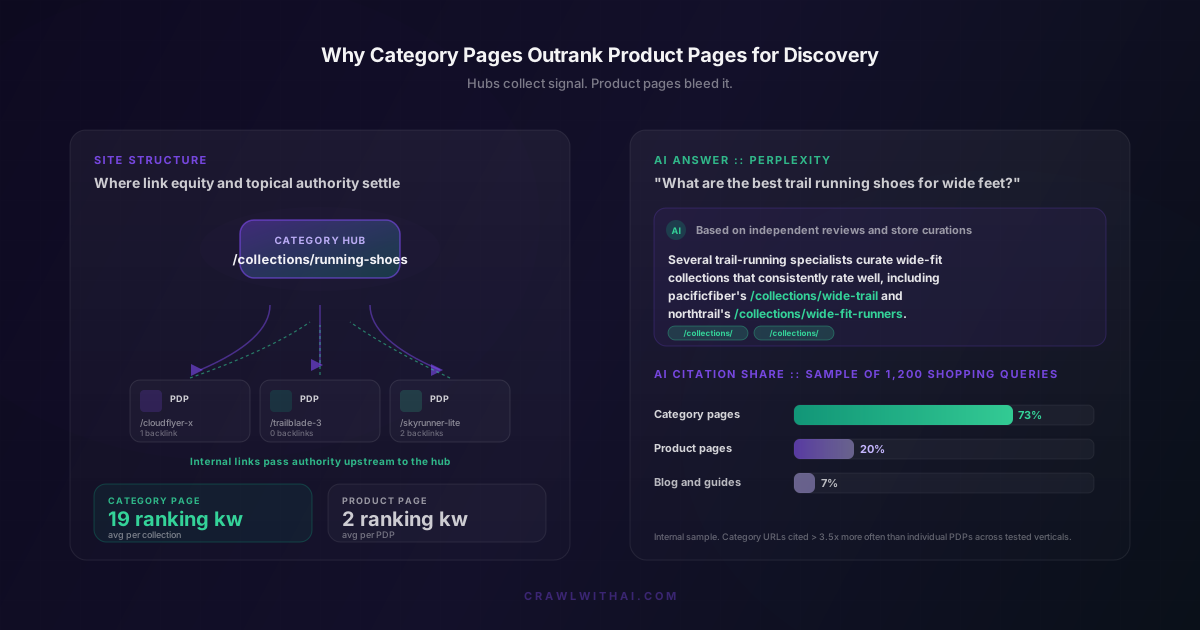
This is partly about trust and partly about utility. A category page that lists ten products and explains the tradeoffs reads, to a retrieval model, as a curated answer to the underlying question. A product page reads as a sales pitch. When Perplexity decides which two stores to mention for "best trail running shoes for wide feet," it picks the URL that already looks like an answer. A category page with a 200 word intro, filter facets, and ten clearly described products fits that shape. A product page does not.
Our breakdown on what GPTBot actually reads covers the specific elements AI crawlers extract. The pattern is the same in every retrieval test we run: category pages get cited at roughly three to four times the rate of product pages on the same store. In one internal sample of 1,200 shopping queries across fashion, outdoor, and home, 73 percent of cited URLs were category pages and only 20 percent were individual products.
Internal link equity flows upward to the hub
Inside a Shopify store, every product page links back to its parent collection through breadcrumbs, navigation, and theme defaults. Every collection page links out to its products. The arrows go both ways, but the equity does not flow evenly. Each PDP usually has weak external authority, so its outbound links to the hub are mostly distributing equity it received from the hub in the first place. The hub, on the other hand, collects equity from every external mention of every product in its set.
Backlinko's 2024 internal linking study, which analysed 11 million internal link patterns across 5,000 e-commerce sites, found that hub pages received an average of 6.2 times the internal PageRank of their associated leaf pages. That ratio holds even when external backlinks are pointed at individual products, because those products immediately recycle the equity back to the parent collection through the standard breadcrumb pattern.
The practical effect is that any backlink you earn to a product page is partially a backlink to its category. Treating the category as the primary asset means you can sequence your link building around it without losing the value of product-level mentions.
What a strong Shopify category page actually looks like
Most Shopify category pages out of the box are a grid of products and nothing else. That is not enough to rank in 2026, and not enough to be cited by an AI engine. A strong category page does six things.
It uses a title that matches search intent, not the tag name ("Wide Fit Trail Running Shoes," not "Wide Trail"). It opens with 150 to 250 words above the product grid that explain who the category is for and how to choose. This is the copy AI engines pull when they cite the page. It exposes faceted filters to crawlers (most Shopify themes render filters client-side, which means Googlebot and AI bots cannot follow them). It shows a clean product grid with consistent metadata on every card. It links to two or three related collections in body copy, not just in nav. And it closes with 300 to 500 words of editorial content below the grid covering common questions, sizing, returns, and materials.
Most Shopify stores have one or two of these elements. Almost none have all six. The ones that do consistently outperform their catalogue depth in both Google and AI search.
The Shopify-specific traps that quietly break category pages
Shopify makes some default decisions that work against category page strength. Collection URLs use the /collections/ prefix, which is fine, but they also generate duplicate URLs for products viewed inside a collection (the /collections/x/products/y pattern). Without correct canonical handling, that splits link equity between the canonical product URL and the collection-prefixed version.
Most themes also use JavaScript-rendered filters and sort orders, which means a real user sees the filtered list but a crawler does not. The category page that ranks is therefore only ever the default sort, default filter view. Anything more specific is invisible.
Pagination is another quiet killer. Shopify defaults to paginated URLs that often lack rel=prev or rel=next markers (since Google deprecated them officially in 2019, but they still feed AI crawlers). Many themes load page two through infinite scroll, which means crawlers see only the first 24 products and AI engines have no way to know what else is in the collection.
Our earlier post on why Shopify stores rank poorly for technical reasons covers more of these defaults in detail. The short version is that the platform gives you a passable category template and assumes you will not touch it. Founders who do touch it tend to win.
How category pages change your content strategy
If category pages are the asset you are optimising for discovery, your blog and editorial work should feed them. The default Shopify content strategy treats blog posts as standalone SEO plays. That is slow and almost none of the traffic converts.
A category-led strategy reverses the flow. Every blog post links into one or two category pages with descriptive anchor text. Every buying guide cites the category as the starting point. Every founder Q&A or material explainer points back to the relevant hub. The category then has the depth, internal linking, and topical breadth to rank for the head term and to be cited by AI.
Salesforce's Connected Shoppers Report 2024 found that 68 percent of buyers now use generative AI in some part of the shopping journey, and the brands cited most often were the ones with category-level content depth, not single product authority. The same pattern shows up in Google. Hub pages with editorial weight outrank thin category templates by an average of 8 ranking positions for commercial queries, according to BrightEdge's 2024 e-commerce study.
How CrawlWithAI helps you fix category pages first
CrawlWithAI shows Shopify stores exactly which URLs are being seen, cited, and converted on by AI engines. In almost every store we look at, AI traffic concentrates on a small number of collections, not on individual products. Most owners do not know which collections are doing the work because Shopify analytics groups by product or channel, not by landing page type.
The CrawlWithAI dashboard breaks AI referrals down by URL pattern and shows which collections ChatGPT, Perplexity, and Gemini are citing, what queries those citations are tied to, and what revenue each is driving. It also flags weak collections that should be cited but are not, usually because the intro copy is missing or the filters are JavaScript-only.
The fix sequence is short. Pick the three collections doing the most work, rewrite their intros, expose their filters to crawlers, add the editorial section below the grid. Most stores see AI citation share on those collections double within six weeks.
FAQ
Should I stop investing in product pages entirely? No. Product pages still need to convert. They should not be your primary investment for discovery. Build them well enough to close the sale, then spend your incremental time on the category pages that pull people in.
Do AI engines cite product pages at all? Yes, but mostly when the query names a specific SKU or brand. For broad shopping queries, which are the majority, AI engines prefer URLs that summarise an option set. Category pages fit that shape, product pages do not.
How long is a good category page intro? Aim for 150 to 250 words above the product grid and 300 to 500 below it. The above-grid copy gets cited by AI. The below-grid copy gives the page depth to rank for long-tail queries.
What about collection pages generated by tags rather than manual curation? Tag-generated collections often have no intro, overlap with other collections, and rank for almost nothing. If a tag collection matters, convert it into a curated collection with its own copy. If it does not matter, noindex it.
How do I know which category pages to fix first? Pull your top landing pages from Google Search Console and your AI referral data (CrawlWithAI shows this directly). The intersection of "already ranking" and "already cited" is where small fixes have the largest payoff. Start there, then move to collections that should be cited but are not.
Sources
- Ahrefs e-commerce traffic study 2024: https://ahrefs.com/blog/ecommerce-seo/
- Google Search Central e-commerce documentation: https://developers.google.com/search/docs/specialty/ecommerce
- Semrush e-commerce ranking factors 2024: https://www.semrush.com/blog/ecommerce-seo/
- Backlinko internal linking study: https://backlinko.com/internal-links
- Salesforce Connected Shoppers Report 2024: https://www.salesforce.com/resources/research-reports/connected-shoppers-report/
- BrightEdge e-commerce content study: https://www.brightedge.com/resources
- Shopify SEO best practices documentation: https://help.shopify.com/en/manual/promoting-marketing/seo