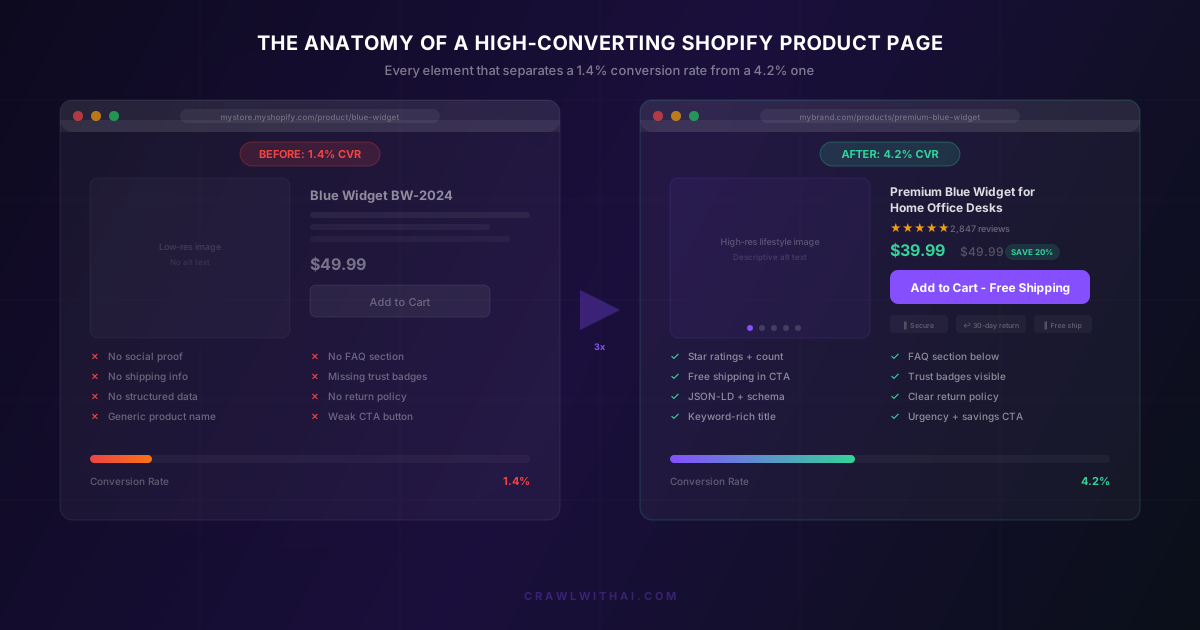
The average Shopify store converts at 1.4%. That means for every 100 visitors who land on a product page, roughly 99 of them leave without buying anything. Most store owners blame their ads, their pricing, or their niche. But the real problem is almost always the product page itself.
A study by Baymard Institute found that 69.99% of online shopping carts are abandoned, and the majority of those abandonments happen because of issues that exist right on the product page: unexpected costs, lack of trust, poor information architecture. The good news is that every one of these problems is fixable. The stores that fix them consistently hit conversion rates of 3.5% to 5%, which is a completely different business at the same traffic level.
The Product Title Is Doing More Work Than You Think
Most Shopify store owners treat their product title like an internal SKU label. "Blue Widget BW-2024" tells a warehouse worker what to pick. It tells a customer nothing.
A high-converting product title does three things at once. It describes what the product is, who it is for, and what makes it different. "Premium Ergonomic Desk Organiser for Home Offices" beats "Desk Organiser DO-450" every time, not just for humans but for search engines and AI systems too.
According to Salsify's 2025 Consumer Research report, 87% of shoppers say product content is extremely important when deciding to buy. The title is the first piece of content they read. If it does not immediately communicate value, the rest of the page barely matters.
Your title also shows up in Google Shopping results, AI recommendations, social shares, and browser tabs. It is the single most visible piece of text attached to your product. Write it like a headline, not a filing code.
Product Images That Actually Sell
Shopify lets you upload up to 250 images per product. Most stores use three. And those three are usually shot on a phone against a bedsheet.
The stores converting above 3% almost always have five or more images per product, and they follow a consistent pattern: hero lifestyle shot, product on white background, close-up of materials or texture, product in use, and a size or scale reference. Shopify's own merchant data from 2025 showed that products with five or more images convert 2.4x higher than those with one or two.
Alt text matters here too, and not just for accessibility. Google uses alt text for image search indexing. AI crawlers like GPTBot use it to understand what a product looks like and what it does. If your alt text says "IMG_4521.jpg" you are invisible to every discovery channel that matters. Write descriptive, keyword-aware alt text for every image. If you want a deeper look at how this works, read our post on how image alt text affects both Google and AI product discovery.
Pricing Psychology and the Compare-At Price
Showing a price by itself gives the customer no anchor. They have nothing to compare against, so they default to comparing against competitors.
Shopify has a built-in "compare at" price field. Using it correctly is one of the simplest conversion lifts you can make. A product priced at $39.99 with a crossed-out $49.99 next to it communicates a deal without requiring a discount code or a sale banner. According to research published in the Journal of Consumer Research, anchoring effects increase purchase intent by 15 to 30% depending on the category.
High-converting pages also break the price into smaller units when appropriate. "$1.33 per day" feels different from "$39.99 per month" even though the math is the same. Subscription D2C brands have figured this out. Everyone else should too.
The Call-to-Action Button Nobody Reads Carefully Enough
"Add to Cart" is fine. It is also generic, forgettable, and says nothing about what happens next.
The highest-converting Shopify stores modify their CTA button text to include a value proposition. "Add to Cart, Free Shipping" outperforms "Add to Cart" alone. "Buy Now, 30-Day Guarantee" outperforms "Buy Now." According to a 2024 study by VWO, CTA buttons that include a secondary benefit see an average 14.6% increase in click-through rate.
Button colour matters less than contrast. The CTA should be the most visually prominent element above the fold. If your "Add to Cart" button is the same shade as your navigation links, it is not working hard enough. Make it impossible to miss.
Also, consider what sits directly below the button. High-converting pages place trust signals immediately underneath: a lock icon with "Secure Checkout," a return policy snippet, accepted payment icons. These micro-reassurances address the fear that kicks in right at the moment of commitment.
Social Proof: Reviews, Ratings, and Real Numbers
A product page without reviews feels like a restaurant with no customers. People notice the absence.
Baymard Institute found that 95% of online shoppers read reviews before making a purchase decision. The key metric is not just the star rating but the review count. A product with a 4.3-star average across 2,800 reviews converts better than one with a perfect 5.0 across 12 reviews. Volume signals legitimacy. Imperfection signals honesty.
Display your review count and star rating directly below the product title, above the fold. Do not hide reviews in a tab at the bottom of the page. Shopify apps like Judge.me and Loox make this easy to implement, but the default placement matters more than the app you pick.
If your store is new and you do not have reviews yet, use other forms of social proof: "1,200 units sold this month," press mentions, or a real customer photo with a quote. Something is always better than nothing.
Structured Data and the Hidden Conversion Engine
Structured data does not directly change what a customer sees on your product page. But it changes what Google and AI platforms see, and that determines whether customers ever arrive at your page in the first place.
Product schema markup tells Google to show your price, availability, and star rating directly in search results. Pages with rich snippets get 20 to 30% more clicks than plain blue links, according to a 2024 analysis by Search Engine Journal. That is a meaningful conversion improvement that happens before anyone even lands on your site.
For AI systems, structured data is even more critical. When ChatGPT, Perplexity, or Gemini try to recommend products, they pull information from pages that clearly communicate what the product is, how much it costs, whether it is in stock, and what customers think of it. Without structured data, your product page is a wall of unstructured HTML that AI crawlers struggle to parse.
Shopify outputs some JSON-LD by default, but it is usually incomplete. You need to verify that your product pages include the full Product schema with properties like name, description, brand, offers (price, currency, availability), and aggregateRating. Our post on how structured data markup changed e-commerce SEO covers the technical implementation in detail.
Page Speed: The Silent Conversion Killer
Every second of load time costs you roughly 7% of conversions. That is not a metaphor. It is a well-documented finding from research by Portent, confirmed repeatedly across e-commerce studies.
A Shopify product page that takes 4 seconds to load on mobile is losing nearly 30% of potential buyers before they even see the product. The fix is usually straightforward: compress your images, remove unused apps and scripts, use a modern theme built on Online Store 2.0, and test with Google PageSpeed Insights.
We covered this in depth in our Shopify store speed checklist, but the short version is this: if your Largest Contentful Paint is above 2.5 seconds, you are leaving money on the table every day. High-converting stores treat speed as a product feature, not a technical afterthought.
How CrawlWithAI Makes Your Product Pages Work Harder
You can build the perfect product page with beautiful images, compelling copy, and flawless structured data. But if AI platforms cannot find your store, you are missing an entire channel of discovery.
CrawlWithAI makes sure your Shopify store is visible to the AI systems that increasingly drive purchase decisions. It optimises your pages so that when someone asks ChatGPT, Perplexity, or Gemini for a product recommendation, your store shows up in those answers. And it tracks the revenue that comes from AI referrals, so you can see the actual return on your investment.
The product page elements we covered in this post, descriptive titles, structured data, reviews, clear policies, all feed directly into how AI platforms evaluate and recommend products. CrawlWithAI helps you audit these signals and close the gaps that keep your store out of AI recommendations.
If you have already done the work of building great product pages, CrawlWithAI makes sure that work gets rewarded across every discovery channel, not just Google.
FAQ
What is a good conversion rate for a Shopify product page? The average Shopify store converts at about 1.4%. Stores that optimise their product pages consistently hit 3% to 5%. Top performers in some niches reach 6% or higher. If you are below 2%, your product pages almost certainly have fixable issues.
How many product images should I use on Shopify? Five or more. At minimum, include a hero shot, a white background image, a close-up, a lifestyle shot showing the product in use, and a scale reference. Shopify data shows that products with five or more images convert 2.4x higher than those with fewer.
Does page speed really affect conversion rates? Yes. Every additional second of load time reduces conversions by about 7%. A 4-second load time on mobile means you are losing roughly 30% of potential buyers before they see the product. Target a Largest Contentful Paint under 2.5 seconds.
Should I use "Add to Cart" or something different for my CTA button? Test variations that include a secondary benefit. "Add to Cart, Free Shipping" or "Buy Now, 30-Day Guarantee" consistently outperform the generic "Add to Cart" in A/B tests. The key is pairing the action with a reassurance.
How does structured data affect my product page conversions? Structured data does not change the visible page, but it enables rich snippets in Google (showing price, ratings, and availability in search results) and helps AI platforms understand your product for recommendations. Pages with rich snippets get 20 to 30% more clicks from search.
Sources
- Baymard Institute, Cart Abandonment Rate Statistics 2025: https://baymard.com/lists/cart-abandonment-rate
- Salsify, 2025 Consumer Research Report: https://www.salsify.com/resources/report/2025-consumer-research
- VWO, CTA Button Optimization Study 2024: https://vwo.com/blog/cta-button-optimization
- Portent, Site Speed and Conversion Rate Study: https://www.portent.com/blog/analytics/research-site-speed-hurting-everyones-revenue.htm
- Search Engine Journal, Rich Snippets CTR Analysis 2024: https://www.searchenginejournal.com/rich-snippets-ctr/