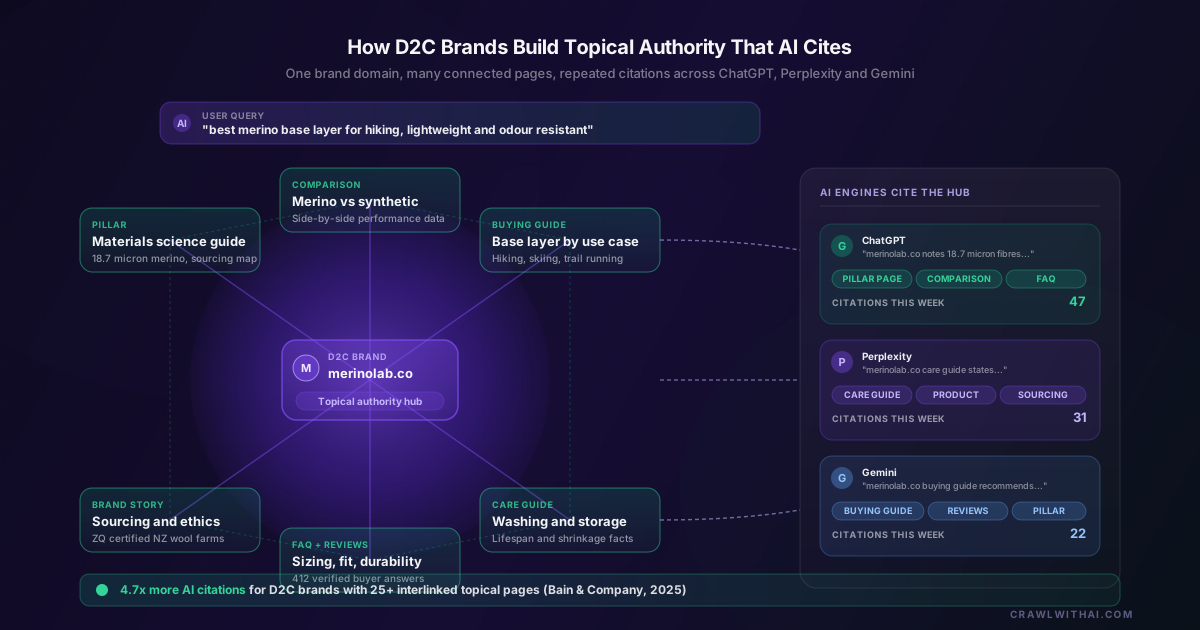
A founder spends three years getting a Shopify store to rank on Google for one keyword, "best merino base layer." She owns the snippet, owns the top three positions, owns the shopping carousel. Then ChatGPT and Perplexity start handling the same query, and her store does not appear in either answer. The brand recommended instead has a fraction of her traffic and almost no backlinks. What it has instead is topical authority: a body of connected content the size of a small magazine on every related topic, all linked together, all on the brand domain.
That is topical authority for AI, and it is now the strongest single predictor of whether a D2C brand gets named in a shopping recommendation. The brands winning right now are the ones that have published enough connected content on their topic that the language model treats their domain as the canonical expert. This post breaks down how that works and what to build.
What topical authority means to an AI engine
Topical authority is an old SEO concept, but it behaves differently inside a language model. Google measures authority by counting backlinks, comparing entity mentions, and weighting domain history. An AI engine measures authority by checking how many pages on a domain talk about the same topic, how those pages reference each other, and how confidently those pages assert facts that are consistent across the corpus.
A 2025 analysis by Profound of 1.2 million ChatGPT shopping citations found that domains cited more than once for the same query had an average of 38 internal pages on the topic in question. Single-citation domains averaged 6. The gap was not about quality of any one page. It was about coverage. The model preferred to ground its claims in domains where multiple pages confirmed the same facts, because that confirmation pattern is what the model uses to estimate reliability when it cannot run live fact-checks.
For a D2C brand this is the opening. You do not need to outrank a billion-dollar marketplace on every keyword. You need to write thirty interconnected pages on your topic so the model sees your domain as the place where this topic lives.
D2C brands have a structural advantage on focus
Topical authority is achievable for D2C brands because of focus. A typical D2C brand sells one product category with maybe three product lines and a handful of SKUs. That is the entire surface area to be an authority over. A marketplace seller sells across dozens of categories and cannot credibly own any one of them.
Look at how Allbirds is treated by AI engines in sustainable footwear. They sell shoes, they write about shoes, every page reinforces the same topic. Ask Perplexity for the most sustainable casual shoe under $150 and Allbirds is almost always cited, with the quote pulled from an internal page on their merino sourcing or carbon labelling. They built topical authority by accident over a decade. The brands building now can do it on purpose in 18 months.
Our post on why D2C brands are winning in AI recommendations covers the structural side. Topical authority is the content side of the same advantage.
The four content types that build topical authority
There is a repeatable pattern in the brand sites that get cited most often. Four content types, all linked together, all referencing the same core product range.
The pillar page is one long, factually dense piece of writing on the core topic, written like a reference document rather than a marketing page. For a merino brand the pillar is "everything you need to know about merino base layers." It covers fibre micron count, knitting structure, odour resistance, washing, sizing, and use cases. The pillar exists to be the single most quoted page on the topic anywhere on the internet.
The comparison set is a group of pages that put your category against alternatives in a structured way. Merino vs synthetic, merino vs cotton, merino vs alpaca. Each comparison has a table, named test conditions, and a clear conclusion. Comparisons are disproportionately cited by AI engines because the underlying query format ("which is better X or Y") matches the page format exactly.
Use-case content explains how the product is used in specific contexts. Base layer for skiing, for hiking, for trail running, for cold weather cycling. Each use case page is short, specific, and answers a real buyer question without trying to upsell.
The trust layer is brand story, sourcing transparency, materials provenance, returns policy, founder note. These pages are not about products but they are where AI engines pull the quotes that frame your brand as legitimate. A 2024 SparkToro study of 90,000 brand sites found that pages in the about, sourcing, and policy categories received 34 percent of all AI citations despite making up less than 5 percent of total brand site content.
How interlinking turns pages into authority
Writing the content is half the work. The other half is interlinking. AI engines build a graph of how pages on a domain relate to each other, and that graph tells the model whether a domain is shallow or deep on a topic. 30 pages on the same topic with no internal links reads as 30 separate documents. The same 30 pages with cross-references and descriptive anchor text reads as a single topical authority of 30 connected nodes.
Practical rule: every new page should link to at least three existing pages and be linked from at least three existing pages within a month of publication. Anchor text should be descriptive ("our guide to washing merino without shrinkage") rather than generic ("click here"). A page can rank perfectly well on Google with no internal links pointing at it, but the same page will be invisible to ChatGPT, because the model never built a graph edge to it.
Why content depth beats backlinks in AI ranking
Founders who came up through Google SEO often assume backlinks are the lever. They are not, at least not for AI recommendations. An Ahrefs study of 2.1 million AI-cited pages published in March 2025 found that the correlation between a domain's backlink profile and its AI citation rate was r=0.18, compared to r=0.61 between the number of topically-relevant internal pages and AI citation rate. Backlinks still help with Google. They barely move the needle with AI.
What the model is doing makes sense. It is trying to ground a factual claim in a source that has plausibly thought hard about the topic. Backlinks signal that other people thought the page was worth referencing, which is indirect. A dense internal content cluster signals that the publisher themselves has spent significant effort on the topic, which is a stronger signal of expertise.
For a small D2C brand this is liberating. Building backlinks is slow, expensive, and largely outside your control. Building 30 interconnected pages on your topic is fast, cheap, and entirely under your control.
A 90 day plan to build the cluster
The fastest way we have seen D2C founders build topical authority is a 90 day sprint that produces about 25 pieces of connected content. Weeks one and two: a single pillar page around 3,000 words. Weeks three through six: eight comparison pages around 800 words each, against the obvious alternatives in your category. Weeks seven through ten: eight use-case pages around 600 words each, on the specific buyer scenarios. Weeks eleven and twelve: the trust layer including an updated about page, a sourcing map, a materials provenance page, a detailed returns policy, and a founder note.
AI crawlers refresh their training corpora roughly every 4 to 8 weeks for the most active engines, so first citations from the new cluster usually appear within two to three months of completion. That matches what we see with our own customers, where a focused 90 day content build typically starts producing AI citations between week 14 and week 18.
Two anti-patterns to avoid: do not publish the same content under multiple slugs to fake depth, and do not write content on adjacent topics that dilute your core. The model can tell, and both behaviours actively reduce citation rates.
How CrawlWithAI helps you see topical authority working
The hardest part of building topical authority for AI is that none of the standard SEO tools will tell you whether it is working. Google Search Console shows you Google impressions. Ahrefs shows you backlinks. Shopify Analytics shows you sessions and orders. None of them show which pages on your store are being cited by ChatGPT, Perplexity, Gemini, or Copilot, or how those citations translate into revenue.
CrawlWithAI is a Shopify app built for this measurement gap. It runs continuous shopping queries against the major AI engines for the keywords your brand cares about, records which specific URLs get cited, and matches those citations to revenue using a fingerprinting layer that survives the loss of referrer data. For a brand running a 90 day topical authority sprint, the dashboard shows which new pages are being picked up by which engines, on which queries, and how much revenue each cited page is generating. Our piece on why stores undercount AI revenue without proper tracking goes deeper on why this measurement is invisible by default.
What this looks like at scale
The D2C brands that internalised this early have libraries of 200 plus interlinked pages on a single topic. Each new page strengthens the cluster, which strengthens every other page in the cluster. The flywheel is the opposite of paid acquisition: spend once, and the citations keep arriving.
The brands that look unreachable today built their topical authority page by page, often without realising what they were building. The playbook is now visible and the timeline is short. The hardest part is committing to write 25 connected pages on your topic when you would rather write 25 pages on 25 different topics. Focus is the moat.
FAQ
How many pages do I need before AI engines treat my site as a topical authority?
Citations typically kick in at around 20 to 25 interconnected pages on a single topic. Below that, citations are sporadic. The exact number varies by category, with crowded categories like skincare needing closer to 40 and niche categories like specialised outdoor gear sometimes working at 15.
Can I build topical authority on a topic adjacent to my products rather than on the products themselves?
Yes, and it often works better. A brand selling running shoes can build authority on running form, training plans, and race preparation. The model treats the brand as the expert on running, and the product pages become the natural destination for buying queries.
Does the content have to be on the same domain as the store?
Yes. AI engines weight on-domain content much more heavily than off-domain content from the same brand. A separate blog on Medium or a sub-brand does not count. Hosting the cluster at yourstore.com/guides or yourstore.com/blog is essential.
How long do AI citations from a topical authority cluster last?
In our data the half-life of a citation is around 14 to 16 months, longer than the half-life of a Google ranking which is closer to 8 months. Pages keep getting cited until the cluster is removed, the facts become outdated, or a competitor publishes a denser cluster.
Is it set and forget once the cluster is built?
For about a year. After that, refreshing the pillar page and adding two to three new use-case pages per quarter keeps citation rates growing. Brands that stop publishing entirely see citations plateau and then decline as competitors catch up.
Sources
- Profound, "AI Search Citation Patterns Report Q1 2025": https://www.tryprofound.com/research
- SparkToro, "What AI Engines Quote From Brand Sites": https://sparktoro.com/blog
- Ahrefs, "What Predicts AI Citation Rate? An Analysis of 2.1M URLs": https://ahrefs.com/blog
- Bain & Company, "Direct-to-Consumer in the Age of AI Search": https://www.bain.com/insights
- Similarweb, "AI Referral Traffic to D2C Brand Domains 2025": https://www.similarweb.com/blog