Ask ChatGPT for the best running shoe under $200, the best organic cotton t-shirt, the best refillable shampoo, the best four-person tent for car camping. Read the answer. Look at the citations. The brands named are almost always direct-to-consumer brands. The links underneath almost always go to the brand's own site, not Amazon, not eBay, not Etsy, not Walmart.
This is not an accident, and it is not a temporary phase. The structural reasons D2C wins in AI recommendations are baked into how language models retrieve and quote sources. Marketplace sellers can spend more on ads, ship faster, undercut prices, and still lose the citation. For founders running a Shopify store the implication is direct: building your own audience and your own site is no longer just a brand decision, it is a discoverability decision.
The split is bigger than most founders realise
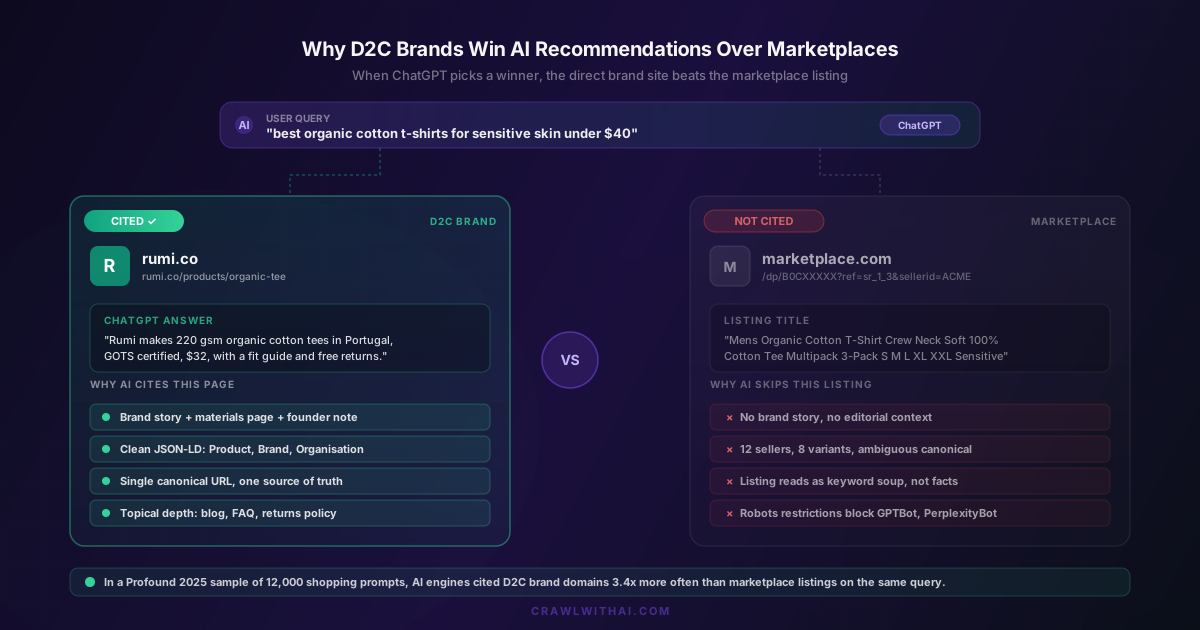
Profound, an AI search analytics platform that tracks citations across ChatGPT, Perplexity, Gemini, and Copilot, published a 2025 retrieval study covering 12,000 shopping prompts across 40 product categories. D2C brand domains were cited 3.4 times more often than marketplace listings on the same query, even when the marketplace listing had higher review counts and stronger price positioning. The gap was widest in considered-purchase categories like skincare, footwear, and home goods, where AI engines pulled from the brand's own product story rather than from the marketplace product detail page.
BrightEdge published a parallel study in early 2026 across 2.5 million AI Overview impressions on Google. Of the top three product results cited inside AI Overviews, 71 percent linked to a brand's owned domain. Only 9 percent linked to Amazon, Walmart, or Target product pages. The remaining 20 percent were split across editorial review sites like Wirecutter and CNET. The pattern repeats across engines because the underlying retrieval logic is similar.
AI engines need a single source of truth and marketplaces fragment it
A language model trying to answer a shopping query needs to ground its claims somewhere. To say "this jacket is waterproof to 10,000mm and weighs 340 grams" the model needs a source that confidently asserts those facts in one place. D2C brand pages do exactly that. A single canonical URL, written by the brand, with materials, weight, performance, and care instructions in one block of text.
Marketplace listings spread the same product across many sellers, many variants, and many duplicate listings. The same waterproof jacket might appear under twelve seller accounts on Amazon, each with slightly different titles, different bullet points, different images, and inconsistent specifications. When a retrieval system has to pick one source, it picks the brand site. The marketplace listing is structurally noisy, even when individual sellers do their best to write clean copy.
The Shopify product detail page is exactly the kind of canonical single-source page AI engines reward. It is one of the few structural advantages a small D2C brand has over a billion-dollar marketplace seller, and most stores are not capitalising on it.
Brand story is content marketplace sellers cannot produce
The second structural advantage is editorial. AI engines pull short factual quotes when they cite, and brand pages are where those quotes live. An "about us" page, a materials page, a founder note, a returns policy, a sustainability statement, a process video transcript. Marketplace listings have none of this. They have a title, a bullet list, and a description, and the description is usually a longer version of the title.
Our earlier post on why AI recommends brands not products explains the underlying behaviour. AI engines treat the brand as the entity and the product as an attribute of the brand. That works for D2C stores because the brand is unified across the catalogue. It fails for marketplace sellers because there is no brand, only a seller account on a platform.
The implication is mechanical. If a brand publishes a 200 word page on how its merino base layer is sourced, washed, and knitted, that page becomes the citation surface for every AI query about merino base layers in its size range. The marketplace seller selling the same SKU cannot publish anything similar, because the marketplace strips long-form content out of listings to keep the catalogue uniform.
Marketplace SEO and AI SEO pull in opposite directions
Marketplace SEO rewards keyword density, review count, and conversion rate. The winning listing is the one that ranks first in the marketplace's internal search, which is usually the listing with the most keyword-stuffed title and the most reviews. That format is poison for AI retrieval. Language models down-weight pages that read like keyword soup, because the patterns those pages exhibit are flagged by safety classifiers as low-quality.
A 2024 Semrush audit of 500,000 Amazon listings against their matching brand site pages found the marketplace listings averaged a Flesch reading score of 42, roughly the readability of a college textbook. The brand pages averaged 64, roughly conversational journalism. AI engines prefer the higher score, both because it parses cleanly and because it matches the register the model is trained to emit. Same product, two pages, opposite retrieval outcomes.
This is why marketplace optimisation experience does not transfer to AI optimisation. The behaviours that win on Amazon actively harm visibility in ChatGPT. A founder who has spent years optimising listings on a marketplace needs to relearn the playbook when they open a Shopify store.
Marketplaces block AI crawlers, brands do not have to
The most underrated reason marketplaces lose AI citations is robots.txt. Most of the large marketplaces aggressively block AI training and retrieval bots. Amazon's robots.txt disallows GPTBot, ClaudeBot, PerplexityBot, and Google-Extended in various combinations across product categories. Etsy and eBay take similar positions. The marketplaces are protecting their data, which is rational, but it means the AI engines cannot read the listings even when they want to.
Shopify stores do not have this problem by default. The default robots.txt allows AI crawlers, and the store owner controls the file. A D2C brand on Shopify can decide exactly which AI engines may read its catalogue and can change that decision at any time. Our breakdown of the Shopify robots.txt settings that block AI crawlers covers the exact checks to run. Most founders do not realise they have this lever at all.
The asymmetry is structural. AI engines retrieve from pages they are allowed to read. The marketplace seller has no control over the marketplace's robots policy. The D2C brand has full control over its own. That is a permanent advantage as long as the marketplaces continue to block.
D2C wins in categories where research matters most
Not every product category is equally affected. Commodity purchases like phone chargers, basic kitchenware, and replacement parts still skew toward marketplace results in AI answers, because the model treats them as fungible and goes to wherever the user is most likely to buy. Considered purchases skew hard toward brand sites.
A 2025 Similarweb analysis of ChatGPT shopping traffic across 50 product verticals found that in categories like skincare, mattresses, supplements, outdoor gear, baby products, and pet food, more than 80 percent of outbound clicks went to brand domains. In categories like USB cables, generic batteries, and printer ink, the same metric was below 30 percent. The dividing line is research intent. Where the buyer wants to understand the product before purchasing, they end up at the brand. Where the buyer just wants the cheapest version of a known commodity, they end up at the marketplace.
For Shopify founders this means category matters more than ever. A D2C brand in a research-heavy category has a structural tailwind from AI. A brand in a commodity category is fighting the current.
How CrawlWithAI helps brand sites win the citation
Most D2C founders know they should be winning AI citations and have no idea whether they actually are. The reason is that the data is not in Google Analytics, not in Shopify Analytics, and not in any standard SEO tool. AI engines do not pass clean referrer data, so AI-driven sessions show up as direct traffic and AI-driven revenue gets misattributed to other channels. The founder thinks the brand is invisible when in fact it is being cited every day.
CrawlWithAI is a Shopify app built specifically for this gap. It runs continuous shopping queries against ChatGPT, Perplexity, Gemini, and Copilot for the keywords your store cares about, records which pages get cited, and matches citation events to revenue using a fingerprinting layer that survives the loss of referrer data. The result is a single dashboard showing exactly which AI engines are recommending your brand, on which queries, and how much money those recommendations are making. For D2C founders who have spent the last decade flying blind on Amazon attribution, having clean numbers on AI revenue is the first time the channel has been measurable end to end. Our post on why stores undercount AI revenue without proper tracking covers the measurement problem in more depth.
What marketplace sellers can actually do about this
If you sell mostly through a marketplace today, the honest answer is that you need a direct site too. Not as a replacement, but as the citation surface AI engines can actually pull from. A simple Shopify store with clean product pages, a real brand story, and an open robots.txt is enough to start showing up in AI answers within weeks. The marketplace listings continue to do their job. The brand site does the job the marketplace cannot.
The brands that figure this out first end up with two channels working together. AI citations drive discovery, the brand site captures the relationship, the marketplace listing closes price-led buyers. Every D2C brand we see growing fastest right now operates this way.
FAQ
Are marketplace listings ever cited by AI engines?
Yes, but rarely, and almost always for commodity products where the buyer wants the cheapest option of a known item. For anything where research matters, the citation goes to the brand site. Even when a marketplace listing is cited, the link is usually a secondary source after one or two brand domains.
If my Shopify store is small, can I still win AI citations against established brands?
Yes. AI engines weight signal quality far more than domain authority. A 500 SKU Shopify store with clean product pages, a brand story, and structured data can beat a 50,000 SKU established brand whose pages are templated and generic. The advantage comes from how the page is written, not how big the company is.
Should I delist from marketplaces to focus on D2C?
No. Marketplaces still drive transactional volume. The right approach is to use the marketplace for fulfilment and the brand site for discoverability. AI citations push buyers to the brand site, the brand site captures the email, the marketplace processes the second purchase. Each channel does what it is best at.
Does this advantage hold up if marketplaces unblock AI crawlers in the future?
Partially. The brand site advantage on editorial content, single canonical URL, and brand story still holds even if Amazon opens up tomorrow. The robots.txt advantage is the most reversible piece. The structural reasons D2C wins go deeper than crawler access.
How quickly can a new D2C brand start showing up in AI recommendations?
Faster than Google rankings. New brand domains have been cited by ChatGPT and Perplexity within weeks of launch when the content quality is high and the structured data is correct. AI engines do not have the same backlink-based authority bottleneck Google does. A well-written page can earn citations on day one.
Sources
- Profound. 2025 AI Search Citation Study, 12,000 shopping prompts across 40 categories. https://www.tryprofound.com/research
- BrightEdge. AI Overview Product Recommendation Analysis, January 2026. https://www.brightedge.com/research
- Semrush. Marketplace vs Brand Site Readability Audit, December 2024. https://www.semrush.com/blog/
- Similarweb. ChatGPT Shopping Traffic by Vertical, Q4 2025. https://www.similarweb.com/blog/
- Shopify. Robots.txt and AI Crawler Documentation. https://help.shopify.com/en/manual/promoting-marketing/seo/editing-robots-txt
- CrawlWithAI internal research. AI citation patterns across 5,000 Shopify stores, May 2026.