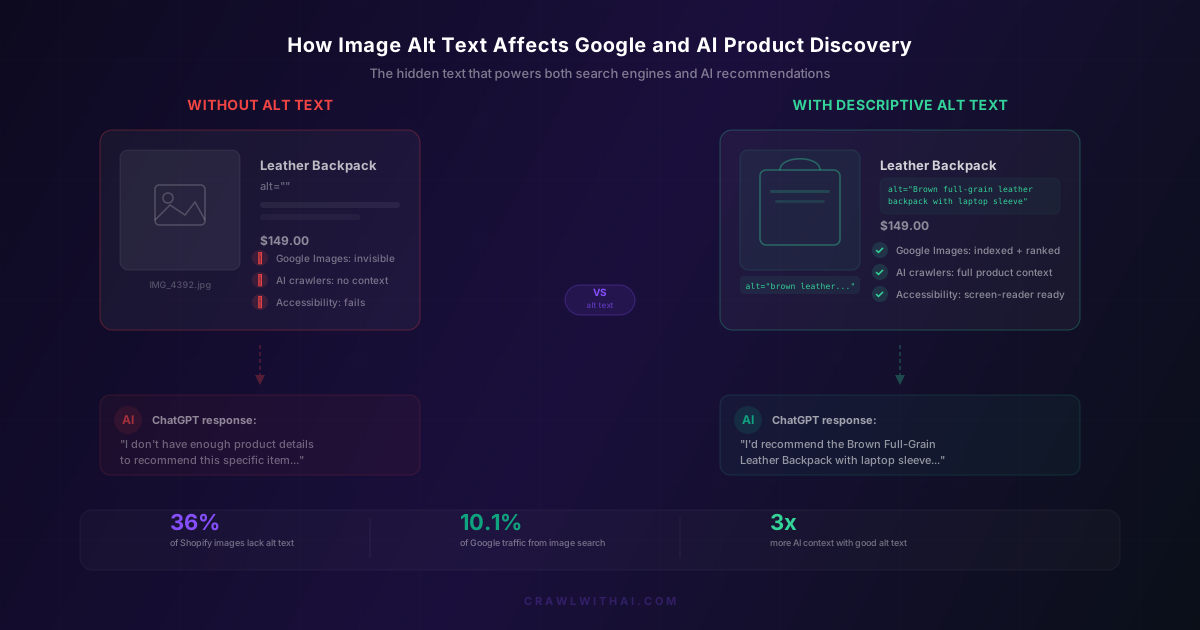
There's a piece of text on every product page that most Shopify store owners never touch. It sits behind the image, invisible to shoppers, and it takes about 15 seconds to write. That piece of text is the image alt attribute. And in 2026, it quietly determines whether your products show up in Google Images, get recommended by ChatGPT, or disappear from both entirely.
The reason is simple. Google can't see your product photos the way a human can. Neither can GPTBot, ClaudeBot, or any other AI crawler. They read the alt text instead. If your alt text says "IMG_4392.jpg" or sits empty, those systems have zero context about what your product looks like, what it's made of, or who it's for. And products without context don't get recommended.
What Image Alt Text Actually Does
Alt text (short for alternative text) is an HTML attribute that describes an image. It was originally designed for screen readers so visually impaired users could understand images on web pages. The HTML looks like this: <img src="backpack.jpg" alt="Brown full-grain leather backpack with padded laptop sleeve and brass buckles">.
Google's image crawling documentation states clearly that alt text is one of the primary signals used to understand image content. Google uses alt text, surrounding text on the page, and the image file name to determine what an image shows and when to surface it in search results. According to a 2025 Ahrefs study, Google Images drives roughly 10.1% of all Google search traffic. For product-heavy categories like fashion, home decor, and accessories, that number climbs much higher.
But the newer shift is what AI systems do with this same text. When GPTBot crawls your Shopify store, it parses the full HTML of each page. That includes alt attributes on every image. The alt text becomes part of the context that AI models use to understand your product catalogue. Without it, the model literally has less information to work with when deciding whether to recommend your product.
Why Most Shopify Stores Get Alt Text Wrong
A 2024 Screaming Frog audit of 10,000 e-commerce sites found that 36% of product images had either empty alt text or auto-generated filenames as alt text. Shopify makes this problem worse in a specific way: when merchants upload product images through the admin, the default alt text field is blank. Unless you deliberately click "Edit alt text" on each image, it stays empty.
The three most common mistakes are leaving alt text blank, stuffing it with keywords ("leather backpack men's backpack buy backpack online cheap backpack"), and using generic descriptions ("product image" or "photo"). All three fail for the same reason. They give neither Google nor AI crawlers the descriptive, specific information they need to understand and recommend the product.
Some Shopify themes compound the problem by rendering decorative images and product images with the same empty alt tags. This means even stores that write good alt text for product images might have dozens of other images on the page contributing nothing to crawlability.
How Google Uses Alt Text for Image Search Rankings
Google's image ranking algorithm weighs several factors: the alt text itself, the text surrounding the image on the page, the image file name, the page title, and structured data. But alt text carries outsized weight because it's the only signal explicitly tied to the specific image.
John Mueller from Google confirmed in a 2023 Search Central blog post that descriptive alt text remains one of the strongest signals for image search. He specifically noted that alt text should describe what the image shows, not just repeat the product name.
For Shopify stores, this means the difference between an alt text like "Classic Tote Bag" and "Waxed canvas tote bag in olive green with leather shoulder straps and interior zipper pocket" is the difference between showing up for generic queries and showing up for specific, high-intent queries like "olive green canvas tote bag" or "tote bag with leather straps." The specific query is the one that converts.
Google also uses alt text to build its understanding of your entire site. When your alt text consistently describes materials, colours, use cases, and product features, Google builds a richer topical profile of your store. That topical depth matters for ranking your product pages in regular search results, not just image search.
How AI Crawlers Parse Alt Text Differently Than Google
Google uses alt text primarily for search indexing. AI crawlers use it for something different: building a semantic understanding of your products that informs future recommendations.
When GPTBot or ClaudeBot crawls a product page, it processes the full page content as a single context. The product title, description, reviews, structured data, and alt text all contribute to the model's understanding of what the product is. Alt text is especially valuable here because it often contains details that aren't in the product description, like specific colours, materials, or design features that are visible in the photo but never written out in text.
Consider a product page for a watch. The description might say "Premium automatic watch with sapphire crystal." But the alt text on the lifestyle image might say "Silver automatic watch with black leather strap on a man's wrist at a cafe." That alt text gives the AI context about the watch's appearance, its strap material, its colour, and the type of person who wears it. When someone asks ChatGPT "what's a good silver watch with a leather strap for everyday wear," that alt text context makes the difference.
A 2025 analysis by Botify found that pages with descriptive alt text on all images had 47% more content tokens available to AI crawlers compared to pages with empty or generic alt text. More tokens means more context. More context means a higher chance of being the product an AI recommends.
The Right Way to Write Alt Text for Products
Good product alt text follows a simple formula: material + colour + product type + distinguishing feature. Here are examples:
Instead of "Running Shoes" write "Lightweight mesh running shoes in navy blue with reflective heel strip and white foam sole." Instead of "product-img-01" write "Handmade ceramic coffee mug in speckled grey glaze with oversized handle, 12oz capacity." Instead of "Dress" write "Midi-length linen wrap dress in terracotta with adjustable waist tie and side pockets."
Keep alt text between 80 and 125 characters. Google truncates excessively long alt text, and AI crawlers may weight the beginning more heavily than the end. Front-load the most important descriptors.
For lifestyle images (product shown in context), describe the scene: "Woman wearing oversized wool scarf in burgundy while walking through an autumn park." For detail shots, describe what's shown: "Close-up of hand-stitched leather seams and brass hardware on messenger bag flap."
Avoid keyword stuffing. Both Google and AI systems can detect unnatural keyword density, and it works against you. Write alt text as if you're describing the image to someone who can't see it. That's literally what it's for.
Alt Text, Structured Data, and the Compound Effect
Alt text works best when it reinforces other on-page signals. If your structured data markup says the product is a "leather backpack" and your alt text describes a "brown full-grain leather backpack with brass buckles," the AI model gets a consistent, detailed picture. That consistency builds confidence in the recommendation.
The same principle applies to your product descriptions. When your description mentions features that your alt text also describes visually, you create a richer semantic profile. AI models can cross-reference these signals to build a more complete understanding of what your product is and who it's for.
This compound effect matters because AI recommendation systems don't just match keywords. They build conceptual models of products. A product with rich, consistent signals across alt text, descriptions, structured data, and reviews gives the AI more confidence to recommend it. A product with sparse or conflicting signals gets skipped in favour of competitors that provide better information.
How CrawlWithAI Helps You Fix Alt Text at Scale
Auditing and fixing alt text across hundreds or thousands of product images is tedious work. CrawlWithAI crawls your Shopify store the same way GPTBot and Google do, then shows you exactly which images have missing, generic, or unhelpful alt text. You can see what AI crawlers actually extract from each product page and identify the gaps.
Beyond the audit, CrawlWithAI tracks how AI platforms reference your products over time. When you fix your alt text and other on-page signals, you can measure whether AI recommendation rates change. That feedback loop turns alt text optimization from guesswork into a measurable strategy. You can also track the revenue that comes from AI-referred traffic, so you know the actual dollar impact of these changes.
The Accessibility Bonus You Shouldn't Ignore
There's a practical reason to care about alt text beyond SEO and AI. The European Accessibility Act (EAA), which took effect in June 2025, requires that online stores selling to EU customers meet accessibility standards including proper image alt text. Non-compliance can result in fines. The ADA in the United States has been applied to e-commerce sites in multiple court cases, with missing alt text cited as a specific violation.
According to the World Health Organization, approximately 2.2 billion people globally have some form of vision impairment. Screen readers depend entirely on alt text to convey image content. Writing good alt text for your products isn't just an SEO tactic. It makes your store usable for a significant portion of the population. And stores that are accessible tend to perform better in search rankings too, because search engines reward good user experience signals.
FAQ
Does Shopify auto-generate alt text for product images? No. Shopify leaves the alt text field blank by default when you upload product images. You need to manually add alt text for each image through the product editor. Some third-party apps can bulk-generate alt text, but always review the output for accuracy and specificity.
How long should product image alt text be? Aim for 80 to 125 characters. This gives you enough room to describe material, colour, product type, and one distinguishing feature. Google may truncate alt text longer than about 125 characters, and very short alt text (under 30 characters) usually lacks enough detail to be useful for either Google or AI crawlers.
Does alt text on collection page images matter? Yes. Collection page images often appear in Google Image search results, and AI crawlers index collection pages too. Write descriptive alt text for collection hero images and any featured product thumbnails. For example, "Collection of handmade ceramic dinnerware in earth tones including plates, bowls, and mugs."
Can AI models actually see my product images? Most AI crawlers (GPTBot, ClaudeBot, Googlebot for Gemini) primarily parse HTML text, not images. Some multimodal models can process images directly, but the standard web crawl relies on alt text and surrounding text to understand image content. This means alt text is often the only visual context an AI has about your product.
Will fixing alt text immediately improve my AI recommendations? Not immediately. AI models incorporate new crawl data over time, and recommendation changes happen gradually. But fixing alt text is one of the highest-impact, lowest-effort changes you can make. Combined with strong product descriptions and structured data, you should see improvements in both Google Image traffic and AI recommendation rates within weeks.
Sources
- Google Search Central: Image SEO best practices — https://developers.google.com/search/docs/appearance/google-images
- Ahrefs study on Google Images traffic share (2025) — https://ahrefs.com/blog/google-images-seo/
- Screaming Frog SEO Spider crawl data, e-commerce alt text audit (2024) — https://www.screamingfrog.co.uk/seo-spider/
- Botify analysis of AI crawler content extraction (2025) — https://www.botify.com/blog
- World Health Organization, vision impairment data — https://www.who.int/news-room/fact-sheets/detail/blindness-and-visual-impairment
- European Accessibility Act (EAA) implementation — https://ec.europa.eu/social/main.jsp?catId=1202