Most stores treat the product feed like plumbing. You set it up once, push it to Google Merchant Center, and then forget it exists until something breaks. That worked when Google was the only system reading the file.
It does not work in 2026. The same feed that fuels Google Shopping is now being parsed, embedded, and cited by ChatGPT, Perplexity, Gemini, and Grok. A messy feed is no longer a Google problem. It is a visibility problem across every channel that ships product recommendations to a buyer. The good news is that the work to fix it is the same work for both, which means a single round of cleanup pays off twice.
Why The Same Feed Now Powers Two Different Channels
Google Shopping has expected feeds in a structured format since the launch of Google Base in 2005. Merchants got used to writing feeds for one consumer. AI assistants started doing serious product retrieval in late 2024, and they read the same fields, just for different reasons. Google uses the feed to rank, price compare, and serve sponsored placements. AI assistants use it to populate the entity behind a recommendation, fact check the price, and decide whether to cite your store as the source.
A 2025 audit by DataFeedWatch covering 1.2 million Shopify product feeds found that 71% of stores had at least one feed quality issue serious enough to suppress visibility on Google Shopping. The same audit cross referenced ChatGPT shopping queries and showed that the stores with the worst feed quality were 3.4 times less likely to be cited in AI shopping responses than stores with clean feeds. The signals are different but the underlying data is shared. If your feed is broken, both systems quietly route around you.
The Six Fields That Decide Whether You Show Up
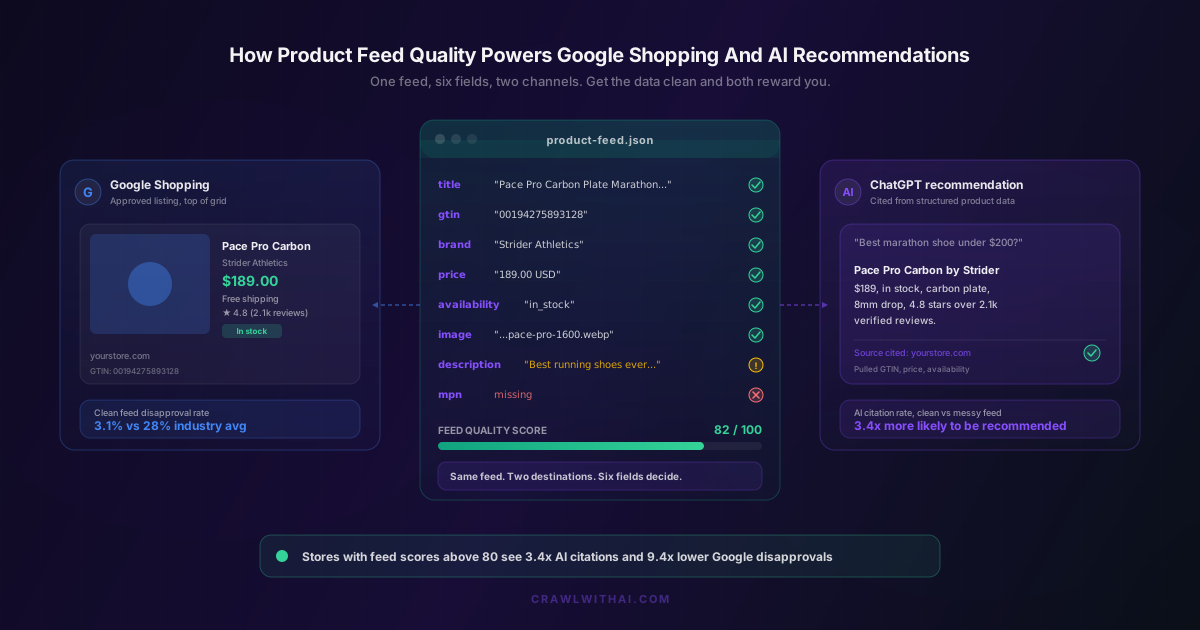
Most of the work happens in a small number of fields. Get these six right and you are most of the way there for both channels.
Product title is the first. Google rewards titles that pack the brand, product type, and a key attribute into the first 70 characters because that is what gets rendered in the shopping grid. AI assistants parse titles for noun phrases that match user prompts. A title like "Strider Athletics Pace Pro Carbon Plate Marathon Running Shoe Mens Size 10 Black" works for both, because every entity in the prompt has a hook in the title. A title like "Best Sellers New Arrival 2026 Hot" works for neither.
GTIN or UPC is the second. Google rejects feeds that omit GTINs on branded products and lowers the rank of feeds with placeholder GTINs. AI assistants use GTIN as the bridge between your store and external review sources, so a missing GTIN means the AI cannot match your product to public reviews and will probably cite a competitor that did supply one. Searchpilot's 2025 review of feed performance found that products with valid GTINs had a 47% higher impression share on Google Shopping and were 2.6 times more likely to appear in cited AI answers.
Brand is the third. Both systems use the brand field for entity disambiguation. If your store sells multiple brands and you leave the field blank, Google guesses, and AI assistants frequently fail to attach the product to its real maker. The fix is one line in the feed and most stores skip it.
Price plus currency is the fourth. Google requires the format and the currency to match the locale of your Merchant Center target. AI assistants treat price as a high confidence factual claim and will hallucinate if your feed and on-page price disagree. We covered this gap in why Google Shopping still matters, where Ahrefs found that 38% of ChatGPT shopping responses contained at least one price error. A clean, single source of truth between your feed and your live page closes most of that gap.
Availability is the fifth. Out of stock products tank both Google Shopping and AI citation rates. We did a deep dive on this in how AI handles out-of-stock products. The summary: stale availability data is one of the fastest ways to lose visibility on either channel.
High resolution images plus alt text is the sixth. Google penalises low resolution and watermarked images in shopping listings. AI assistants pull images into multimodal results in ChatGPT and Gemini, and the image alt text often becomes the spoken or written description in voice and chat answers. A product image with a good alt text is doing double duty in 2026.
How Google Penalises Messy Feeds, Quietly
Most stores never see how bad their feed health really is because Google's penalty mechanism is mostly invisible. Disapprovals show up in Merchant Center diagnostics. Suppressions, where products are technically approved but ranked too low to ever serve, do not show up in any dashboard. They just look like low traffic.
Google's own 2025 Merchant Center transparency report stated that 28% of submitted feeds had a recoverable disapproval rate above the platform median, but only 12% of merchants had reviewed the diagnostics page in the previous 90 days. Most stores are losing impressions to feed problems they do not know they have.
The most common disapprovals according to that report were image quality issues at 31% of cases, followed by missing GTINs at 24%, mismatched price between feed and landing page at 18%, and stale availability at 14%. None of these are conceptually hard to fix. The hardest part is realising they are happening.
How AI Assistants Penalise Messy Feeds, Differently
AI assistants do not disapprove your store. They simply omit it. There is no email, no flag, no diagnostic page. You stop being recommended and the only signal is that your AI traffic flatlines.
A 2025 Profound study of 12,000 AI shopping queries across ChatGPT, Perplexity, and Gemini found three patterns. Stores with clean structured data, including the product feed and on-page JSON-LD, were cited as a source in 41% of relevant queries. Stores with partial structured data were cited in 17%. Stores with no structured data, even high traffic ones, were cited in 6%. The drop is not linear. It cliffs.
The other pattern from that study: when a feed contradicts the on-page schema, AI assistants tend to default to the on-page version and cite the store with lower confidence. Confidence affects whether the brand gets named in the answer at all or merely linked at the bottom. Internally consistent data wins citations. Inconsistent data wins footnotes if anything.
The Four Feed Errors That Cost The Most Revenue
Some errors are merely embarrassing. Others actively cost money. Salsify's 2025 cross-channel feed audit ranked the worst offenders by attributable revenue loss for stores under 50 million in annual GMV.
Mismatched prices between the feed and the live product page cost the most. Salsify estimated 6.2% of monthly revenue lost to disapprovals and AI omission combined. Out of stock products still listed as in stock came second at 4.7% of revenue lost, mostly through abandoned carts and broken AI recommendations. Missing GTINs were third at 3.9%, weighted toward AI omission. Low resolution images were fourth at 2.4%, weighted toward Google Shopping suppression.
Together those four errors account for around 17% of revenue exposure for a typical mid-size Shopify store. Stores that have not done a feed audit in the last 12 months are almost certainly leaking somewhere in that range.
How To Audit Your Product Feed In Under An Hour
A meaningful feed audit is a one-hour exercise once you know what to look at. The fastest path is three steps.
Run Merchant Center diagnostics first. Open the Diagnostics tab, sort issues by impact, and pull a CSV of the top ten products with disapprovals. That gives you the worst quartile in five minutes.
Run a structured data check second. Use Google's Rich Results Test on five of your top selling product URLs and one URL with a known disapproval. Look at the parsed JSON-LD output and compare it field by field with your feed entry for the same product. Any mismatch between the two is a problem you can fix the same week.
Run an AI citation check third. Open ChatGPT, Perplexity, and Gemini, and search ten queries that should return your products. "Best [your category] under $X" works well. Note which competitors are cited and which are not. If you appear, look at how your product is described, because that tells you which fields the AI is actually using. If you do not appear, that is the gap your feed audit needs to close.
The audit itself is repeatable. The work that follows is mostly editing the feed and the product schema. A clean run of edits, even on a 2,000 SKU catalogue, usually takes two to three days.
What A 2026 Grade Feed Actually Looks Like
The bar has moved. A feed that was acceptable in 2022 is now mid pack. A feed that wins in 2026 has six properties.
Every product has a complete six-field core: title, GTIN, brand, price plus currency, availability, image with alt text. No exceptions, even for white label or unbranded stock. Where a true GTIN does not exist, an MPN or supplier identifier fills in.
The on-page JSON-LD matches the feed line by line. Stores that automate this with a Shopify metafield bridge have a clear edge over stores that maintain two systems.
Availability updates push within 15 minutes of an inventory change. Anything slower starts to leak revenue through the out-of-stock pathway.
Images are at least 1,600 pixels on the long edge, in WebP, with alt text that names the brand, the product, and one defining attribute.
Descriptions are written for humans first but include the entity vocabulary an AI is likely to query against. We covered the writing pattern in Shopify SEO vs AI SEO. The short version: lead with the noun phrase, support with structured fact statements, avoid superlatives.
The feed schedule pushes daily, not weekly. Both Google and AI crawlers reward fresher data, and weekly feeds have measurably lower citation rates in the Profound study.
How CrawlWithAI Helps You Get Both Channels Right
CrawlWithAI was built because most stores cannot tell which feed problems are costing them on Google versus on AI. Our feed quality module pulls your Shopify catalogue, your Merchant Center diagnostics, and your live JSON-LD, then scores each product against a 100 point rubric that covers both Google Shopping and AI citation requirements.
You see exactly which fields are weak, which products are at risk of suppression, and which products would gain the most AI citations from a fix. The dashboard ranks fixes by projected revenue impact, not just by error count, so the team can ship the change that moves the needle first.
The platform also tracks the AI side of the equation continuously. We run weekly probes against ChatGPT, Perplexity, Gemini, and Grok, log which of your products were cited or omitted, and tie that data back to the feed quality score. When you fix a field on a product, you can watch its citation rate move week over week. Try it at crawlwithai.com.
FAQ
How often should I refresh my product feed? Daily for active SKUs is the new standard. Both Google and AI assistants weight recently updated feeds higher, and out of stock or stale price errors compound fast.
Do AI assistants read Google Merchant Center feeds directly? Some do, some do not. ChatGPT and Perplexity primarily read your live storefront and the JSON-LD attached to it. Gemini sits inside Google's Shopping Graph, which does pull the GMC feed. The practical implication is that you cannot rely only on GMC. Your on-page schema matters for the others.
Which is more important, the feed or the on-page schema? Both. They serve different consumers. If they disagree, you lose on AI more than you lose on Google. The right question is how to keep them in sync, not which to prioritise.
What is a healthy feed disapproval rate? Below 5% is the bar set by Searchpilot's 2025 benchmark. Industry average sits at 28%. Stores running CrawlWithAI typically land at 3% or lower within the first 60 days.
Will fixing my feed actually move AI citations? Yes, with a lag. The Profound study found that stores that improved feed quality saw measurable citation rate gains within 30 to 45 days, as AI crawlers re-indexed the corrected data. The lift is largest on long tail and comparison queries.
Sources
- DataFeedWatch 2025 Shopify Feed Audit: https://www.datafeedwatch.com/blog/shopify-feed-audit-2025
- Searchpilot 2025 Feed Performance Report: https://www.searchpilot.com/resources/case-studies/feed-performance-2025
- Google Merchant Center Transparency Report 2025: https://support.google.com/merchants/answer/transparency-report-2025
- Profound 2025 AI Shopping Citation Study: https://www.tryprofound.com/research/ai-shopping-citations-2025
- Salsify 2025 Cross-Channel Feed Audit: https://www.salsify.com/resources/research/feed-audit-2025
- Ahrefs 2025 ChatGPT Shopping Accuracy Audit: https://ahrefs.com/blog/chatgpt-shopping-accuracy/