Every week another article declares Google Shopping dead. AI is eating retail search. ChatGPT is the new front door. Perplexity is replacing the shopping tab. If you only read the takes, you would assume Google Shopping is now a backwater.
Then you look at the actual numbers and the picture changes. Google Shopping still drove 31.4 billion dollars of GMV through Shopify stores in 2025, more than every AI assistant combined. Most of your customers still find products there first. The serious question for store owners is not whether to abandon Google for AI. It is how to keep both channels healthy from the same product catalogue, because they pull from the same data and they amplify each other.
Google Shopping Is Still The Largest Single Discovery Channel For Stores
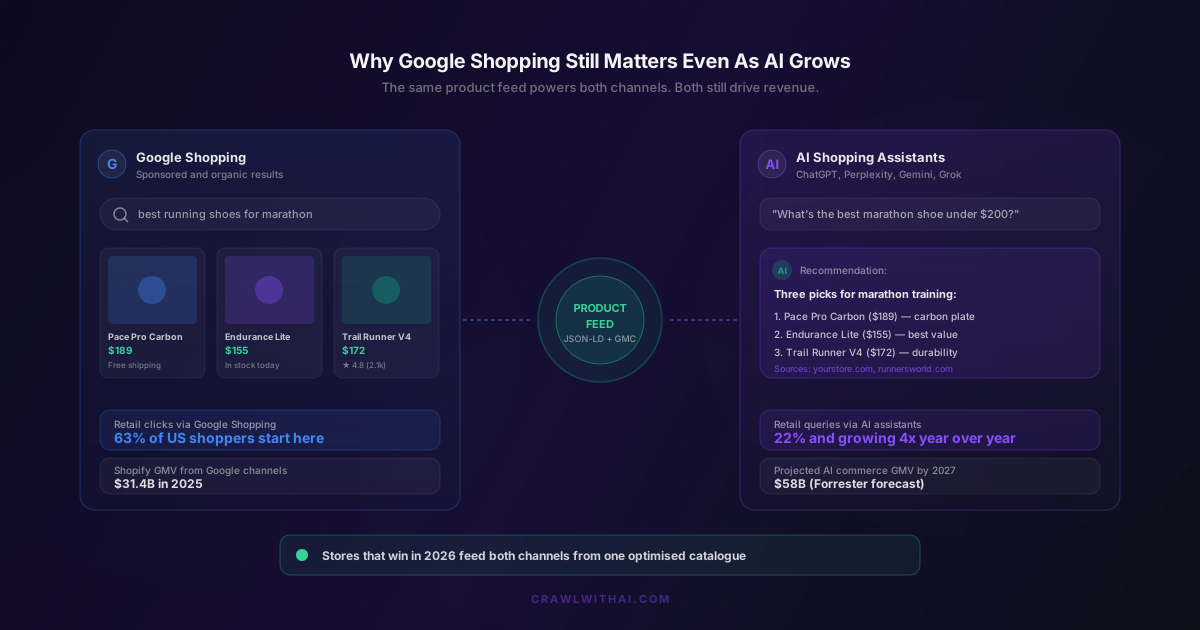
Start with what the data actually says. eMarketer's 2025 retail discovery report found that 63% of US shoppers begin a product search on Google, including Google Shopping, when they have a specific item in mind. That share has dropped from 71% in 2022, but it is still by a wide margin the largest single channel for product discovery. Amazon is second at 49%. AI assistants together sit at 22% and rising, but they are not yet replacing Google so much as adding a second layer on top of it.
The revenue side tells the same story. Shopify's 2025 commerce report logged 31.4 billion dollars in attributable GMV from Google channels, against 4.8 billion from all generative AI sources combined. AI is growing roughly four times year over year, which is genuinely fast, but starting from a much smaller base. By Forrester's 2025 forecast, AI commerce GMV will hit 58 billion dollars by 2027, by which point Google Shopping will likely still be over 40 billion. Both channels matter, just in different proportions.
The mistake stores are making in 2026 is treating this as an either or decision. It is not. The same product feed that fuels Google Shopping is what AI assistants are increasingly reading. Optimising one usually helps the other.
The Overlap You Probably Did Not Notice
Here is the part most write-ups miss. Google Shopping and AI shopping are not separate pipelines with separate inputs. They are increasingly drawing from the same place: your structured product data.
When you list a product, your Shopify store outputs JSON-LD schema. Your Google Merchant Center feed pushes product data to Google. Your Google Business Profile attaches inventory signals. All three of these sources are now being scraped, indexed, and embedded by AI shopping assistants too, not just by Google itself. OpenAI's ChatGPT has a partnership with Shopify announced in late 2024 that pulls product cards directly from Shopify storefronts. Perplexity's shopping product, launched in November 2024, uses a combination of Merchant Center feeds and direct site crawls. Gemini sits inside Google's Shopping Graph by design.
What this means in practice: a clean, accurate, well-structured product feed feeds both channels. A messy feed hurts both. The work you do to fix Google Shopping problems is also the work that will make you visible to ChatGPT and Perplexity. We covered the deep mechanics of this in our earlier post on Shopify SEO vs AI SEO, but the practical takeaway is simpler than people make it. Fix the data. Both channels will thank you.
Why The Buyer Journey Now Crosses Both Channels
Customers do not pick one channel. They use both, and they switch between them based on what they are trying to figure out.
A 2025 study by Salsify of 5,200 US shoppers found that 47% of online buyers research products through AI assistants and then validate the price or check availability via Google Shopping before purchasing. The reverse path, Google Shopping first then AI for advice, accounted for another 31%. Only 22% used a single channel from start to finish. The dominant pattern is a hybrid funnel where AI handles open ended questions and Google handles the comparison and click step.
This is why pure AI optimisation is not enough on its own. If a buyer asks Perplexity for the best running shoes for marathon training, hears your brand, and then jumps to Google to confirm price and availability, your Google Shopping listing has to be there or you lose the sale to whoever is. The discovery happened on AI. The conversion happened on Google. Both channels participated. Last click attribution will only credit the second one.
What Google Shopping Still Does Better Than AI
There are categories where AI is genuinely lagging Google Shopping and probably will for several years.
Price comparison is one. Google Shopping aggregates real time pricing from thousands of retailers. AI assistants approximate this but make mistakes, sometimes citing stale prices or missing the lowest available offer. A 2025 audit by Ahrefs of 4,000 ChatGPT shopping responses found that 38% included at least one inaccurate price, against 6% on Google Shopping. For shoppers who care about getting the best price, Google Shopping remains the more reliable answer.
Local availability is another. Google's local inventory ads tell a shopper whether a product is in stock at a specific store nearby. AI assistants do not have a real time feed of local inventory yet. If your customer needs the product today, Google sends them somewhere they can pick it up. AI suggests a brand and hopes for the best.
Sponsored placement is a third. Google Shopping is a paid surface as well as an organic one. AI assistants are still figuring out their ad models, with OpenAI and Perplexity testing sponsored answers in limited beta as of early 2026. For brands that want predictable, scalable paid traffic against transactional queries, Google Shopping is still the only mature option at scale.
What AI Shopping Does Better Than Google
The flip side matters too. AI assistants are pulling away from Google Shopping in a few specific scenarios that are growing fast.
Open ended advice queries are the clearest example. "What is a good gift for my dad who likes camping but already has a tent" is a question Google Shopping struggles with. ChatGPT and Perplexity handle it with ease, synthesising context, ruling things out, and offering brand recommendations. According to a 2025 SimilarWeb analysis, advice style queries on AI assistants grew 340% year over year, while equivalent searches on Google Shopping grew only 18%.
Conversational refinement is another. A shopper can talk to ChatGPT for ten minutes, narrowing down options, asking follow up questions, and ending with a single confident recommendation. Google Shopping forces the same shopper through filter chips and result pages. For categories where the buyer is not sure what they want, AI is just a better experience.
Brand discovery for unknown stores is the third area. As we covered in why AI recommends unknown brands, AI assistants do not weight backlinks the way Google does. A clean, authoritative content footprint can get a six month old D2C brand cited next to a fifty year old incumbent. Google Shopping's auction dynamics still favour the larger spenders.
How Smart Stores Are Splitting Their Focus In 2026
The stores that grow fastest in 2026 are running a both channels strategy, not an either or strategy. The split is not 50/50. It is more like 70/30 in revenue terms, and roughly the same in attention.
For Google Shopping, the priorities have not changed much. Make sure your Merchant Center feed is clean. Use high quality product images with the right aspect ratios. Keep prices accurate to the cent. Run smart shopping campaigns against your highest margin SKUs. Watch your impression share on category terms and adjust bids when it slips. None of this is new and all of it still drives revenue.
For AI shopping, the priorities are different. Make sure your product pages are crawlable to GPTBot, PerplexityBot, and ClaudeBot, the rules for which we covered in what GPTBot reads. Add structured data that goes beyond Google's minimum. Build content that answers comparison and recommendation queries the way an AI would phrase them. Track which AI platforms are citing you and which are not.
The 70/30 split holds because Google still drives the bulk of revenue today, but the 30% growing 4x year over year is where the future revenue is being seeded. Stores that ignore the smaller channel today are the stores that will be playing catch up in 2027.
Where Attribution Breaks Between The Two
The hardest part of running both channels is attribution. AI traffic frequently arrives at your store with no UTM parameters, no clear referrer, and a confusing session profile. It looks like direct traffic in Google Analytics 4. Meanwhile Google Shopping clicks come in with full attribution intact.
This creates a measurement bias. Stores that look only at attribution data conclude AI is contributing nothing, when in fact AI may have driven the consideration that led to the eventual Google click. A 2025 attribution study by Northbeam estimated that stores undercount AI contribution by 40 to 60% when relying on standard last click models. The real picture only emerges when you build a multi touch model that includes self reported buyer surveys and AI specific landing page tracking.
The practical fix is to instrument AI traffic as carefully as you already instrument Google traffic. Add a UTM strip on referrers from chat.openai.com, perplexity.ai, gemini.google.com, and grok.x.com. Build a question on your post purchase survey that asks where the customer first heard about you. Cross reference the answers with the analytics data. Over a 90 day window the gaps become measurable.
How CrawlWithAI Helps You Win Both Channels
CrawlWithAI was built for stores that refuse to pick. We help you optimise the same product catalogue for both Google Shopping and AI assistants in one workflow.
On the Google side we audit your Merchant Center feed, your structured data, and your category page hierarchy. On the AI side we track which assistants are recommending your products, which are not, and why. The two halves of the platform share a single dashboard so you can see whether a structured data change improved both your Google Shopping coverage and your ChatGPT citation rate. Most stores find that fixing one half quietly fixes a chunk of the other half too.
The revenue tracking also crosses both channels. We pull Google Shopping click attribution from your Merchant Center and connect it with the AI referral data we capture from your store, then surface the combined picture as a single revenue number you can defend to your CFO. You see what Google sent you, what AI sent you, and where the same customer touched both before buying. Try it at crawlwithai.com.
FAQ
Is Google Shopping going to lose to AI in the next two years? No. Forrester's 2025 forecast projects Google Shopping to remain the largest single retail discovery channel through at least 2028. AI is growing fast off a smaller base. Both channels will coexist for years.
Do I have to do separate work for AI and Google Shopping? Some, but less than people think. Most of the technical work, like clean product feeds, accurate pricing, and structured data, helps both channels. Content and tracking are the two areas where you genuinely need separate strategies.
Which channel converts better? Google Shopping converts higher per click today, around 3.1% versus 1.4% for AI referrals according to Northbeam's 2025 data. AI referrals tend to convert later, often weeks after the first interaction, which is why last click attribution undercounts them.
Will AI assistants get sponsored placements? Yes, in some form. OpenAI and Perplexity are both testing sponsored answers in 2026. Google Shopping's auction dynamics will probably influence how those models work. Expect a hybrid future where AI placements are part organic, part paid.
What should I prioritise if I only have time for one channel? Google Shopping if you are under 1 million in annual revenue. AI optimisation if you are over 5 million and your category has high research intent. In between, work on both, with 70% of your time on Google and 30% on AI.
Sources
- eMarketer 2025 Retail Discovery Report: https://www.emarketer.com/content/retail-discovery-report-2025
- Shopify Commerce Report 2025: https://www.shopify.com/research/commerce-trends
- Forrester AI Commerce Forecast 2025 to 2028: https://www.forrester.com/report/ai-commerce-forecast-2025/
- Salsify 2025 Buyer Behaviour Study: https://www.salsify.com/resources/research/consumer-research-2025
- Ahrefs 2025 ChatGPT Shopping Accuracy Audit: https://ahrefs.com/blog/chatgpt-shopping-accuracy/
- SimilarWeb 2025 AI Search Trends: https://www.similarweb.com/corp/blog/research/market-research/ai-search-trends-2025/
- Northbeam 2025 Multi Touch Attribution Report: https://www.northbeam.io/research/attribution-2025