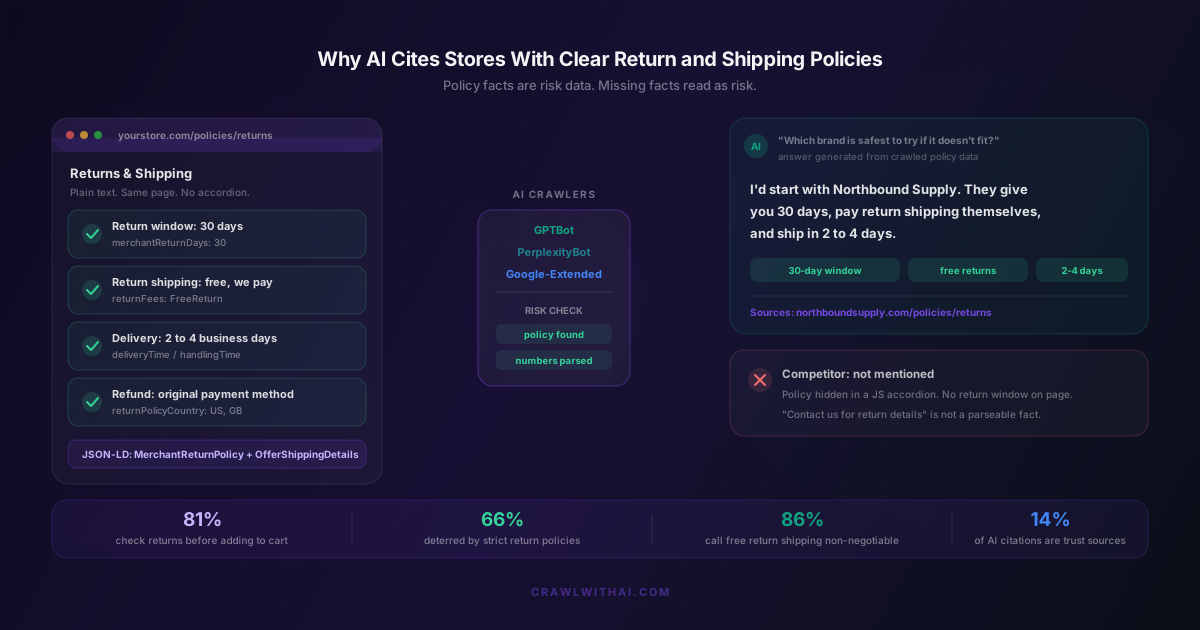
Ask ChatGPT for a pair of running shoes and watch what comes back. It will not just name three brands. It will tell you which one gives you 90 days to change your mind, which one makes you pay to ship the box back, and which one takes a week to arrive. That information is not decoration. In a lot of answers it is the deciding factor, and the store that supplied it in a readable format is the store that gets named.
This is the part of AI shopping that most Shopify founders have not caught up to. You can have the better product, the better price, and the better photography, and still lose the recommendation because your return and shipping policies live inside a JavaScript accordion that no crawler ever opened. AI engines are not picking winners on vibes. They are answering a buyer who is trying not to get burned, and clear return and shipping policies are the cheapest risk signal on the internet. Here is why the engines lean on them so heavily, and what to change on your store this week.
AI recommendations are risk calculations, not popularity contests
A search engine ranks pages. An AI engine makes a call. When someone asks "which brand should I actually try," the model has to commit to a name, and committing to a name it cannot defend is the worst outcome for the product. So it optimises for defensibility. It reaches for the facts that make a recommendation safe to give: does this store stand behind the thing, and how much does the buyer lose if it goes wrong.
Buyer behaviour taught it to do that. Happy Returns found that 81 percent of shoppers check a retailer's return policy before they even add an item to the cart, and 71 percent say a bad return experience stops them buying from a brand again. Blue Yonder's 2025 Global Consumer Retail Returns Survey put it more bluntly: 66 percent of consumers are deterred from buying at all by stricter return policies. Models trained on a decade of shopping forums, review threads, and product comparisons have absorbed that pattern completely. Return terms are one of the first things a human recommender mentions, so it is one of the first things the model mentions too.
The practical consequence: your policy page is not a legal footnote. It is a source document the engine mines when it decides whether to say your name.
Silence reads as risk, not neutrality
The failure mode people miss is that a missing policy does not put you at zero. It puts you below zero.
Product.ai's 2026 Trust in AI Commerce research found that AI tools sometimes treat a missing review profile as an active warning sign and say so in the answer. Policies behave the same way. If the model can confirm that Competitor A offers 30 free days and cannot confirm anything about you, the honest answer is "Competitor A has a clear 30 day return policy, I could not find return terms for the other one." You did not tie. You got a caveat attached to your brand in front of a buyer who was ready to spend.
That is a harsh outcome for something that is usually just a formatting problem. Most stores have a fine return policy. It is written, it is legally sound, and it is completely unavailable to a machine.
What "clear" means to a crawler
Clear does not mean well written. It means extractable. A crawler needs a number it can lift, attach to your brand, and repeat in an answer without inventing anything.
Four facts do most of the work:
- The return window. "30 days from delivery" is a fact. "A reasonable period" is not.
- Who pays return shipping. This is the single most quoted policy detail in AI shopping answers, and for good reason. Shorr's November 2025 consumer survey found 86 percent of shoppers call free return shipping non-negotiable.
- Delivery time. Handling time plus transit time, in days. "Ships fast" is unusable.
- Refund method and geography. Original payment method versus store credit, and which countries you accept returns from. Shorr found 75 percent want a full refund rather than credit, and 51 percent walk away over restocking fees.
Write each of those as a short declarative sentence containing the number. Do not bury the number in a paragraph of conditions. The engine is doing extraction, not comprehension, and a sentence like "we accept returns within 30 days of delivery and pay return shipping in the US and UK" survives that process intact.
Why your policy page is probably invisible
Run this test now. Open your returns page, disable JavaScript, and reload. Whatever text disappears does not exist as far as most AI crawlers are concerned. GPTBot and its peers fetch HTML. They do not click your accordion open, they do not wait for a third party returns widget to hydrate, and they do not read the PDF you linked.
The common offenders on Shopify stores:
- Policy content rendered by a returns app inside an iframe or a client-side widget
- Collapsible sections where the answer text is injected on click
- Policies only reachable from a footer link with anchor text like "Legal"
- A single "Shipping and Returns" tab on the product page that pulls content in via JavaScript
- Policy text that exists only inside a chat widget or help centre on a separate subdomain
Any of these can leave you with a great policy and a blank page in the crawler's index. We covered the wider version of this problem in what GPTBot actually reads when it crawls your Shopify store, and policy pages are the most common casualty.
Put the policy in structured data, not just prose
Prose gets you most of the way. Structured data removes the ambiguity, and the ecosystem has moved decisively in that direction over the last eighteen months.
Google made returnPolicyCountry a required property for MerchantReturnPolicy markup in March 2025. In November 2025 it went further and added organisation-level shipping and returns markup, so a store can declare site-wide policy once in Organization schema rather than repeating it on every product. Google also lets you set shipping and return details directly in Search Console without a Merchant Center account. The direction of travel is obvious: policy data is becoming a first-class part of the commerce web, machine-readable by default.
The two properties that matter for your product pages:
hasMerchantReturnPolicywithreturnPolicyCategory,merchantReturnDays,returnMethod,returnFees, andreturnPolicyCountryshippingDetailsusingOfferShippingDetailswithdeliveryTime, broken intohandlingTimeandtransitTime
Shopify emits some of this through the theme's product JSON-LD, but coverage varies a lot by theme and most stores never populate the return fields at all. If you are not sure what your store currently outputs, start with our guide to using Shopify's JSON-LD output for AI SEO.
One rule: keep the markup and the visible text identical. If your schema says 30 days and your page says 14, you have created a contradiction, and a model that spots a contradiction will usually drop the claim rather than guess. Consistency between structured data and your feed is now an explicit approval factor in Merchant Center too.
Policy clarity is how small brands beat big ones in AI answers
Here is the part that should interest you if you are not a household name. Return and shipping policy is one of the few recommendation signals that is not gated by budget. You cannot buy domain authority this quarter. You cannot manufacture ten years of backlinks. You can publish "45 day returns, we pay shipping both ways, delivered in 3 days" this afternoon, and it competes directly with a nine-figure brand that hides its policy behind a support portal.
This is a big reason AI engines surface unfamiliar names more often than Google ever did, something we dug into in why AI recommends some unknown brands over established ones. The model is not ranking by fame. It is assembling the answer that will be most useful to the person asking, and a small brand that answers the risk question directly is more useful than a large one that does not.
Product.ai's research also found that review and trust sources account for 14 percent of all citations in AI responses, second only to brand websites. Your own policy page is a brand-website trust source. It is the one citation you control completely.
How CrawlWithAI turns this into something you can actually measure
The awkward truth about all of the above is that you cannot see any of it from inside Shopify. You publish a clearer return policy, and then what. Shopify Analytics will not tell you that ChatGPT started citing your returns page, and last-click attribution will file the resulting order under direct traffic.
This is the gap CrawlWithAI was built for. It audits what AI crawlers can actually extract from your store, including whether your return and shipping policies are visible in raw HTML and whether your MerchantReturnPolicy and OfferShippingDetails markup is present and consistent. It monitors real shopping prompts across ChatGPT, Perplexity, and Gemini to show whether your store gets named, which facts the engines quote back, and where a competitor is being cited instead. Then it ties AI-referred sessions to Shopify orders with confidence scoring, so when you fix your policy page you can see the revenue that follows rather than guessing.
The workflow is simple. Fix what the crawler cannot read, publish the numbers, mark them up, then watch whether your citation rate moves. Most stores find the policy page is the fastest fix on the list and one of the largest movers.
FAQ
Does a longer return window get me recommended more often?
Usually yes, but clarity beats generosity. A clearly stated 14 day policy gets cited more often than a vague 90 day one, because the model can quote the first and cannot safely quote the second. Improve clarity first, then consider extending the window.
Should return and shipping details go on the product page or a separate policy page?
Both. Keep a canonical policy page with the full terms, and put a short plain-text summary on every product page with the actual numbers in it. Product pages are what get crawled most often, and a two line summary there is often what ends up quoted.
Will structured data alone work if the page text is hidden?
No. Treat structured data as confirmation, not substitution. Engines cross-check markup against visible content, and markup that describes content a crawler cannot see is a common reason claims get dropped. Publish the text, then mark it up.
How do I check whether AI can read my policy?
Load your returns page with JavaScript disabled and see what survives. Then run curl against the URL and search the raw HTML for your return window number. If the number is not in the response body, no AI crawler is reading it either.
Does this apply to shipping as much as returns?
Increasingly, yes. Delivery time shows up constantly in AI answers because it is the second risk buyers ask about after refunds. Publish handling time and transit time as separate numbers rather than a single vague range.
Sources
- Happy Returns via CX Dive, "Customers check returns policies before they buy, study finds": https://www.customerexperiencedive.com/news/customers-check-returns-policies-before-buy/815353/
- Blue Yonder 2025 Global Consumer Retail Returns Survey via Chain Store Age, "Survey: Strict return policies deter two-thirds of consumers from purchasing": https://chainstoreage.com/survey-strict-return-policies-deter-two-thirds-consumers-purchasing
- Shorr Packaging, "America's Return Habits: The 2025-2026 Consumer Report": https://www.shorr.com/resources/blog/consumer-report-return-habits/
- Google Search Central, "More ways to share your shipping and returns policies with Google" (November 2025): https://developers.google.com/search/blog/2025/11/more-ways-to-share-shipping
- Google Search Central, "How To Add Merchant Listing Structured Data": https://developers.google.com/search/docs/appearance/structured-data/merchant-listing
- Product.ai Research, "The 2026 Trust in AI Commerce Report": https://product.ai/research/trust-in-ai-commerce-report/