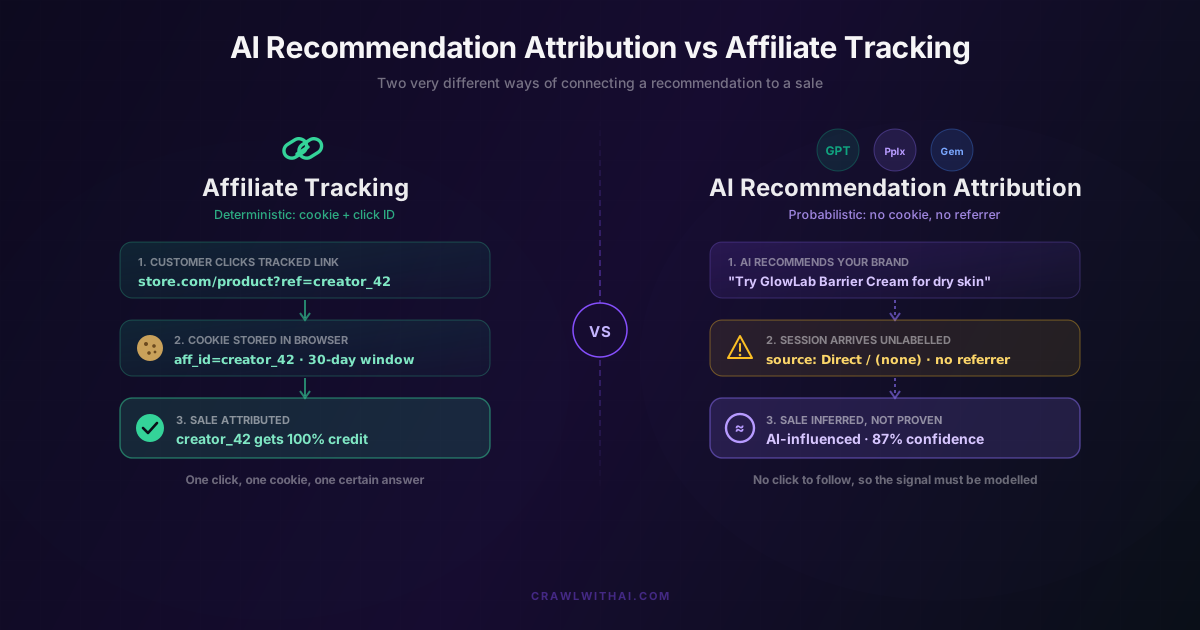
Affiliate marketing gives you a receipt. A customer clicks a partner link, a cookie lands in their browser, they buy, and the commission goes to the exact person who sent them. Every step is logged. You can audit it line by line and pay out on the numbers.
AI recommendation attribution gives you none of that. When ChatGPT tells a shopper to buy your barrier cream, there is no partner link, no cookie, and often no referrer at all. The shopper reads the answer, types your domain into the browser, and buys. Your analytics records a direct visit and an anonymous order. The recommendation that drove the sale leaves no trace you can click on. Both are ways of connecting a recommendation to a sale, but they work on completely different mechanics, and treating them the same is how stores end up underpaying attention to the channel that is growing fastest.
What affiliate tracking actually does
Affiliate tracking is a counting system. It was built to answer one question with certainty: which partner sent this buyer? The mechanism is deterministic, meaning the same inputs always produce the same answer.
Here is the chain. A partner shares a link with a unique identifier, something like store.com/product?ref=creator_42. The shopper clicks it. A cookie drops into their browser recording the affiliate ID, the click time, and the campaign. When the shopper checks out inside the cookie window, the system reads the cookie and assigns the sale to that partner.
Most programs use last-click attribution and a 30-day cookie window as the industry default, according to Post Affiliate Pro, though windows range from 24 hours on Amazon Associates to 60 days on ClickBank. The point is that the answer is never a guess. There is a click event, a stored token, and a rule. US affiliate marketing spending will exceed 12 billion dollars in 2025, per eMarketer, and companies only pour that kind of budget into a channel they can measure to the cent.
Why AI recommendation attribution has no equivalent receipt
AI recommendation attribution is the problem of crediting a sale to an AI platform that recommended your store. And it starts from a disadvantage that affiliate tracking never had: there is usually nothing to click.
When ChatGPT, Perplexity, or Gemini names your brand in an answer, the recommendation is text. The shopper often does not click a link inside the chat at all. They read the answer, remember the name, and come back later through a browser tab, a branded Google search, or a direct URL. No affiliate link means no cookie. No cookie means no stored token to read at checkout.
Even when the shopper does click a link from an AI answer, the session frequently arrives with no source data. Many AI platforms, especially mobile apps, do not pass a referrer header. One analysis of roughly 450,000 AI-adjacent visits found that around 70 percent arrived with no referrer and were logged as Direct in Google Analytics 4. So the one moment where you might catch the referral gets erased in transit. This is the same reason UTM parameters break on ChatGPT traffic: the tagging system assumes a link with parameters survives the journey, and here it does not.
Meanwhile the volume is not small. Adobe Digital Insights reported that AI-driven traffic to US retail sites jumped 12 times over between July 2024 and February 2025. The channel is scaling fast, and the tracking is scaling nowhere.
Deterministic versus probabilistic: the core difference
The cleanest way to hold the two apart is this. Affiliate tracking is deterministic. AI recommendation attribution is probabilistic.
Deterministic means the system knows. There was a click, the click carried an ID, the ID was stored, and the sale matched it. No inference required. If the cookie says creator_42, then creator_42 gets paid. You could defend it in court.
Probabilistic means the system infers. There is no click ID to read, so you assemble circumstantial signals and estimate a likelihood. Did an AI platform recommend this store recently? Did a matching product get bought soon after by a customer with no other traceable source? Does the order arrive as Direct rather than from a known ad or email? Each signal nudges a probability up or down. The output is not "this sale came from ChatGPT." The output is "this sale is 87 percent likely to be AI-influenced." That is a different kind of answer, and pretending it is as crisp as a cookie read will get you in trouble.
This is not a flaw you can engineer away. It is structural. AI recommendations happen in a conversation you do not own, on a platform that does not hand you a click ID. The best AI recommendation attribution can do is model the signal well, which is why confidence scoring exists.
The three things affiliate tracking has that AI attribution lacks
It helps to name exactly what goes missing when you move from affiliate to AI.
First, the click. Affiliate tracking has a discrete click event with a timestamp. AI recommendations are often read and acted on without any click at all, so there is no event to anchor to.
Second, the identifier. An affiliate link carries a partner ID that travels with the click. AI answers carry your brand name in prose, not a machine-readable tag, so nothing labels the source.
Third, the persistence. A cookie stores the affiliate ID for days or weeks, bridging the gap between click and purchase. AI referrals leave no token behind, so if the buyer returns three days later, there is nothing in the browser tying them to the recommendation.
Lose all three and last-click attribution does not just get less accurate. It gets structurally blind, because it is looking for a final click that never carried the source. That is the mechanism behind why last-click attribution misses most AI-driven revenue.
How you actually attribute an AI-influenced sale
If there is no cookie to read, what do you do instead? You reconstruct the likely path from signals you can see.
Start with the supply side. You can monitor when AI platforms actually mention your brand and which products they recommend, because you can query the platforms and watch how often your store appears. That gives you a baseline of AI recommendation activity over time.
Then match it to demand. When Direct and branded-search orders rise in the days after your AI mention rate climbs, and those orders feature the products AI was recommending, the correlation is a signal. Add order timing, landing pages, and the absence of any other trackable source, and you can assign each order a confidence score rather than a false certainty.
This is the opposite workflow to affiliate tracking. Affiliate tracking starts from a known click and looks forward to the sale. AI attribution starts from the sale and looks backward through probability to the likely cause. Neither is wrong. They are just built for different evidence.
Why the difference changes your budget decisions
Here is why none of this is academic. If you judge AI the way you judge affiliates, by direct clicks with attached IDs, AI will always look like a rounding error, and you will defund it.
Adobe found that 34 percent of consumers use AI assistants to research products before buying later through traditional search or direct visits. Read that again. A third of shoppers now let AI shape the decision, then complete the purchase through a channel that steals the credit. Your affiliate dashboard is precise and your AI contribution is invisible, so the precise number wins the budget meeting every time. That is a measurement artifact, not a real signal about value.
The same Adobe data shows AI traffic was 43 percent less likely to convert than non-AI traffic in July 2024, but by February 2025 that gap had narrowed to just 9 percent. The channel is closing in on parity while most attribution setups still score it near zero. If you keep waiting for an affiliate-style receipt before you invest, you will be late to a channel your competitors are already feeding. Shopify's own reporting makes this worse, which is a topic we cover in why Shopify analytics misses AI-referred orders.
What not to do about the gap
The instinct is to force AI into the affiliate mold. Resist it. A few traps are common.
Do not assume you can drop affiliate links into AI answers and track them like partners. You do not control the output of ChatGPT or Gemini, and the platforms rewrite, summarise, or omit links as they see fit. Building your measurement on links you cannot place is a plan that fails quietly.
Do not treat all Direct traffic as loyal, branded, returning customers. A rising share of Direct is now AI discovery arriving without a referrer. Counting it as brand strength hides the AI channel that created it.
And do not demand cookie-level certainty from a probabilistic system before you act. If you wait for proof that matches an affiliate payout, you will wait forever. Confidence scoring is the honest answer, and a well-built model beats a precise number that measures the wrong thing.
How CrawlWithAI closes the gap
CrawlWithAI is built for the probabilistic side of this problem, not the deterministic one. Instead of hunting for a click ID that AI never provides, it monitors when ChatGPT, Perplexity, Gemini, and other AI platforms actually reference your store, tracks which products and brand mentions are surfacing, and ties that activity to order data inside your Shopify store.
That gives you the piece affiliate tools already have and AI analytics usually miss: a defensible link between a recommendation and the revenue that follows it. Not a cookie, because there is no cookie, but a confidence-scored attribution that shows how much of your income is AI-influenced, kept separate from the direct and branded-search buckets that would otherwise absorb the credit. You keep affiliate tracking for your partners and add a measurement layer built for the channel that does not behave like one. The result is a revenue picture where AI stops being the invisible line item and becomes a number you can plan around.
FAQ
Can I just put affiliate links into AI answers and track them the normal way? No. You do not control what ChatGPT, Perplexity, or Gemini output. They mention brands by name without any link, or rewrite links entirely. You cannot reliably place a tracked affiliate URL inside an AI recommendation, so the affiliate model has nothing to attach to.
Is AI recommendation attribution less accurate than affiliate tracking? It is less certain by nature, not less useful. Affiliate tracking reads a stored cookie and returns a definite answer. AI attribution infers from signals and returns a confidence score. For a channel with no click ID, a good probabilistic estimate is the accurate answer.
Does Google Analytics 4 track AI referrals the way it tracks affiliate clicks? Not reliably. Affiliate clicks carry parameters that GA4 reads on arrival. Many AI sessions carry no referrer, especially from mobile apps, so GA4 logs them as Direct. One analysis found roughly 70 percent of AI-adjacent visits landed as Direct, indistinguishable from bookmarks or typed URLs.
What confidence level is high enough to act on? There is no universal threshold, but treat AI attribution like a portfolio, not a receipt. You do not need every order proven to 100 percent. You need a consistent, well-modelled estimate of the AI-influenced share so budget decisions reflect reality. Trends over time matter more than the figure on any single order.
Should I replace affiliate tracking with AI attribution? No. They measure different channels and both are real. Keep affiliate tracking for the partners who send clicks you can count. Add AI attribution for the recommendations that send buyers with no click to follow. The mistake is running only the deterministic system and assuming the probabilistic channel does not exist.
Sources
- eMarketer, US Affiliate Marketing Spending Will Exceed 12 Billion in 2025: https://www.emarketer.com/chart/c/353804/us-affiliate-marketing-spending-will-exceed-12-billion-2025-353804
- Adobe Digital Insights, The Explosive Rise of Generative AI Referral Traffic (May 2025): https://business.adobe.com/blog/the-explosive-rise-of-generative-ai-referral-traffic
- Post Affiliate Pro, Recommended Cookie Lifetime for Affiliate Programs: https://www.postaffiliatepro.com/faq/recommended-cookie-lifetime-affiliate-programs/
- Traffic Masters, What Is Direct Traffic in GA4 and Why AI Is Inflating It: https://www.traffic-masters.net/blog/what-is-direct-traffic-in-ga4-and-why-ai-platforms-are-making-it-worse/
- Google Analytics 4 Attribution Documentation: https://support.google.com/analytics/answer/10596866