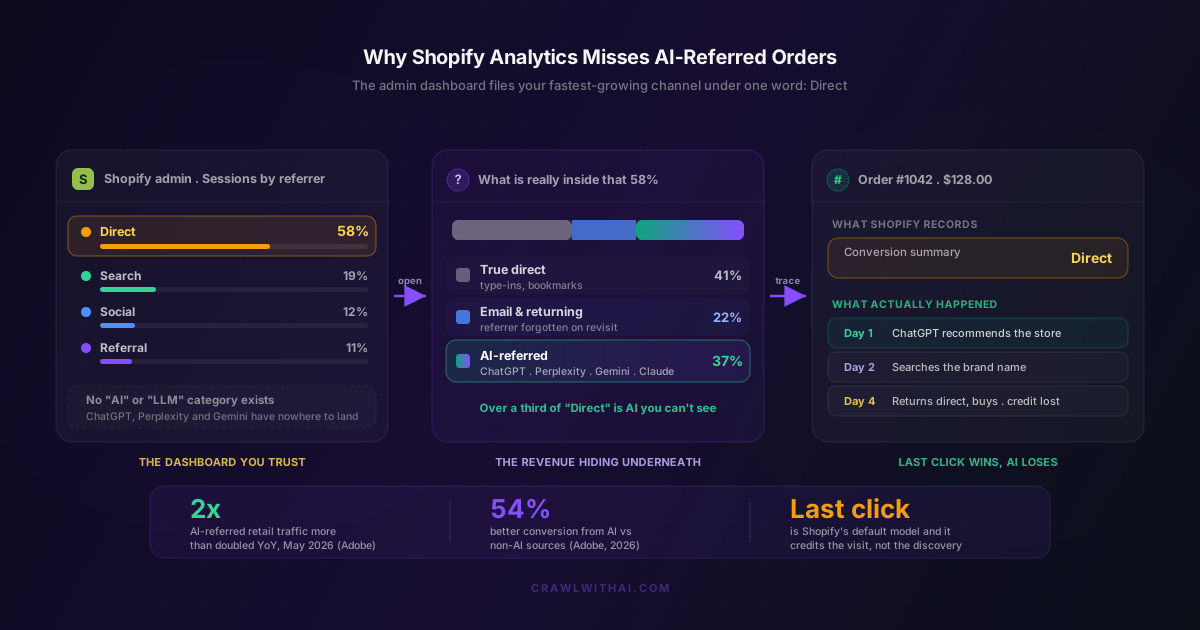
Your revenue is climbing and the Shopify dashboard tells a clean story. Direct is your biggest channel, and it keeps growing. So you do the natural thing and read it as a good sign. Loyal customers typing your name from memory. Word of mouth doing its job. A brand strong enough that people come straight to you.
Most of that read is wrong. A large and growing slice of your Direct bucket is not loyalty at all. It is ChatGPT, Perplexity and Gemini sending you pre-sold buyers, and Shopify analytics has no way to tell you that. This is not a tracking pixel you forgot to install or a setting buried three menus deep. The built-in reports were designed for a web where every visit carried a referrer, and AI assistants quietly broke that assumption. Here is exactly where the misses happen, and what they cost.
How Shopify Analytics Decides Where an Order Came From
Open Analytics, then Reports, then Sessions by referrer. That report is the foundation of how Shopify sorts your traffic. For each visit it reads the referrer, the small piece of data a browser sends that says where the click came from. Then it drops the session into a broad bucket: Direct, Search, Social, Referral, or Email.
When a sales metric meets a marketing dimension, Shopify also runs an attribution model to assign credit for the order. The default is last click. Whatever source touched the customer last gets the sale. The whole system leans on cookies stored on the shopper's device, one to identify the visitor and one to track the session. A session closes after 30 minutes of inactivity and resets at midnight UTC.
That design is fine for the channels it was built around. Click an ad, the referrer says so. Click an email link, the referrer often carries it. The trouble starts when a customer arrives from a source that hands Shopify nothing to read, which is exactly what AI assistants do.
Why AI Assistants Land in the Direct Bucket
Shopify has one rule when a session shows up with no referrer. It calls it Direct. That is the right call for someone who typed your URL or opened a bookmark. It is the wrong call for the growing crowd arriving from AI, because AI traffic strips the referrer in three common ways.
Many assistants attach rel="noreferrer" to outbound links, which tells the browser to send nothing. The ChatGPT and Perplexity mobile apps open links in an in-app browser that drops the referrer before the request reaches your store. And plenty of people copy a URL out of an AI answer and paste it into a fresh tab, which carries no referrer at all. In every case the session reaches Shopify naked. No referrer, no UTM tag, nothing. So it lands in Direct, sitting in the same row as a loyal repeat customer. We pulled this apart in detail in AI-referred sessions versus direct traffic, and the short version is that your Direct bucket has become a hiding place.
Shopify Analytics Has No AI Channel at All
Suppose the referrer does survive. Say a desktop ChatGPT session passes chatgpt.com through to your store. You would think Shopify could catch it. It cannot give it a fair name, because there is no AI category in the native reports. There is no row for ChatGPT, no row for Perplexity, no row for assistants of any kind. A surviving AI referrer falls into Referral and gets lumped together with every forum, blog and random backlink that ever pointed at you.
This is the part that separates Shopify's built-in analytics from a tool like GA4. In GA4 you can write a custom channel group with a regex rule that catches chatgpt.com, perplexity.ai and the rest, and at least cluster them under one AI label. We walked through that setup in how to track AI traffic in Google Analytics 4. Shopify's native reports do not offer custom channel definitions. The referrer groupings are fixed and broad, so even the AI traffic that arrives correctly labeled has nowhere sensible to go.
Last-Click Attribution Buries the AI Touch That Started It All
Here is the journey that breaks Shopify's model. A shopper asks ChatGPT for the best option in your category. ChatGPT names your brand and explains why. The shopper does not buy on the spot. They sit with it for a day, search your brand name to double-check, browse, leave again, then come back two days later and buy.
Shopify's default last-click model credits the final touch. That last visit was a direct type-in or a branded search, so that is what gets the sale. The ChatGPT recommendation that introduced your brand and did the actual convincing earns nothing in the report. This is the same structural flaw we covered in why last-click attribution misses your AI-driven revenue, and inside Shopify it is the default behavior, not an edge case you opted into. The channel that started the purchase is invisible precisely because it was first, not last.
The Cookie Window Forgets Your Buyer Came Back
AI shoppers do not behave like impulse buyers, and that works against Shopify's tracking. Adobe found that people who arrive from an AI referral spend 53% more time on retail sites and browse 23% more pages per visit than other shoppers. They are researching, comparing, and taking their time across multiple sessions.
Shopify's session logic is not built for that pace. A session ends after 30 minutes of inactivity and resets at midnight UTC, and identity rests on a cookie that may not survive a multi-day gap, a device switch, or a cleared cache. By the time the AI-referred shopper returns to buy, the original context is gone. Shopify already does this with email, attributing a sale to Direct when a customer clicks an email, leaves, and comes back later without clicking again. AI discovery makes that gap wider, because the research-to-purchase window is measured in days, not minutes.
Shopify's Agentic Checkout Numbers Only Cover One Slice
Shopify has started tagging orders that complete inside an assistant. When a shopper buys through ChatGPT's agentic checkout, that order can arrive labeled with the AI platform it came from. That is a real improvement, and if you sell through those surfaces you should watch those numbers.
It only covers the orders that finish inside the AI. That is the small slice. The far larger group discovers you in an AI answer, clicks through to your normal storefront, and checks out there in their own time. Those orders flow through the same referrer-and-cookie machinery as everything else, which means they keep landing in Direct. The agentic checkout tag is a clean signal for one narrow path. It tells you almost nothing about the much bigger wave of AI-influenced buyers who shop on your own site.
What the Shopify Analytics Blind Spot Costs You
This would be a footnote if AI traffic were a rounding error. It is the opposite. Citing more than a trillion visits to US retail sites, Adobe reported that AI-referred traffic more than doubled year over year in May 2026, up 138%, and has grown 1,324% since the company started tracking it in October 2024. In its Q1 2026 report Adobe measured a 393% year-over-year jump in AI-sourced traffic to US retail sites. And this traffic converts. Adobe found AI-referred visits converted 54% better than non-AI sources, because the assistant did the comparison shopping before the customer ever reached you.
So the fastest-growing, best-converting channel in retail is the exact one your Shopify dashboard cannot name. When that revenue piles up inside Direct, you make three expensive decisions. You under-invest in the product data and content that earned the AI recommendations, because the report says AI drives nothing. You over-credit branded search and email, which often just catch a buyer an AI already sold. And you read a swelling Direct bucket as brand loyalty, when much of it is fresh AI demand wearing a disguise. That misread is the engine of the dark funnel problem, where buyers research through AI and surface as anonymous direct visits.
How CrawlWithAI Closes the Gap
CrawlWithAI approaches this from the side Shopify cannot see. Instead of waiting for a session to land and trying to reverse-engineer its origin from a referrer that no longer exists, it monitors when ChatGPT, Perplexity, Gemini and other assistants mention and recommend your store. It tracks which of those recommendations drive clicks, then ties that activity back to the orders in your Shopify store.
The change is in the timing. Identification happens when the AI references you, not when a browser hands over a referrer the app already deleted. So the orders that vanish into Direct under Shopify's native reports get counted, because the signal comes from the AI side of the conversation rather than the broken handoff at your front door. You get a revenue layer that sits on top of Shopify analytics and shows how much of your income is genuinely AI-influenced. If you have read our breakdown of AI-referred sessions versus direct traffic, this is the missing measurement that makes the difference visible instead of theoretical.
FAQ
Why does my Shopify store show so much Direct traffic? Because Shopify files any session with no referrer as Direct, and a growing share of your visits now arrive with no referrer. AI assistants strip referrer data through noreferrer links, in-app browsers, and copy-pasted URLs. Email clicks and returning visitors add to the pile. The result is a Direct bucket that mixes true type-ins with AI-referred buyers Shopify cannot distinguish.
Can I see AI traffic in Shopify's built-in analytics? Not as its own channel. Shopify's native reports use fixed, broad referrer groups and do not let you create custom channel definitions, so there is no AI or LLM row. Most AI sessions arrive with no referrer and land in Direct, and the few that keep a referrer get lumped into Referral with every other website.
Does Shopify track ChatGPT orders now? Only the orders that complete inside ChatGPT's agentic checkout, which can arrive tagged with the platform. The much larger group of shoppers who discover you in an AI answer and then buy on your own storefront still flows through the standard referrer and cookie system, so those orders keep landing in Direct.
How much AI revenue is my Shopify store missing? It depends on how much of your traffic comes from mobile apps and pasted links, but the gap is large. With AI-referred retail traffic more than doubling year over year and most of it arriving without a referrer, a store that does not track AI separately can easily undercount its AI-influenced orders by a third or more.
Should I use GA4 instead of Shopify analytics for AI traffic? GA4 gives you more room because you can build a custom channel group to cluster known AI domains, which Shopify's native reports do not allow. But GA4 still relies on a referrer surviving the trip, so it misses the same no-referrer sessions. Closing the gap properly means measuring from the AI side, where the recommendation actually happens.
Sources
- Digital Commerce 360, Adobe: AI-referred traffic to retail sites doubles in a year (June 2026): https://www.digitalcommerce360.com/2026/06/17/adobe-ai-referred-traffic-to-retail-sites-doubles-in-a-year/
- Adobe Business, AI traffic surges across industries, retail sees biggest gains: https://business.adobe.com/blog/ai-driven-traffic-surges-across-industries
- Adobe Business, The explosive rise of generative AI referral traffic: https://business.adobe.com/blog/the-explosive-rise-of-generative-ai-referral-traffic
- Shopify Help Center, Acquisition reports (Sessions by referrer and attribution): https://help.shopify.com/en/manual/reports-and-analytics/shopify-reports/report-types/default-reports/acquisition-reports
- Shopify Help Center, Marketing reports and attribution models: https://help.shopify.com/en/manual/reports-and-analytics/shopify-reports/report-types/default-reports/marketing-reports