Your Shopify dashboard shows an order. $148.00. Source: direct. But the customer first heard your brand name three days earlier, when they asked ChatGPT for the best running shoes for flat feet and your store came up. Did AI drive that sale or not? Last-click says no. Your gut says probably. Neither of those is a number you can put in a budget.
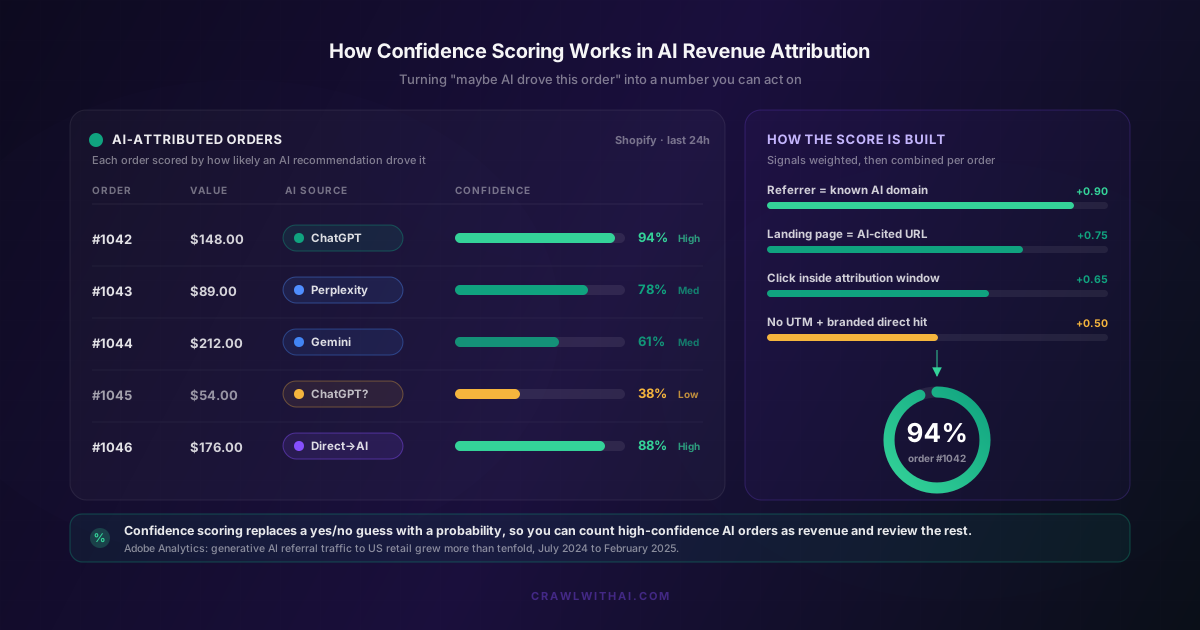
That gap is the whole problem, and confidence scoring is how you close it. Instead of forcing every order into a yes or a no, AI revenue attribution with confidence scoring assigns each order a probability that an AI recommendation influenced it. Order #1042 might score 94%. Order #1045 might score 38%. Now you have something better than a guess: a calibrated estimate you can sort, threshold, and report.
Why AI revenue attribution needs a probability, not a yes or no
Traditional attribution was built for clean clicks. A customer clicks a tagged ad, lands on your site, buys. The chain is unbroken, so the credit is certain.
AI breaks that chain in three places. Many AI platforms strip the referrer header, so the session arrives with no source. The link a customer clicks from a chat answer rarely carries a UTM parameter, because the AI generated the URL, not your marketing team. And the most common pattern is not a click at all. The customer reads an answer, remembers your name, and comes back later by typing your domain or searching your brand. We covered that pattern in detail in why UTM parameters break with ChatGPT traffic.
So for AI channels, certainty is gone. You cannot prove a specific order came from ChatGPT the way you can prove it came from a tagged Google ad. Last-click attribution responds to that uncertainty by crediting AI with zero, which is wrong in a measurable way. The honest answer is not zero and it is not 100%. It is a probability. Confidence scoring is the method that produces it.
This matters more every quarter. Adobe Analytics reported that traffic to US retail sites from generative AI sources grew more than tenfold between July 2024 and February 2025. Capital One Shopping research put US generative AI shopping adoption at roughly 59% of consumers in 2026. A channel that big cannot sit in your reports as a rounding error labelled "direct."
What a confidence score actually is
A confidence score is a number, usually 0 to 100, that represents how likely it is that an AI platform influenced a given order. It is not a claim of fact. It is the model telling you its best estimate based on the signals it can see.
This is the same idea that powers probabilistic attribution across the rest of marketing. As Northbeam describes it, deterministic data gives you certainty where you have it, and probabilistic models fill the gaps where you do not. A 90% confidence match carries more weight than a 60% inference, and both carry more than a blind guess.
The output you want is three bands. High confidence orders, say 85% and above, are safe to count as AI-influenced revenue. Medium confidence orders, roughly 60 to 84%, are worth tracking as a trend but not banking on. Low confidence orders, below 60%, are flagged for review or excluded. The bands turn a fuzzy probability into a decision.
The signals that feed a confidence score
A score is only as good as the evidence behind it. These are the signals that move the number, roughly in order of how much they should count.
The strongest signal is a referrer header from a known AI domain. If a session arrives from chatgpt.com, perplexity.ai, or gemini.google.com, that is close to deterministic and should push the score high on its own.
Next is the landing page. If the page the customer arrives on is a URL that AI platforms are actually citing for your brand, that is strong corroboration. AI answers tend to link the same product and comparison pages repeatedly, so a hit on one of those pages is meaningful.
Then comes timing. If the order or session falls inside a sensible attribution window after a known AI citation event, that raises confidence. If your store appeared in a wave of ChatGPT answers on Tuesday and your direct orders spiked Wednesday, the timing is not a coincidence.
After that, the session pattern. An order with no UTM, no paid click, and a branded or direct arrival is exactly the fingerprint of AI-influenced demand. On its own it is weak, because plenty of direct traffic is just loyal customers. Combined with the signals above, it tips the balance.
Weaker supporting signals include new versus returning customer status, order value relative to your average, and whether the customer's first session matches an AI referral. None prove anything alone. Together they sharpen the estimate.
How the signals become a single number
The mechanics are less mysterious than they sound. Each signal gets a weight. The model combines the weights for an order, then maps the total to a 0 to 100 score. A referrer match might be worth 0.90, a cited landing page 0.75, a timing match 0.65, a no-UTM branded hit 0.50. Fire the top two and an order lands in the high band. Fire only the weakest and it lands in the low band, flagged.
The hard part is not the arithmetic, it is calibration. A confidence score is only useful if 80% confidence actually means roughly an 80% chance the order was AI-influenced. AdExchanger has made this point clearly in its coverage of probabilistic attribution: the models drift, and they need regular validation to stay honest. If you never check the scores against reality, you end up with confident numbers that are quietly wrong.
The way to keep scores calibrated is to anchor them on the cases where you do have certainty. Every clean referrer match, every AI session that does carry through with a known source, becomes a training example. You use the deterministic cases you can see to tune how much weight the probabilistic signals deserve. This is the deterministic-anchor, probabilistic-layer approach that Northbeam recommends, applied specifically to AI channels.
High, medium, low: how to read the bands
The point of scoring is to change what you do, so the bands need clear actions.
High confidence orders are revenue you can report. When you tell a stakeholder that AI drove a certain dollar figure last month, you are summing the high band. These are the orders where the evidence is strong enough that treating them as AI-influenced is the accurate call, not an optimistic one.
Medium confidence orders are a trend line, not a total. Watch them over time. If your medium band is growing month over month while you invest in AI visibility, that is a real signal even before any single order crosses into high confidence. Do not add them to your headline number, but do not ignore them either.
Low confidence orders are noise control. Their job is to stop the system from overclaiming. A model that calls everything AI is as useless as one that calls nothing AI. The low band is where you put the maybes so they do not inflate your results.
This banded approach is what makes confidence scoring more defensible than the alternatives. First-click attribution would hand AI 100% of credit for any journey it touched, which overstates. Last-click hands it nothing, which understates. The score sits in between and shows its work. If you want the fuller comparison of models, we wrote about how multi-touch attribution handles AI referrals.
Where confidence scoring goes wrong
Three failure modes are worth knowing before you trust any score.
The first is bad input data. If your store is not capturing first-party session data cleanly, the model has nothing to weigh and every score collapses toward the middle. No model rescues a broken pixel.
The second is uncalibrated weights. A vendor that ships fixed weights and never validates them against your actual orders is selling false precision. Your store's AI mix is not the same as the next store's. The weights have to be tuned to your data and rechecked as AI platforms change how they cite.
The third is double counting. If an order is genuinely driven by a paid retargeting ad and you also score it as AI-influenced, you have credited the same dollar twice across two reports. Confidence scoring has to live alongside your other channels, not on top of them. The cleanest setups treat the AI score as one input into a multi-touch picture, not a separate ledger. This is the same trap that makes Shopify's built-in analytics miss AI orders in the first place, just from the opposite direction.
How CrawlWithAI brings confidence scoring to AI revenue attribution
CrawlWithAI builds the score from the side most tools cannot see. Rather than waiting for a session to arrive and trying to reverse engineer its source from a referrer that may not exist, it monitors when ChatGPT, Perplexity, Gemini and other AI platforms actually mention and cite your store. That citation activity becomes the timing and corroboration signal that browser-side tracking lacks.
It then ties that AI activity to your Shopify order data and assigns each order a confidence score, sorted into high, medium and low bands. You see how much of your revenue is genuinely AI-influenced, with an explicit confidence level attached, instead of a pile of orders labelled direct.
Because the scoring is anchored on observed AI citation events and tuned against the orders where the source is clear, the numbers stay calibrated as the platforms shift. The result is a revenue figure you can defend in a budget meeting: not a guess, not zero, but a probability with the evidence behind it. For the bigger picture on why this revenue hides in the first place, start with why last-click attribution misses most AI-driven revenue.
FAQ
What confidence threshold should I use to count AI revenue? Most stores set the high band at 85% and above and report only that band as AI-influenced revenue. That keeps your headline number conservative and defensible. Track the 60 to 84% medium band separately as a trend, and exclude anything below 60% from totals.
Is confidence scoring the same as data-driven attribution in GA4? No. GA4 data-driven attribution distributes credit across touchpoints it can already see, and AI sessions that arrive as direct are invisible to it. Confidence scoring is built specifically to estimate the likelihood that AI influenced an order even when the session carries no clean source. They solve different parts of the problem.
Can I build confidence scoring myself in GA4? Partially, and with real effort. You can flag sessions from known AI referrer domains and build custom segments, but GA4 cannot see the citation activity happening inside the AI platforms, and it cannot easily score the delayed direct visits that make up most AI-influenced orders. The signal you most need lives outside your analytics.
Does confidence scoring double count revenue with my paid channels? It can if you treat the AI score as a separate ledger. Used correctly, the score is one input into a multi-touch view, so an order influenced by both a paid ad and an AI recommendation is split, not counted twice. Check that your AI numbers reconcile against total store revenue.
How accurate is a confidence score? As accurate as its calibration. A score is trustworthy when 80% confidence really does mean roughly an 80% chance the order was AI-influenced, which requires validating the model against orders where the source is known. A system that is never checked against reality drifts.
Sources
- Adobe, The explosive rise of generative AI referral traffic: https://business.adobe.com/blog/the-explosive-rise-of-generative-ai-referral-traffic
- Capital One Shopping, AI Shopping Statistics 2026: https://capitaloneshopping.com/research/ai-shopping-statistics/
- Salesforce State of Commerce: https://www.salesforce.com/resources/articles/state-of-commerce/
- Northbeam, Probabilistic vs Deterministic Attribution: https://www.northbeam.io/blog/probabilistic-vs-deterministic-attribution-marketing
- AdExchanger, The Pros And Cons Of Probabilistic Attribution: https://www.adexchanger.com/data-driven-thinking/the-pros-and-cons-of-probabilistic-attribution/