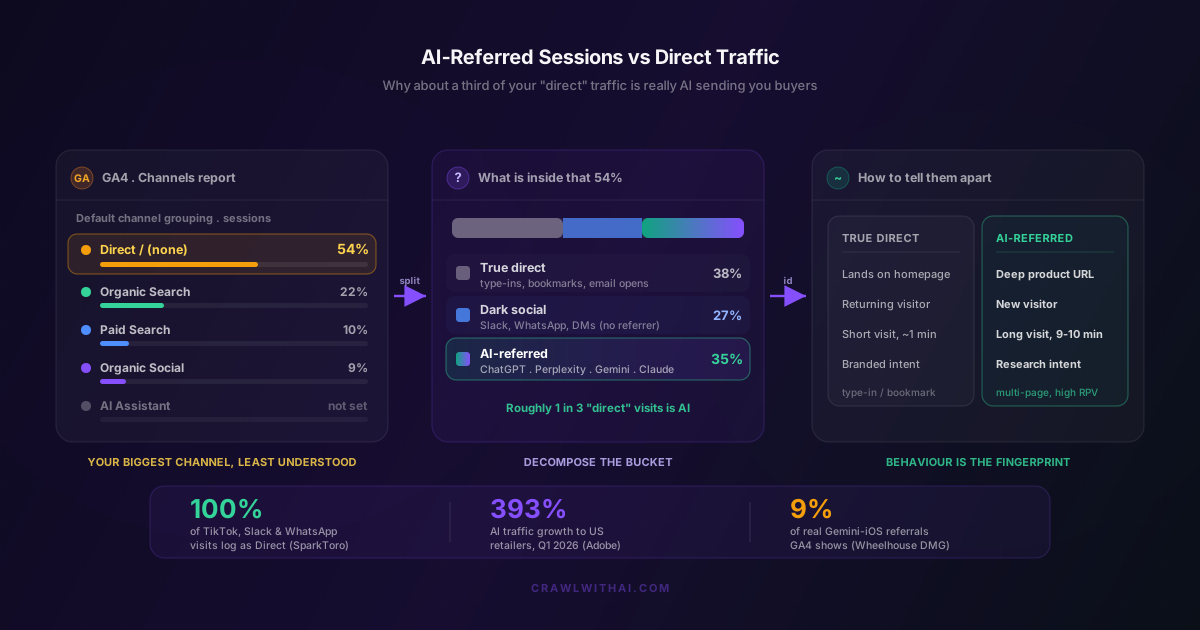
A shopper opens ChatGPT, asks for the best waterproof hiking boots under 150 dollars, reads the answer, taps the link to your store, and buys a pair twenty minutes later. That order just funded your week. Open Google Analytics 4 the next morning and you will find that sale filed under Direct, in the same bucket as the person who typed your domain from memory. That AI-referred session, the channel that actually introduced the buyer to your brand, gets no line of its own.
This is the quiet measurement problem most Shopify stores have right now. AI-referred sessions and direct traffic look identical in analytics, so they get lumped together, and the fastest-growing slice of your revenue wears the disguise of your most boring one. If you read Direct as loyal repeat buyers, you misread your best new acquisition channel as old demand. Telling the two apart is the difference between knowing where growth comes from and guessing.
What Direct Traffic Actually Means in GA4
Direct is not a channel. It is what GA4 writes down when it cannot figure out where a visit came from. No referrer header, no UTM tags, no campaign data, so the session gets dropped into Direct as a fallback. The label is a confession of ignorance, not a real source.
Plenty of legitimate traffic belongs there. Someone types your URL, clicks a bookmark, opens a link from a desktop email client, or follows a link out of a PDF. But the bucket fills with far more than that, because any platform that fails to pass referrer data dumps its traffic into Direct too. SparkToro proved how leaky this is back in 2023, when it ran 1,113 real visits across 11 networks and watched the analytics. Every single visit from TikTok, Slack, Discord, Mastodon, and WhatsApp, 100 percent of them, landed as Direct with no referral information at all. SparkToro also noted that 95 percent of its own site traffic shows up as Direct in Google Analytics, a figure it knows is false. Direct has been a junk drawer for years. AI just became the biggest thing inside it.
What an AI-Referred Session Actually Is
An AI-referred session is a visit that started because an assistant named or linked your store inside an answer. The buyer asked ChatGPT, Perplexity, Gemini, Claude, Copilot, or Grok a shopping question, the model recommended you, and they clicked through. The comparison shopping happened inside the chat before the person ever reached your site.
That origin makes these sessions behave nothing like a type-in. The visitor arrives already informed and often already sold, because the AI did the research and the filtering on your behalf. Adobe Analytics, in data reported by TechCrunch in April 2026, found that AI traffic to US retail sites grew 393 percent year over year in the first quarter of 2026, and that those AI visitors converted 42 percent better than non-AI traffic. The same buyers also generated 37 percent higher revenue per visit. This is not fringe traffic. It is your most valuable cohort, and it answers to the name Direct.
Why AI-Referred Sessions Collapse Into Direct
The collapse happens because the referrer disappears, and the referrer is the one signal GA4 uses to separate a genuine direct visit from a referred one. Three things strip it. Many AI platforms attach rel="noreferrer" to outbound links, which tells the browser to send no source data. The native mobile apps open links in an in-app browser that drops the referrer before the request reaches your server. And a large share of people copy a URL out of an answer and paste it into a fresh tab, which carries no referrer by definition.
The scale of the loss is easy to underestimate. Wheelhouse DMG documented a case where server logs captured 56 visits from Gemini on iOS while GA4 recorded only 5 of them as referrals, about 9 percent of the real number. The other 91 percent went straight to Direct. The same agency described a brand that found 50,000 dollars misattributed to Direct until it built a dedicated AI channel. This is the same mechanism we covered in why UTM parameters break when traffic comes from ChatGPT. No tag, no referrer, no way for GA4 to know, so the session defaults to the junk drawer.
The Fingerprint That Tells AI-Referred Sessions From Direct
You cannot recover a referrer that was never sent. But AI-referred sessions and true direct traffic behave differently once they land, and behaviour is the fingerprint when the source data is gone. Four tells do most of the work.
Landing page is the strongest. A genuine direct visitor lands on your homepage or a page they already know, because they typed it or bookmarked it. An AI-referred visitor lands on a deep product page or a specific collection URL that no human types from memory, because the model handed them that exact link. A Direct session whose landing page is a long product URL is almost never a type-in.
New versus returning is the second tell. True direct skews returning, because people who navigate straight to you usually already know you. AI-referred sessions skew new, because the assistant is making a first introduction. The third tell is depth and time on site. Adobe found AI visitors browse 13 percent more pages per visit and spend 48 percent longer on the site than non-AI visitors. A slice of your Direct traffic that browses deep and stays long does not match the profile of a quick bookmark click.
The fourth tell is conversion. If your Direct cohort converts and earns well above your real direct baseline, that lift is AI hiding inside the bucket, because pre-qualified AI buyers convert at the higher rates Adobe measured. None of these four is proof on its own. Together they let you carve a credible AI-referred segment out of an undifferentiated Direct number. This is also the cleanest way to separate AI traffic from the other source it gets confused with, which we break down in organic search traffic versus AI-referred traffic.
How to Separate AI-Referred Sessions From Direct in GA4
Start by catching the AI sessions that do arrive with a source. Build a custom channel group in GA4 with a regex rule that matches known AI referrers and source values like chatgpt.com, perplexity.ai, gemini.google.com, claude.ai, and copilot.microsoft.com. That pulls the tagged and referred slice out of Direct and Referral into its own channel. Google's native AI Assistant channel, added to the Default Channel Group in May 2026, does some of this automatically for ChatGPT, Gemini, Copilot, and Grok, though Perplexity still falls into Referral and AI Overviews still count as Organic Search.
Regex handles the easy part. The hard part is the session with no referrer and no tag, which no rule can match because there is nothing in the request to match on. For that residue, build an exploration in GA4 that filters Direct down to sessions where the landing page is not your homepage and the user is new. That combination is a strong proxy for an AI-referred visit, and watching it over time tells you the direction of travel even when you cannot label every session perfectly. A fuller walkthrough lives in our guide on how to set up AI traffic attribution in Google Analytics 4. The honest takeaway is that GA4 alone gets you a useful estimate, not a clean count.
Why Getting the Split Wrong Costs Real Money
This would be a harmless reporting quirk if the numbers were small. They are not, and a wrong Direct figure quietly bends three decisions. You under-invest in the product data and content that earn AI recommendations, because the dashboard credits AI with almost nothing while crediting Direct with a swelling, mysterious total. You over-fund branded search and email, which often just intercept a customer the AI already sold days earlier. And you read a growing Direct bucket as proof of brand loyalty and repeat purchase, when a large part of it is fresh first-time demand that an assistant created.
Each mistake points your budget at the wrong place. The pattern is the same misread that makes last-click attribution miss most of your AI-driven revenue, and the inflated Direct line is where it hides. Industry analyses now estimate that AI and other unattributed referral traffic makes up between 15 and 35 percent of a typical site's Direct, depending on the category. Running your marketing on a Direct number that wrong is expensive, and the cost stays hidden until you wonder why your best-converting channel looks like it barely exists.
How CrawlWithAI Separates AI Revenue From Direct
CrawlWithAI works the problem from the AI side instead of the browser side. Rather than waiting for a session to arrive and trying to reconstruct a source from a referrer that was already deleted, it monitors when ChatGPT, Perplexity, Gemini, and other assistants mention and recommend your store. It tracks which of those recommendations drive clicks, then ties that activity back to orders in your Shopify store.
The advantage is timing. Identification happens at the moment the AI references you, not at the moment a browser is supposed to hand over a referrer it no longer has. So the deep-link, new-visitor sessions that vanish into Direct under standard analytics still get counted, because the signal comes from the conversation, not the request header. You end up with a revenue layer that shows how much of your income is genuinely AI-influenced, sitting alongside whatever GA4 reports, so you can finally see the channel your Direct bucket has been hiding.
FAQ
Why do my AI-referred sessions show up as Direct in GA4?
Because the session arrives with no referrer and no UTM tag. AI platforms often add rel="noreferrer" to links, their mobile apps strip the referrer in an in-app browser, and copy-pasted links carry no referrer at all. With nothing to read, GA4 defaults the visit to Direct, the same bucket as a type-in or a bookmark.
How can I tell whether my direct traffic is really AI? Look at four behaviours. AI-referred visits tend to land on deep product or collection URLs rather than your homepage, come from new rather than returning visitors, browse more pages and stay longer, and convert above your normal direct rate. A Direct cohort that lands deep, is mostly new, and converts well is AI in disguise.
Is AI-referred traffic the same as organic search traffic? No. Organic search comes from a clicked search result and usually still passes a recognisable source. AI-referred traffic comes from an assistant's answer and frequently arrives with the referrer stripped, which is why it lands in Direct instead of Organic. We compare the two in detail in our post on organic search versus AI-referred traffic.
Does GA4's AI Assistant channel separate AI sessions from Direct on its own? Partly. The channel added in May 2026 recognises ChatGPT, Gemini, Copilot, and Grok automatically, which is a real improvement. But it can only classify sessions whose referrer survived the trip, so the in-app and pasted visits that strip the referrer still land in Direct. Perplexity also still falls into Referral.
How much of my direct traffic could actually be AI? It varies by category and by how much of your audience uses mobile AI apps, but analyses put unattributed AI and referral traffic at roughly 15 to 35 percent of a typical site's Direct. Stores that do not track AI separately tend to undercount their AI-influenced orders significantly.
Sources
- SparkToro, New Research: Dark Social Falsely Attributes Significant Percentages of Web Traffic as Direct: https://sparktoro.com/blog/new-research-dark-social-falsely-attributes-significant-percentages-of-web-traffic-as-direct/
- TechCrunch, AI Traffic to US Retailers Rose 393% in Q1, and It Is Boosting Their Revenue Too (April 2026): https://techcrunch.com/2026/04/16/ai-traffic-to-us-retailers-rose-393-in-q1-and-its-boosting-their-revenue-too/
- Wheelhouse DMG, AI Traffic Is Already in Your Analytics: https://www.wheelhousedmg.com/insights/articles/ai-traffic-is-already-in-your-analytics/
- Adobe, Generative AI-Powered Shopping Rises with Traffic to US Retail Sites: https://business.adobe.com/blog/generative-ai-powered-shopping-rises-with-traffic-to-retail-sites
- Google, GA4 Default Channel Group and the AI Assistant channel: https://support.google.com/analytics/answer/9756891