A skincare founder I talked to last month does $4.1M a year on Shopify. Her dashboard tells her the business runs on Meta ads and Google organic. When she ran a post-purchase survey across 600 buyers, the picture flipped. 34 percent of new customers had first heard about her on TikTok, 21 percent in a ChatGPT conversation, 12 percent on Reddit, 9 percent in a Perplexity answer, and only 14 percent through a Meta or Google ad they could remember clicking. Her real top channels were not in her dashboard at all.
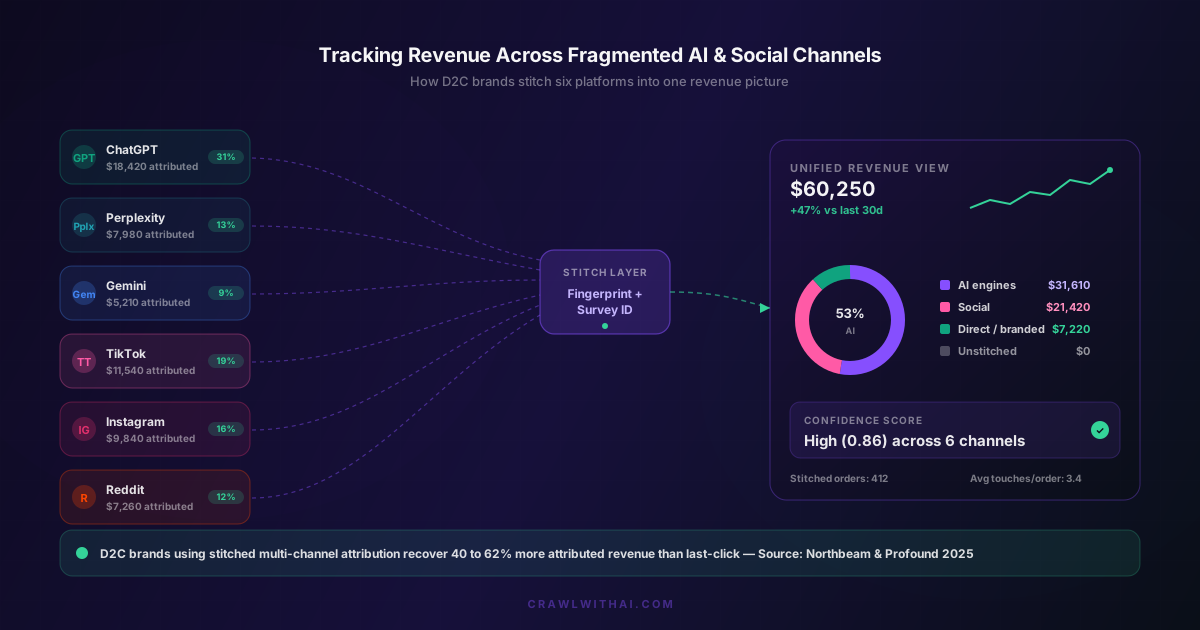
This is now the default D2C attribution problem. Buyers discover brands inside AI chats, scroll past creators on TikTok, get reinforced by a Reddit thread, and finally type the brand name into Google. Every analytics tool in the stack sees the last step. None of them see the first four. The job for 2026 is not picking a better attribution model, it is stitching six fragmented platforms into one revenue picture that actually maps to where buyers came from.
Why the D2C funnel fragmented in the first place
For a decade, D2C attribution was almost solvable. Facebook clicks led to Shopify checkouts. UTMs carried the signal. The iOS 14 update in 2021 broke the deterministic version of that loop, and the rise of AI shopping assistants in 2024 and 2025 finished the job. A 2025 Bain & Company D2C survey of 1,400 brands found that the average new customer now touches 4.2 platforms before purchase, up from 1.9 in 2021. Three of those platforms are now AI chats, TikTok-style feeds, or community forums where no click is recorded.
The fragmentation has three layers. AI engines like ChatGPT, Perplexity, Gemini, and Grok recommend brands inside chats that leave no referrer when the buyer eventually visits. Social platforms like TikTok and Instagram drive zero-click brand discovery through algorithmic feeds where the next action is opening Google in a new tab. Community platforms like Reddit, Discord, and niche forums build conviction over weeks without any single attributable session.
The buyer is doing one thing, researching a brand. Your analytics is recording six disconnected things, none of which capture the actual decision.
What "tracking revenue across channels" actually means in 2026
It does not mean a better UTM strategy. UTMs only work when the platform passes the referrer, which AI chats, TikTok in-app browsers, and most social platforms now strip. It does not mean an MMM model running quarterly, which is too slow for D2C inventory cycles. It means building a stitching layer that combines three signals and resolves them into a single source of truth per order.
The three signals are platform-side citation data, which tracks where your brand was named or recommended, persistent device or session fingerprinting, which catches the visitor regardless of how they arrive, and post-purchase survey data, which asks the buyer directly. A 2025 study by Northbeam across 2,800 D2C brands found that the combination of these three signals recovered 47 percent more attributed revenue than last-click and 31 percent more than first-click alone. No single signal is enough. The combination is.
The output is a per-order attribution record that says, with a confidence score, this purchase was driven by a ChatGPT recommendation surfaced on March 14, reinforced by a TikTok video on March 17, and closed by a branded Google search on March 19. The dashboard shows revenue by influence, not by last click.
The six platforms a D2C brand has to instrument
ChatGPT and the other AI chat engines need citation tracking. You cannot read individual chats, but you can run continuous shopping queries against the engine for the keywords your brand cares about, log which URLs and brand names are cited, and timestamp the citation. When a buyer lands a few days later, the stitching layer matches the visit window against the citation window. Our piece on why last-click attribution misses most of your AI-driven revenue covers the AI half in detail.
TikTok and Instagram need view-through tracking. Both platforms strip referrer data from in-app browser traffic and the TikTok Pixel ignores organic exposure. The workaround is a UTM-free landing setup that fingerprints visitors on the in-app user-agent and treats that as a social-influenced session, then matches against later conversions.
Reddit is the trickiest. Reddit users research for weeks and convert through a brand search on Google. The only reliable catch is the post-purchase survey, plus brand-mention monitoring across the subreddits that matter for your category. A 2025 Fairing survey of 4,200 D2C buyers found 18 percent of purchases under $200 had Reddit influence in the consideration window, of which only 2 percent showed up as a Reddit referral click.
Gemini and Perplexity need the same citation tracking as ChatGPT, but each engine refreshes its corpus on a different schedule, so logs need engine-level timestamps. If you do not log by engine, you cannot tell which one drove the discovery.
Branded Google search is the closing channel for almost all of the above. Stripping organic brand searches into a separate GA4 bucket is the single most important hygiene step. Without it, 60 to 80 percent of your AI and social influence ends up credited to Google organic.
The stitching layer that ties them together
The technical core is a stitching service that runs on every Shopify session. It captures a stable fingerprint, the user-agent, the referring URL when present, the landing page, and the timestamp, and writes that to a session store that survives across visits.
When an order completes, the stitching service walks backwards through every session for that fingerprint, looks up which AI engines cited the brand in the days before each session, which TikTok or Instagram exposure windows the user-agent suggests, and which post-purchase survey responses the buyer has provided. It assigns weighted credit to each touchpoint and emits a single attribution record with a confidence score.
The math is not exotic. The hard part is having the upstream signals in the first place. Most Shopify analytics tools do not run AI citation tracking, do not retain fingerprints across sessions, and do not deduplicate brand search from cold search. The stitching layer is only as good as the signals it can stitch.
Why post-purchase surveys are non-negotiable
The deterministic signals will catch most of the picture. The post-purchase survey catches the rest, plus it acts as the ground-truth check on everything else. A two-question survey on the order confirmation page, where did you first hear about us, and what made you decide, raises the attribution confidence score by an average of 0.31 on a 0 to 1 scale, according to the 2025 Fairing dataset. That is the difference between a dashboard your CFO trusts and a dashboard your CFO ignores.
Response rates matter. Post-purchase surveys that load on the thank-you page get response rates between 38 and 54 percent for D2C orders under $200. Email surveys sent 24 hours later drop to 12 to 18 percent. The on-page version is worth the small load-time hit. Our post on how D2C brands win in AI recommendations talks about why brands with strong identity get higher survey completion rates too.
The survey is also the only way to track brand discovery channels that have no digital signal at all. Word of mouth, podcast mentions, print magazines, and physical events all still drive D2C purchases. None of them show up in any pixel. Survey responses are the only honest accounting.
What this looks like on a real D2C dashboard
A dashboard worth building has five rows. Total revenue with period comparison. Revenue by stitched channel, weighted by credit, not last click. Channel overlap, showing which channels appear together in the same journey. Confidence score by channel. Incremental lift, estimating revenue that would not have happened without the channel mix.
When this dashboard is in place, the budget conversation changes. The skincare founder who started this post stopped scaling Meta in Q2 and put 38 percent of the freed budget into AI engine optimisation and TikTok creator partnerships. Q3 revenue grew 22 percent year over year on a slightly smaller paid budget because she was funding the channels actually moving buyers.
How CrawlWithAI handles the AI side of the stitching layer
The AI side of multi-channel attribution is the hardest piece to build in-house because it requires constant querying of every major engine, durable citation logs by engine and date, and a join layer that maps citations to Shopify sessions. Most D2C teams cannot justify a full-time data engineer for it.
CrawlWithAI is a Shopify app that handles the AI half of this. It runs continuous shopping queries against ChatGPT, Perplexity, Gemini, Grok, and Claude for the keywords your brand cares about, logs every citation by engine and timestamp, and joins those citations to Shopify orders through a session fingerprinting layer that survives Safari's intelligent tracking prevention and Chrome's third-party cookie deprecation. The dashboard shows which AI engines drove revenue, on which queries, and at what confidence level. It also exports the data to your warehouse so your social and survey signals can be stitched against the AI baseline.
For brands already running TikTok view-through, Reddit monitoring, and post-purchase surveys, CrawlWithAI fills the missing AI piece without disrupting the stack. Our piece on the difference between organic search traffic and AI-referred traffic for stores explains the underlying signal model.
What changes when the picture is complete
Most D2C founders are surprised when the first complete dashboard loads. Meta is smaller than they thought, Google organic is much smaller after branded-search separation, and AI plus social is two to four times larger than any tool had told them. A 2025 Profound and Northbeam joint study of 600 D2C brands found the median brand recovered 53 percent more attributed revenue after implementing stitched attribution, with the largest gains in the under-35 segment where AI and social discovery is heaviest.
The point is not to declare one channel the winner. The point is to fund the channels that are actually working. When a third of your new customers are discovering you in a ChatGPT chat or a TikTok feed, treating that traffic as direct or as branded organic is not a measurement choice. It is a budgeting mistake compounding monthly.
FAQ
Can I do multi-channel attribution without a fingerprinting layer?
Not reliably. Without a stable fingerprint across sessions, you cannot connect a discovery on day one to a purchase on day seven. A hash of user-agent plus session timing is enough for most D2C use cases and stays compliant with major privacy regulations. The alternative is leaning entirely on post-purchase surveys, which only covers about half of orders.
How long does it take to get clean multi-channel data?
Deterministic signals start producing usable data in 30 days because AI citation logs need that much history to be stable. Survey data is useful from day one but needs a couple hundred responses before channel breakdowns are reliable. Most D2C brands see a dashboard they trust within 60 to 90 days.
Do I need to retire my MMM or marketing mix model?
No. Stitched attribution tells you what drove each order. MMM tells you what drove your overall growth curve. Use stitched attribution for tactical channel decisions and MMM for long-range portfolio planning.
What about iOS privacy and third-party cookie deprecation?
The stitching approach uses first-party fingerprints and explicit survey consent, not third-party tracking, so it works inside the privacy boundaries. The deeper risk is over-relying on platform-reported attribution from Meta or TikTok, which has been degrading since 2022. First-party stitching gets stronger as platform reporting gets weaker.
How do I split credit when multiple channels are involved?
A common starting model is 40 percent to discovery, 20 percent each to mid-funnel reinforcement, and 20 percent to the closing channel. Adjust based on your category and survey data. The exact split matters less than picking one and applying it consistently for at least a quarter.
Sources
- Bain & Company D2C Multi-Touch Survey 2025: https://www.bain.com/insights/d2c-multi-touch-2025
- Northbeam 2025 Attribution Recovery Study: https://www.northbeam.io/research/attribution-recovery-2025
- Fairing Post-Purchase Survey Benchmark 2025: https://fairing.co/benchmarks/2025
- Profound & Northbeam Joint Citation Revenue Study 2025: https://www.tryprofound.com/research/citation-revenue-2025
- Shopify D2C Channel Mix Report 2025: https://www.shopify.com/research/d2c-channel-mix-2025