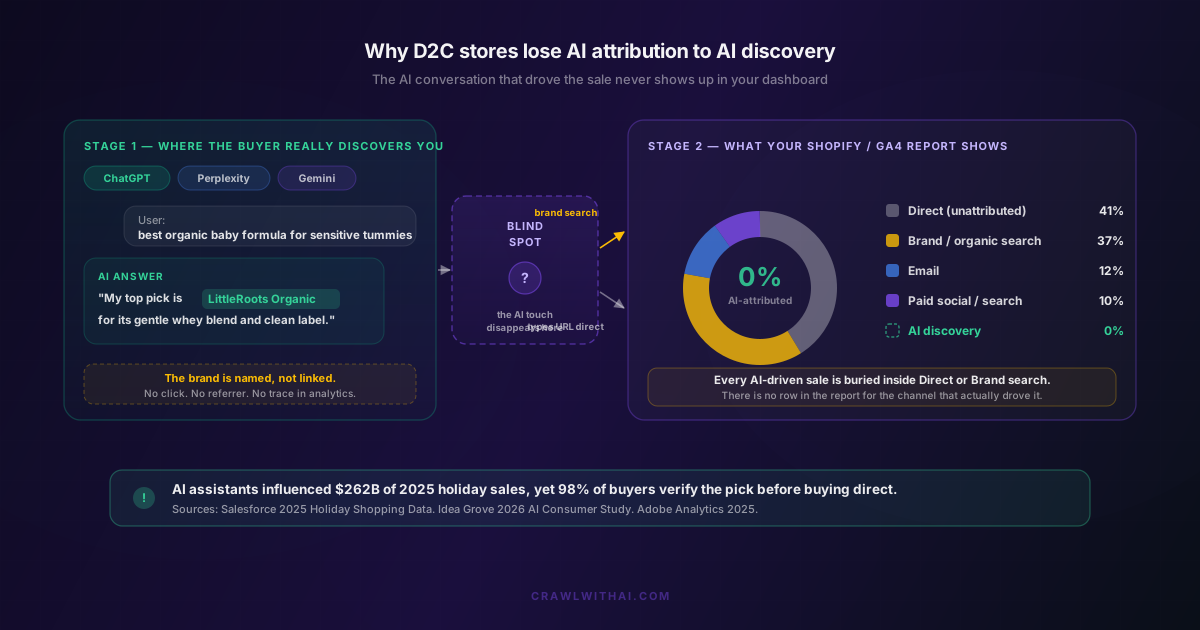
A direct-to-consumer founder checks her Shopify dashboard after a strong month. Direct traffic is up. Branded search is up. She decides word of mouth is finally compounding and her SEO retainer is paying off. What she cannot see is that a large share of those buyers first heard her brand name inside a ChatGPT answer, then opened a new tab and searched for her. Her store has an AI attribution problem, and nothing in her reporting tells her it exists.
This is the quiet tax on D2C brands in 2026. You own your store, your customer data, and your checkout, which should mean you see the whole journey. But when an AI assistant does the recommending, the one touch that mattered most never reaches your analytics. The sale lands in your reports as direct or branded search, your real discovery channel reads zero, and every budget call you make off that dashboard rests on a number that is wrong.
What discovery through AI actually looks like for a D2C brand
Start with the mechanics, because the attribution gap is a side effect of how people actually use these tools. A buyer asks ChatGPT, Perplexity, or Gemini something like "best organic baby formula for sensitive tummies." The model returns a short list of brands by name. The buyer does not click a blue link the way they would on Google. They read the answer, pick a name they like, and go find that brand on their own terms.
That behavior is now common enough to matter. Salesforce reported that 5 percent of all shoppers now start their product search with an AI chat assistant, rising to 10 percent for Gen Z, and that 39 percent of shoppers used an AI chat at some point during their shopping journey over the 2025 holiday season. Adobe Analytics found that traffic to US retail sites from generative AI sources jumped roughly 1,200 percent between July 2024 and February 2025. The volume is small next to Google today, but it is the fastest-growing discovery surface in retail, and it is growing on a behavior that your analytics was never built to record.
Why D2C brands lose AI attribution that marketplaces keep
Here is the part that stings for D2C specifically. A marketplace seller barely feels this problem. When an AI assistant recommends a product that lives on Amazon, the buyer who follows up lands on Amazon, and Amazon books the sale without caring which channel sent it. The marketplace owns such a dominant share of the buyer's attention that the discovery source becomes a rounding error inside its own funnel.
A D2C brand has the opposite setup. You depend on people reaching your owned store, and you depend on reconstructing how they got there. When AI recommends you by brand name, and AI overwhelmingly recommends brands rather than specific SKUs, the natural next step for the buyer is a branded Google search. That search hands the credit to Google organic, not to the AI conversation that planted the name. You have no second dataset to cross-check against, so the misattribution goes unquestioned. The brands most exposed to this are exactly the ones AI tends to surface: focused, well-reviewed, story-driven stores. We wrote more about why D2C brands are winning in AI recommendations, and the same traits that get you recommended are the traits that get your attribution stolen.
The three exits that launder an AI sale into something else
Once the AI names your brand, the buyer takes one of three actions, and all three erase the AI touch.
The first is branded search. The buyer types your name into Google and clicks the top result, which is usually your own store. Google Analytics 4 records this as google / organic. The AI conversation is gone.
The second is direct navigation. The buyer types your URL, uses a saved tab, or taps a name they already half-remember. GA4 logs this as (direct) / (none). Most D2C stores already see direct absorbing 30 to 40 percent of traffic, so nobody notices when it quietly swallows AI-driven sales too.
The third, and increasingly common, is a click inside the AI interface itself. ChatGPT, Perplexity, and Gemini now ship inline product links and citations. When a buyer clicks one, the referrer might read chat.openai.com or perplexity.ai, but those domains sit in the "Other" or "Referral" bucket of a channel grouping you configured years ago, with no path back to the query that triggered the visit. We broke down this exact failure mode in our post on why last-click attribution misses your AI-driven revenue.
How big is the AI attribution gap really
The gap is large and it is widening. The mechanic that makes it worse is verification. An Idea Grove 2026 study of 1,000 US consumers found that 98 percent of people verify an AI recommendation before buying. Verification almost always means leaving the chat to search the brand or read reviews, which is the precise moment the AI credit gets handed to another channel. The more buyers trust AI for discovery, the more they verify, and the more your attribution leaks.
The volume behind the gap keeps climbing. TechCrunch, citing Adobe data, reported that ChatGPT referrals to retailers grew 28 percent year over year heading into late 2025. Bain and Company found that a meaningful share of online shoppers had used an AI assistant to research a purchase in the prior month, and a majority of them said the conversation influenced what they bought. Independent estimates of the size of the undercount land in a consistent range: D2C stores with a strong AI citation presence tend to under-report AI-influenced revenue by 40 to 60 percent on last-click models. Whatever your exact figure, the direction is the same. The channel your dashboard says is zero is not zero.
What the missing attribution actually costs you
Bad attribution is not just an accuracy annoyance. It quietly steers your spending in the wrong direction. When your reports credit Google organic and direct for sales that AI actually drove, the rational move looks like pouring more into SEO and branded paid search. So you bid on your own brand terms and pay an agency to defend rankings you already hold, because buyers were told your name by an AI before they ever searched.
Meanwhile the real driver, your visibility inside AI answers, gets no budget, because it does not appear as a line in any report. You also misread your own growth story. "Word of mouth is working" feels good and costs nothing to believe, but if the truth is "ChatGPT recommends us for three high-intent queries," those are two completely different businesses to run. One you cannot influence. The other you can win or lose deliberately. Founders who track this properly stop guessing about why direct traffic moves. For a fuller treatment of the measurement side, see our guide on tracking D2C revenue across AI and social channels.
How to start tracking AI discovery before you have perfect data
You do not need a perfect model to stop flying blind. Four moves get you most of the way.
First, fix your GA4 channel groupings so chat.openai.com, perplexity.ai, gemini.google.com, and copilot.microsoft.com break out into their own AI channel instead of dissolving into "Other." This captures only the buyers who click straight from the AI, which is the minority, but it is a clean, deterministic signal you can trust.
Second, add a post-purchase "how did you hear about us" survey at checkout. It is the bluntest tool available and also one of the most honest, because it asks the buyer directly about a touch your tracking cannot see. When the AI share in that survey runs far ahead of the AI share in GA4, you have measured your blind spot.
Third, watch the correlation between your brand search volume and your presence in AI answers. When AI starts recommending you for a query, branded search tends to rise a week or two later. That lag is a fingerprint of AI-driven demand showing up as organic.
Fourth, monitor whether AI engines are citing your store at all, and for which queries. Without that, you are matching sales to a conversation you cannot prove happened.
How CrawlWithAI closes the AI attribution gap
CrawlWithAI is the Shopify app built for this exact blind spot. It tracks how often your store is cited in ChatGPT, Perplexity, Gemini, and Grok answers, for which queries and which products, then matches those citations against your real Shopify order data to produce a corrected revenue number that includes AI-influenced sales.
The app handles the part that manual setup cannot. It runs the brand-search-lift correlation for you, applies a confidence score to every attributed order so you can choose how conservative your reporting is, and surfaces the result inside your Shopify admin in plain language. You do not rebuild your attribution model or rewrite your GA4 setup. You keep your existing reports and add an AI revenue layer on top. For most D2C stores running it for 60 days, the AI-attributed share of revenue moves from the zero their dashboard showed to somewhere between 18 and 45 percent. The orders were always there. Now the channel that drove them has a name.
FAQ
Why does my Shopify dashboard show so much "direct" traffic?
A large share of "direct" is not truly direct. It is buyers who learned your name somewhere your tracking could not see, including AI chats, and then typed your URL or searched your brand. Direct is where untracked discovery goes to hide, and AI has added a fast-growing source of it.
If AI does not send a click, how can anything track it?
Through two signals. The deterministic one is the small but real stream of clicks that come straight from the AI interface with a chat.openai.com or perplexity.ai referrer. The probabilistic one is citation tracking matched to brand-search lift and order timing, which produces a confidence-scored estimate of how much of your direct and branded revenue is AI-influenced.
Do marketplaces like Amazon have this attribution problem too?
Far less. The marketplace captures the sale regardless of the discovery channel and does not need to reconstruct the journey. D2C brands carry the full burden of attribution themselves, which is why the AI gap hits owned stores hardest.
Should D2C brands stop investing in SEO because AI is driving discovery?
No. AI engines build their answers from web content, so the pages that rank well are often the pages that get cited. The mistake is treating SEO as your only investment because broken attribution makes it look like the only thing working. Fund AI visibility as its own line once you can see it.
How fast does AI attribution data become useful?
The deterministic referral data is useful immediately. The probabilistic citation and brand-lift data needs a few weeks to establish a baseline, and tends to become reliable enough for budget decisions inside about 60 days.
Sources
- Salesforce, "Salesforce Reveals 2025 Holiday Shopping Data": https://www.salesforce.com/news/stories/2025-holiday-shopping-data/
- Adobe, "Adobe Analytics: Traffic to US Retail Websites from Generative AI Sources Jumps 1,200 Percent": https://blog.adobe.com/en/publish/2025/03/17/adobe-analytics-traffic-to-us-retail-websites-from-generative-ai-sources-jumps-1200-percent
- TechCrunch, "ChatGPT referrals to retailers' apps increased 28% year-over-year, says report": https://techcrunch.com/2025/12/02/chatgpt-referrals-to-retailers-apps-increased-28-year-over-year-says-report/
- Idea Grove, 2026 AI Consumer Study (1,000 US consumers), reported via industry coverage: https://ideagrove.com/
- Bain & Company, "How AI is changing consumer behavior in retail" (2025): https://www.bain.com/insights/
- Google Analytics 4 documentation on default channel groupings: https://support.google.com/analytics/answer/9756891