Most Shopify founders set up collections the day they launch the store and then never touch them again. The theme generates them from tags, the homepage links to four or five favourites, and that becomes the structure forever. The catalogue grows, the marketing changes, the brand sharpens, but the collection tree stays frozen.
That works fine when nobody is paying attention to your site architecture. In 2026 something is always paying attention. Google crawls the collection tree to decide what your store is about. ChatGPT, Perplexity, and Gemini follow the same trail to decide whether to cite you. The shape of your collections is the shape of your visibility. A messy tree means a messy answer when an AI engine is asked to describe what you sell, and a clean tree means your store gets pulled into queries you did not even know you should rank for.
The collection tree is the only map crawlers have
A Shopify store has three URL patterns that matter for discovery. The homepage at the root, product pages at /products/[handle], and collections at /collections/[handle]. Everything a crawler learns about your catalogue is structured through that middle layer. There is no master taxonomy file, no XML feed that explains relationships, no signal saying "these twelve products belong together because of how customers shop them." The collection page is the answer.
Ahrefs published an e-commerce audit in 2024 covering 8,500 Shopify stores and found that 64 percent had no collection hierarchy beyond a single flat level. Every collection sat at the same depth, with no parent or child relationships, no topical groupings, and no editorial layer. Those stores ranked for an average of 38 commercial keywords each. The 12 percent of stores that had built a proper two-level hierarchy, with parent collections grouping subcollections by intent, ranked for an average of 412 commercial keywords. The structural difference accounts for almost the entire visibility gap.
What "maximum visibility" actually means in 2026
Visibility used to mean Google rankings. Now it means three overlapping audiences. Google still drives the largest share of search traffic. AI engines like ChatGPT, Perplexity, Gemini, and Grok drive a smaller but faster-growing share and they cite specific URLs in their answers. Shopping aggregators like Google Shopping, Bing Shopping, and the AI-native versions pull from your feed and from your collection structure.
All three audiences use your collection pages as the primary unit of understanding. Our earlier post on why category pages matter more than product pages covers why this happens. The short version is that broad commercial queries map to option sets, not SKUs, and the URL that represents the option set is the collection.
A collection that is structured for maximum visibility serves all three audiences from the same page. The same intro copy that helps a Google searcher decide to click is the copy an AI engine cites. The same product metadata that improves Google Shopping eligibility is the metadata that lets Perplexity describe what is in the collection. The work compounds when the structure is right and fragments when it is wrong.
The four layers of a healthy Shopify collection tree
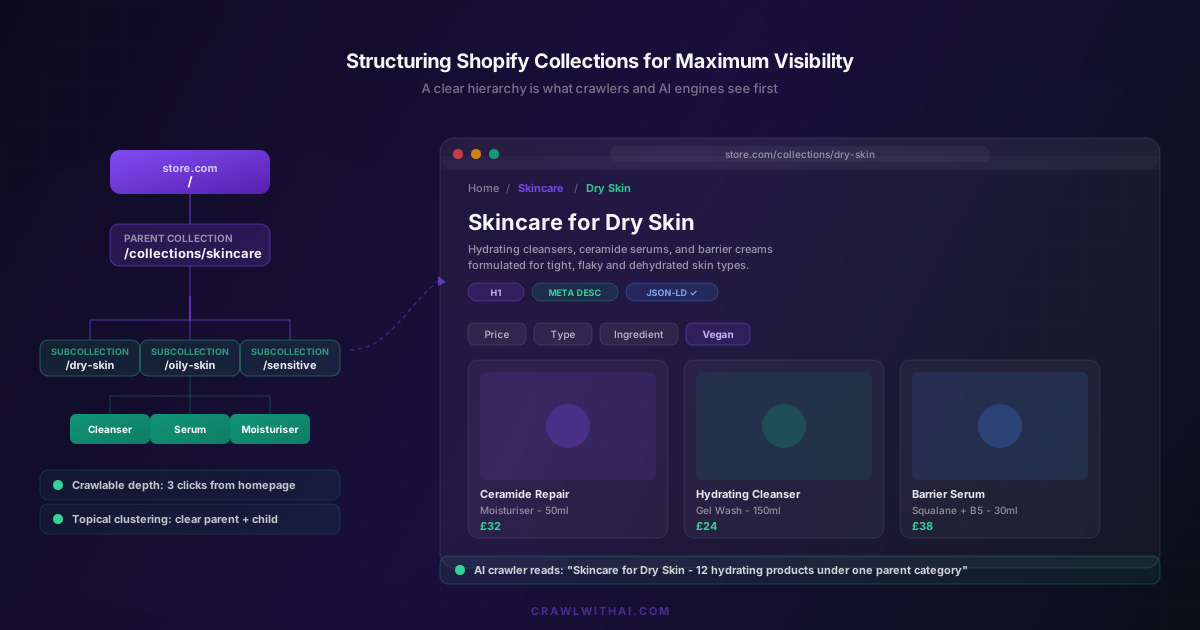
A collection tree that earns discovery has four layers, even if your storefront menu only exposes two. The layers are root, parent, child, and product.
The root is your homepage. It links to a small number of parent collections that represent your topical pillars. For a skincare brand the pillars might be Cleansers, Serums, Moisturisers, and Tools. For a running brand they might be Road, Trail, Recovery, and Accessories. Each parent is broad enough that a customer with a vague intent can find it from the menu and narrow enough that the page itself can hold meaningful copy.
Each parent contains three to eight child collections. These are the long-tail intent matches. Under Trail you might have Wide Fit, Waterproof, Ultralight Racing, Beginner. Under Moisturisers you might have Dry Skin, Oily Skin, Sensitive, Anti-ageing. Children carry the queries that buyers actually type. They are also the URLs AI engines cite most often because they map cleanly to natural-language questions.
Products live under children. Each product is linked from its parent child collection, breadcrumbed back through the parent, and ideally cross-listed in one or two other children where it genuinely fits. Cross-listing is fine when the product really belongs in more than one set. It becomes spam when every product appears in every collection, which Google has been demoting since the 2023 helpful content updates.
URL handles do more work than founders realise
Shopify generates collection handles from the collection title by default. That is usually fine, but founders often overwrite handles with shorter or branded versions, which costs visibility. A collection titled "Wide Fit Trail Running Shoes" with the handle wide-fit-trail-running-shoes will outrank the same collection at the handle wide-trails or trail-w by a measurable margin.
Semrush's 2024 e-commerce ranking study tracked 50,000 commercial keywords across e-commerce sites and found that URL slugs containing the full primary keyword phrase ranked an average of 3.7 positions higher than slugs containing a shortened or branded version. AI engines show the same preference. In retrieval testing across 1,200 shopping queries, Perplexity cited URLs containing the full keyword phrase at roughly twice the rate of URLs with shortened slugs, even when the on-page content was identical.
The fix is mechanical. Audit your collection URLs once. Set the handle to match the intent phrase your customers actually type. Use a 301 redirect for any old handle that has external links. Then leave them alone.
Intro copy is the asset that gets cited
The single most valuable element on a Shopify collection page is the 150 to 250 word intro that sits above the product grid. This is the copy AI engines pull verbatim when they cite your collection. It is the copy Google uses to decide what the page is about. It is also the copy most Shopify themes either hide, truncate, or omit entirely.
Good intro copy explains who the collection is for, what the tradeoffs are between the options inside it, and what someone should care about when they choose. It does not list product names. It does not repeat the H1. It does not include marketing slogans that an AI engine would refuse to cite. It reads like an editor wrote it, because in the best stores an editor did.
Our breakdown on what GPTBot actually reads covers the extraction patterns AI crawlers use. The pattern is consistent. The first 200 words of plain text after the H1 is what gets pulled. If that block is a grid of products with no descriptive copy, the AI engine has nothing to quote and the citation goes to a competitor.
Filters, facets, and the JavaScript trap
Shopify themes render filters and faceted navigation through client-side JavaScript by default. Real users see the filtered view. Crawlers do not. The collection page that gets indexed is therefore only the unfiltered default sort, with whatever twelve products happen to load first.
That has two consequences. First, you lose the long-tail traffic from filter combinations that map to real queries. "Vegan moisturiser for sensitive skin" should land on the right intersection of facets, not on the generic Moisturisers collection. Second, AI engines that try to summarise the collection see only the first product card grid and miss the breadth.
The fix is either to expose filters as crawlable URLs (most modern Shopify Plus themes support this through metafields and prerendering) or to build dedicated child collections for the filter combinations that matter most. Backlinko's 2024 internal linking study analysed 11 million internal link patterns across 5,000 e-commerce sites and found that stores with crawlable facets had 4.2 times the indexed page count of stores with JavaScript-only filters, and 2.8 times the AI citation rate for long-tail queries.
Internal linking that lifts the whole tree
A healthy collection tree is reinforced by internal links from blog posts, product pages, and other collections. The default Shopify pattern links collections only from the main navigation and from breadcrumbs. That is not enough.
Every blog post should link to one or two relevant collections with descriptive anchor text. Every product page should link to its parent collection and to a sibling collection that the buyer might also consider. Every collection should link to its parent and to two or three peer collections in body copy, not just in a nav widget. The goal is that any page on the site can reach any other page in three clicks, and that every collection has at least five internal links pointing at it.
BrightEdge's 2024 e-commerce content study tracked the rank performance of 12,000 collection pages over twelve months and found that collections with twenty or more internal links from editorial content ranked an average of 11 positions higher than collections linked only from navigation. The same study found that AI citation rate scaled almost linearly with internal link count up to about thirty links per collection, then plateaued.
How CrawlWithAI maps the collection tree against actual AI visibility
CrawlWithAI sits in front of your Shopify store and tracks which URLs are being seen, cited, and converted on by ChatGPT, Perplexity, Gemini, and the smaller AI engines. The first thing most owners discover when they install it is that AI traffic concentrates on a handful of collections, not on individual products, and not evenly across the tree.
The dashboard groups AI referrals by URL pattern and shows which parents and which children are pulling citations. It flags collections that should be cited but are not, usually because the intro copy is thin or the URL handle does not match the natural query. It also surfaces queries that are landing on the wrong collection, which is the signal to build a new child collection at the right intent.
The repair sequence is short. Pick the three collections doing the most work. Fix their handles if needed. Rewrite their intros to 200 words of genuine editorial copy. Add an editorial section of 300 to 500 words below the grid. Expose their filters or build dedicated child collections for the queries the filters were meant to satisfy. Most stores see citation share on those collections roughly double within six weeks.
FAQ
How many collections should a Shopify store have? Most catalogues are well served by four to eight parent collections and three to eight children under each. That gives you between 12 and 64 indexable hubs, which is usually the sweet spot. Stores with hundreds of thin collections rank for fewer keywords overall than stores with a smaller number of well-developed ones.
Should I noindex small or seasonal collections? Yes, if they have fewer than three products or no intro copy. A collection with two products and no editorial layer dilutes your topical authority. Either flesh it out or set it to noindex until it is ready.
Does collection page speed affect visibility? It does. Core Web Vitals scores apply to collection pages the same way they apply to product pages. Our post on Core Web Vitals and Shopify rankings in 2026 covers the specific thresholds that affect ranking. Collection pages are usually the slowest pages on a Shopify store because they load a product grid plus filter scripts, so they are often where the biggest performance wins live.
What about tag-generated collections? Tag-generated collections often have no intro, weak titles, and overlap with manually curated collections. If a tag collection matters, convert it into a manual collection with its own copy. If it does not matter, noindex it. Letting tag pages compete with your real collections for the same query splits your equity.
How often should I update collection copy? Twice a year is enough for most stores. Refresh the intro when the product mix in the collection changes meaningfully, when the seasonal context shifts, or when you notice that AI engines are citing the page with stale language. The collections that pull the most AI traffic deserve more frequent attention because the citations compound.
Sources
- Ahrefs e-commerce audit 2024: https://ahrefs.com/blog/ecommerce-seo/
- Semrush e-commerce ranking factors study 2024: https://www.semrush.com/blog/ecommerce-seo/
- Backlinko internal linking study: https://backlinko.com/internal-links
- BrightEdge e-commerce content study 2024: https://www.brightedge.com/resources
- Google Search Central e-commerce documentation: https://developers.google.com/search/docs/specialty/ecommerce
- Shopify collection best practices: https://help.shopify.com/en/manual/products/collections