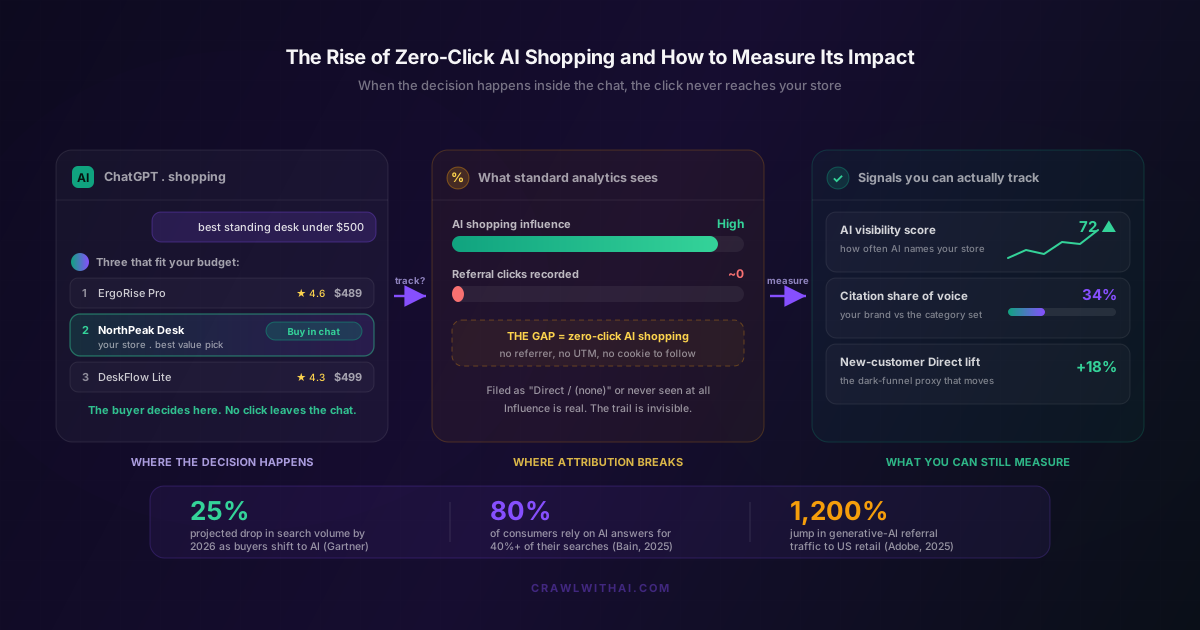
A buyer opens ChatGPT on their phone and asks for the best standing desk under $500. The assistant returns three options with a sentence on why each one fits. The buyer reads the answer, picks one, and moves to buy. At no point did they click a blue link, load a search results page, or pass through anything your Shopify analytics can read. This is zero-click AI shopping, and it is quietly becoming the default way people find and choose products.
The uncomfortable part is not that it is happening. It is that most stores cannot see it. When the decision happens inside the chat, there is no referrer, no UTM parameter, and often no click at all. The revenue still lands in your account, but your dashboard has no idea where it came from. This post explains what zero-click AI shopping is, why it is growing so quickly, and the practical ways to measure its impact even when the trail goes cold.
What Zero-Click AI Shopping Actually Is
Zero-click AI shopping is any purchase decision that gets made inside an AI assistant rather than on a search results page or a website you can track. The buyer asks a question, the model answers with specific product or brand recommendations, and the choice is effectively locked in before the person ever reaches your store.
It comes in two shapes. In the first, the buyer decides inside the chat and then buys the product without clicking through, either by completing the purchase in the assistant itself or by typing your brand name into the address bar later. In the second, the buyer clicks through to your site, but the recommendation that sent them was formed entirely inside the AI, so the credit belongs upstream even when a click exists.
The common thread is that the moment of persuasion moves off your property. Your product page used to be where you won or lost the sale. Now the shortlist is often set before anyone arrives. That shift changes what you need to optimize and, just as importantly, what you need to measure.
Why Zero-Click Shopping Is Growing This Fast
The behavior is not a fringe experiment anymore. Gartner has projected that traditional search engine volume will fall by 25% by 2026 as buyers move queries to AI chatbots and virtual agents. When a quarter of search demand shifts channel, product research shifts with it.
The consumer data backs this up. Bain & Company found that roughly 80% of consumers now rely on AI-generated answers for at least 40% of their searches, and that 42% of people using large language models already use them for shopping recommendations. People are not just asking AI to summarize news. They are asking it what to buy.
Search itself has been getting quieter for years, which primed buyers for this. According to SparkToro's analysis of clickstream data, close to 60% of US Google searches ended without a click in 2024, and by 2026 fewer than one in three searches still sends a click to an external site. Buyers have been trained to accept an answer in place of a list of links. AI assistants simply finish the job.
And the commerce traffic is following. Adobe Analytics reported that traffic to US retail sites from generative AI sources jumped roughly 1,200% between July 2024 and February 2025, and kept climbing through the 2025 holiday season. Adobe also found that shoppers arriving from AI assistants were more engaged and more likely to convert than the average visitor. The channel is small in absolute terms for many stores, but it is growing faster than anything else on the board.
The Two Faces of Zero-Click AI Shopping
The cleanest example of zero-click AI shopping is a purchase that finishes inside the assistant. In September 2025, OpenAI launched Instant Checkout, built on its Agentic Commerce Protocol with Stripe, letting shoppers buy from participating merchants without leaving ChatGPT. The exact mechanics of in-chat checkout are still being worked out across the industry, but the direction is set: the assistant is becoming a place where buying happens, not just a place where research happens.
The far more common face today is research inside the chat followed by a purchase that looks organic. The buyer asks ChatGPT or Perplexity or Gemini for a recommendation, gets convinced, and then navigates to your store directly or through a branded search. No referrer survives that hop. This is the pattern we covered in depth in the dark funnel problem, and it is where most zero-click AI revenue hides right now.
Both faces produce the same measurement headache. Whether the sale closes in the chat or on your site after an untracked hop, the influence that created it never appears in a standard traffic report. You are left staring at a Direct number that grew for reasons you cannot explain.
Why Your Dashboard Shows Almost None of It
Google Analytics 4, Shopify's built-in reports, and most attribution tools were built on one assumption: if a session has no readable referrer, call it Direct. That logic was fine when the only unattributed traffic was bookmarks and type-ins. It breaks the moment a large share of your demand starts flowing through AI assistants that pass no referrer at all.
When someone taps through from the ChatGPT mobile app, there is no browser referral chain to read. When they use the web interface, the referrer is frequently stripped. When they close the app and type your domain, the connection to the AI is gone entirely. Every one of those journeys lands in the same bucket, and that bucket is labeled Direct. We walk through the exact mechanics in why Shopify analytics misses AI-referred orders.
The result is a systematic undercount. Your fastest-growing source of demand is scattered across Direct traffic and branded search, wearing a label that tells you nothing. If you make budget decisions off that dashboard, you will keep pouring money into the channels that happen to get last-click credit while starving the AI visibility work that actually created the intent.
How to Measure Zero-Click AI Shopping Impact
You cannot recover a referrer that was never sent. What you can do is triangulate. Measuring zero-click AI shopping impact is about combining a few imperfect signals into a picture that is good enough to act on.
Start with a post-purchase survey. A single question at checkout, "How did you first hear about us?", with an explicit option for "AI assistant such as ChatGPT, Perplexity, or Gemini", is the most reliable tool available. It catches the buyers who researched in the chat and arrived looking like Direct traffic. Stores that add this option routinely find a meaningful share of customers selecting it, almost all of whom their analytics had filed as Direct.
Next, watch your server logs for AI crawlers. GPTBot, PerplexityBot, Google-Extended, and ClaudeBot leave clear traces when they read your pages. Rising crawl activity is a leading indicator that AI systems are indexing your catalog, which is the precondition for being recommended. We covered what these bots actually read in what GPTBot reads when it crawls your Shopify store.
Then correlate. Track your new-customer Direct traffic over time and line it up against periods when your AI visibility is rising. Zero-click buyers are usually first-time customers who navigated directly, so a climb in new-customer Direct sessions that has no other explanation is a strong sign of AI-driven demand. No single one of these signals is proof. Together they size the channel well enough to justify investment.
The Metrics That Move Before the Revenue Does
Waiting for revenue to show up in a clean attribution report is the wrong game, because that report will never be clean for this channel. Better to track the leading signals that predict AI-driven sales.
The first is an AI visibility score: how often the major assistants name your store when asked the buying questions that matter in your category. If you sell standing desks, you want to know your hit rate on prompts like "best standing desk under $500" across ChatGPT, Gemini, and Perplexity, sampled over time.
The second is citation share of voice. Being mentioned once is nice. What you really want to know is how often you appear relative to the set of competitors the assistant tends to name. A rising share means you are winning the shortlist, which is where zero-click purchases are decided.
The third is that new-customer Direct lift we mentioned above, treated as a proxy rather than a vanity number. When your visibility score climbs and your new-customer Direct traffic climbs in the same window, you have a working model of the channel's contribution, even without a single tracked click.
How CrawlWithAI Measures Zero-Click AI Shopping
Standard analytics tools try to solve this from the demand side, by catching a referrer that AI assistants do not send. That approach will always miss most of the channel. CrawlWithAI works from the supply side instead.
It monitors which AI platforms are crawling your store and how often, tracks whether your products and brand are being surfaced in AI answers for the queries that matter in your category, and scores your citation share against the competitors that assistants name alongside you. Instead of guessing what your Direct bucket contains, you get a direct read on your AI visibility and how it is trending.
That visibility signal is what you correlate with your new-customer Direct movements to model the revenue zero-click AI shopping is driving. CrawlWithAI also flags the content and technical gaps that keep AI systems from recommending you, so the measurement leads to action rather than just a prettier chart. Knowing the channel exists only helps if you can grow it on purpose.
Where to Start This Quarter
You do not need new infrastructure to begin. Add the AI assistant option to your post-purchase survey this week. It takes an afternoon and starts producing data immediately.
Then pull your new-customer Direct traffic for the last 18 months and look for the unexplained climb. If it is there, you are almost certainly looking at zero-click AI demand that your reports have been crediting to nothing. Finally, treat AI visibility as a top-of-funnel investment with real budget, even though it produces no trackable clicks. The buyer who never clicks a link but buys because of what an assistant said is worth exactly as much as any other customer. Right now they are just invisible in your reporting, and that is a problem you can fix.
FAQ
What is zero-click AI shopping? Zero-click AI shopping is when a buying decision gets made inside an AI assistant like ChatGPT, Perplexity, or Gemini, rather than on a search results page or a trackable website. The assistant recommends products, the buyer decides, and the purchase either completes in the chat or on a site the buyer reaches with no referrer attached. Your analytics usually files the resulting sale as Direct traffic.
Why does zero-click AI shopping show up as Direct in my analytics? Because AI assistants pass no referrer header when a buyer navigates from a chat to your store, and pass nothing at all when the buyer closes the app and types your URL later. Google Analytics 4 and Shopify both classify sessions with no readable referrer as Direct, so AI-driven demand lands in the same bucket as bookmarks and type-ins.
How can I measure zero-click AI shopping if there is no referrer? Triangulate. Use a post-purchase survey that asks whether the buyer used an AI assistant, watch your server logs for AI crawler activity, and correlate your AI visibility with movements in new-customer Direct traffic. No single signal is proof, but together they size the channel well enough to make budget decisions.
Is zero-click AI shopping actually big enough to worry about? The growth rate says yes. Gartner projects a 25% drop in traditional search volume by 2026, Bain found 42% of large language model users already use them for shopping recommendations, and Adobe measured a roughly 1,200% jump in generative AI referral traffic to US retail sites in a single seven-month window. Even where the base is small today, it is compounding faster than any other channel.
How is this different from normal SEO? Normal SEO optimizes for a click from a results page. Zero-click AI shopping often produces no click at all, so the goal shifts from ranking a page to being the store an assistant names when it answers a buying question. That requires content and structured data an AI can read and cite, and a way to measure visibility inside the assistants themselves.
Sources
- Gartner: "Gartner Predicts Search Engine Volume Will Drop 25% by 2026, Due to AI Chatbots and Other Virtual Agents," February 2024. https://www.gartner.com/en/newsroom/press-releases/2024-02-19-gartner-predicts-search-engine-volume-will-drop-25-percent-by-2026-due-to-ai-chatbots-and-other-virtual-agents
- Bain & Company: "Consumers Are Moving to AI. Are You Ready?", 2025. https://www.bain.com/insights/
- SparkToro: "In 2026, Less Than One Third of Google Searches Still Send a Click." https://sparktoro.com/blog/in-2026-less-than-one-third-of-google-searches-still-send-a-click/
- Adobe: "Adobe Analytics: Traffic to U.S. Retail Websites from Generative AI Sources Jumps 1,200 Percent," March 2025. https://blog.adobe.com/en/publish/2025/03/17/adobe-analytics-traffic-to-us-retail-websites-from-generative-ai-sources-jumps-1200-percent
- OpenAI: "Buy it in ChatGPT: Instant Checkout and the Agentic Commerce Protocol," September 2025. https://openai.com/index/buy-it-in-chatgpt/