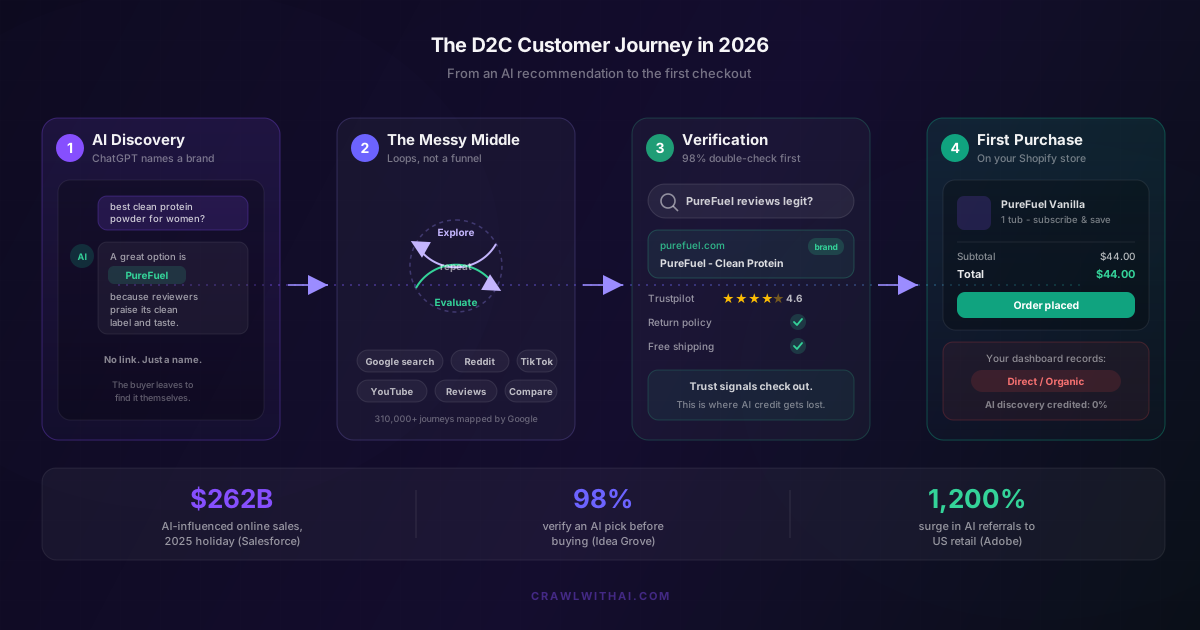
A shopper wants a cleaner protein powder. In 2021 she would have typed "best protein powder for women" into Google, scrolled past three ads, opened four tabs, and clicked a blue link to your store. In 2026 she opens ChatGPT instead, asks the same question in plain language, and reads back a short list of brand names. Yours is one of them. She never sees a search result. She never clicks an ad. She just hears your name, said with confidence, by a machine she already trusts.
That single shift has rewritten the D2C customer journey from the first touch onward. The path from "I need something" to "I bought it" no longer runs through a tidy funnel you can watch in Google Analytics. It starts inside an AI answer you cannot see, loops through channels you do not own, and lands on your store wearing a label that hides where it came from. If you are a direct-to-consumer founder still mapping the journey the old way, you are optimizing for a route most of your buyers stopped taking. Here is what the journey actually looks like now, stage by stage, and why most of it never reaches your reports.
The old D2C funnel is dead. Here is what replaced it.
The classic funnel was a straight line: awareness, consideration, decision, purchase. Each stage handed the buyer down to the next, and each one left a clean footprint in your analytics. McKinsey punctured that model back in 2009 with its consumer decision journey research, which showed buying is a circular loop of consideration, evaluation, and post-purchase, not a one-way slide. AI did not invent the loop. It poured rocket fuel on it.
The modern D2C customer journey has four moments that matter: AI-assisted discovery, the messy middle of exploration and evaluation, verification, and the first purchase. The buyer can enter, exit, and re-enter at any point. She might discover you in a ChatGPT answer, forget about you for two weeks, see you in a TikTok, then search your name on a Tuesday night and buy. The journey is real and repeatable. What changed is that the most important touch now happens somewhere your tracking pixel will never fire.
Stage one: discovery now starts inside an AI answer
Discovery is the first stage of the D2C customer journey, and it has moved. Salesforce, analyzing the activity of more than 1.5 billion shoppers over the 2025 holiday season, found that 5 percent of all shoppers now begin their product search with an AI chat assistant, rising to 10 percent among Gen Z, and that 39 percent used an AI chat at some point during their holiday shopping. The same data showed AI and agents influenced 262 billion dollars in online holiday sales, roughly 20 percent of all retail revenue for the period.
The growth rate is the part founders should not ignore. Adobe Analytics reported that traffic to US retail sites from generative AI sources jumped roughly 1,200 percent between July 2024 and February 2025. Off a small base, yes, but no other discovery channel in retail is compounding that fast. When AI is the first touch, it rarely sends a click. It says a name. The buyer reads "a great option is PureFuel," and then goes to find PureFuel on her own. We covered why these systems hand back brands instead of links in why AI recommends brands not products, and that single habit is what breaks the rest of the journey for measurement.
Stage two: the messy middle got messier
Google's research team studied more than 310,000 purchase decisions and named the chaotic space between a trigger and a purchase the "messy middle." Inside it, buyers cycle between two modes: exploration, where they expand their options, and evaluation, where they narrow them. They loop through both as many times as they need before committing. This is stage two of the journey, and it has always been messy. AI made the loop both faster and harder to see.
A buyer who heard your name in ChatGPT now scatters across channels to make sense of it. She checks Reddit for unfiltered opinions. She watches a YouTube review at 1.5x speed. She reads your "about" page, scans your ingredient list, and searches "is PureFuel any good" three different ways. Each of those touches shapes the decision, and almost none of them are attributable to the AI answer that started the whole thing. The journey looks like a dozen scattered visits from a dozen sources, when in truth they all trace back to one conversation. This is exactly the dynamic we unpacked in how conversational commerce is changing the path to purchase. The funnel did not get longer. It got tangled.
Stage three: verification is where buyers leave the chat
People do not buy on an AI's word alone. An Idea Grove 2026 study of 1,000 US consumers found that 98 percent verify an AI recommendation before purchasing. Verification is its own stage now, and it is the hinge the whole journey turns on. The buyer trusts the AI enough to shortlist your brand, but not enough to skip the background check. So she leaves the chat to confirm what she heard.
Verification means searching your brand name, reading your reviews on Trustpilot or Reddit, checking your return policy, and looking for the signals that tell her you are real. Each is a deliberate exit from the discovery channel, and every exit hands the credit somewhere else. The moment she types your name into Google, the journey an AI started becomes, in your reporting, a story about organic search. The brands that pass verification cleanly tend to have a clear story and obvious proof, which is why brand story matters for AI recommendations more than most founders assume. Verification is also where most carts die. Baymard Institute puts the average ecommerce cart abandonment rate at 70.22 percent, climbing to 80 percent on mobile, with unexpected costs at checkout the biggest reason. A buyer who survived discovery and the messy middle still walks at the till if your shipping math surprises her.
Stage four: the first purchase, mislabeled
The buyer is convinced. She types your URL or clicks the top result for your brand name, lands on your Shopify store, and checks out. From your side of the glass, this is a clean win. The order appears. Revenue goes up. The trouble is the tag attached to it.
Google Analytics 4 records that purchase as google / organic if she searched your name, or (direct) / (none) if she typed your URL. Either way, the AI conversation that planted the name in the first place is nowhere in the record. The single most influential touch in the entire journey, the one that turned a stranger into a shortlist of three brands with yours among them, is invisible. Your dashboard credits the last click and calls it a day. We took apart this exact failure in why last-click attribution misses your AI-driven revenue, and it is why so many founders quietly believe their SEO is working better than it is. The journey ends with a sale that tells you the wrong story about how it happened.
Why this journey punishes D2C brands more than marketplaces
A marketplace seller barely feels this. When an AI recommends a product that lives on Amazon, the buyer who follows up lands on Amazon, and Amazon books the sale without caring which channel sent her. The platform owns so much buyer attention that the discovery source is a rounding error inside its own numbers.
D2C brands carry the opposite burden. You depend on people reaching your own store and on reconstructing how they got there. When AI names you and the buyer verifies through Google before buying direct, you have no second dataset to cross-check against, so the misattribution sails through unquestioned. The brands most exposed are exactly the ones AI favors: focused, well-reviewed, story-driven stores, a pattern we detailed in why D2C brands are winning AI recommendations. The same traits that earn the recommendation get the credit stolen. You win the journey and lose the scoreboard.
What to optimize at each stage of the new journey
Mapping the journey is only useful if it changes what you do. Each stage has a different job.
For discovery, the job is being legible to AI crawlers. These engines build answers from web content they can parse, so clean product pages, clear category structure, and real review content make you easier to name. If GPTBot cannot extract what you sell and who it is for, you do not make the shortlist.
For the messy middle, the job is showing up across the channels where buyers loop: comparison content, an honest FAQ, and a presence in the places people check for unfiltered opinion. Every time she circles back, give her another reason to keep you on the list.
For verification, the job is proof. Visible reviews, a plain return policy, shipping costs shown before checkout, and an "about" page that sounds like a human wrote it. This is where trust is won or a cart is lost, so remove every surprise.
For the first purchase, the job is measurement. The channel that drove the sale currently reads zero, and every budget decision downstream depends on closing that gap.
How CrawlWithAI maps the AI-driven journey
CrawlWithAI is the Shopify app built for the part of this journey your analytics goes blind on. It tracks how often your store is cited in ChatGPT, Perplexity, Gemini, and Grok answers, for which queries and which products, then matches those citations against your real Shopify order data to produce a corrected revenue number that includes AI-influenced sales.
In practice it reconnects the four stages. It shows which AI queries put you on the shortlist, watches the lift in branded search that follows a citation, which is the fingerprint of verification happening off your property, then ties that pattern back to orders your dashboard labeled direct or organic, with a confidence score on each so you decide how conservative to be. You keep your existing reports and add an AI revenue layer on top. For most D2C stores running it across a 60-day window, the AI-attributed share of revenue moves from zero to somewhere between 18 and 45 percent. The journey was always there. Now you can see the part that mattered most.
FAQ
What does the D2C customer journey look like in 2026?
It has four moments: discovery inside an AI answer, a messy middle of exploration and evaluation across channels, verification where the buyer leaves the chat to confirm your reputation, and the first purchase on your store. The buyer can loop between them, and the journey rarely runs in a straight line.
Where does the journey actually start now?
Increasingly, inside an AI chat. Salesforce found 5 percent of shoppers begin product search with an AI assistant, rising to 10 percent for Gen Z, and that AI influenced 262 billion dollars of 2025 holiday sales. The catch is that AI usually returns a brand name rather than a clickable link, so the first touch leaves no footprint in your analytics.
Why does my store get credited with direct and organic traffic for AI-driven sales?
Because of verification. Buyers leave the AI chat to search your brand name or type your URL before purchasing. Google Analytics records that final action as organic or direct, not as the AI conversation that started the journey. The most influential touch goes uncounted.
How is the D2C journey different from a marketplace journey?
Marketplaces capture the sale regardless of the discovery channel, so attribution barely matters to them. D2C brands have to reconstruct the path to their own store themselves, which is why the AI discovery gap hits owned stores hardest while leaving Amazon and similar platforms unaffected.
Can I influence where I appear in the AI discovery stage?
Yes. AI engines build answers from web content they can read, so clean product pages, clear structure, strong reviews, and a coherent brand story make you easier to surface. Tracking your citations tells you which queries you already win and where the gaps are.
Sources
- Salesforce, "Salesforce Reveals 2025 Holiday Shopping Data": https://www.salesforce.com/news/stories/2025-holiday-shopping-data/
- Adobe, "Adobe Analytics: Traffic to US Retail Websites from Generative AI Sources Jumps 1,200 Percent": https://blog.adobe.com/en/publish/2025/03/17/adobe-analytics-traffic-to-us-retail-websites-from-generative-ai-sources-jumps-1200-percent
- Think with Google, "How people decide what to buy lies in the messy middle of the purchase journey": https://business.google.com/en-all/think/consumer-insights/navigating-purchase-behavior-and-decision-making/
- McKinsey & Company, "The consumer decision journey": https://www.mckinsey.com/capabilities/growth-marketing-and-sales/our-insights/the-consumer-decision-journey
- Idea Grove, 2026 AI Consumer Study (1,000 US consumers): https://ideagrove.com/
- Baymard Institute, "49 Cart Abandonment Rate Statistics": https://baymard.com/lists/cart-abandonment-rate
- Google Analytics 4 documentation on default channel groupings: https://support.google.com/analytics/answer/9756891