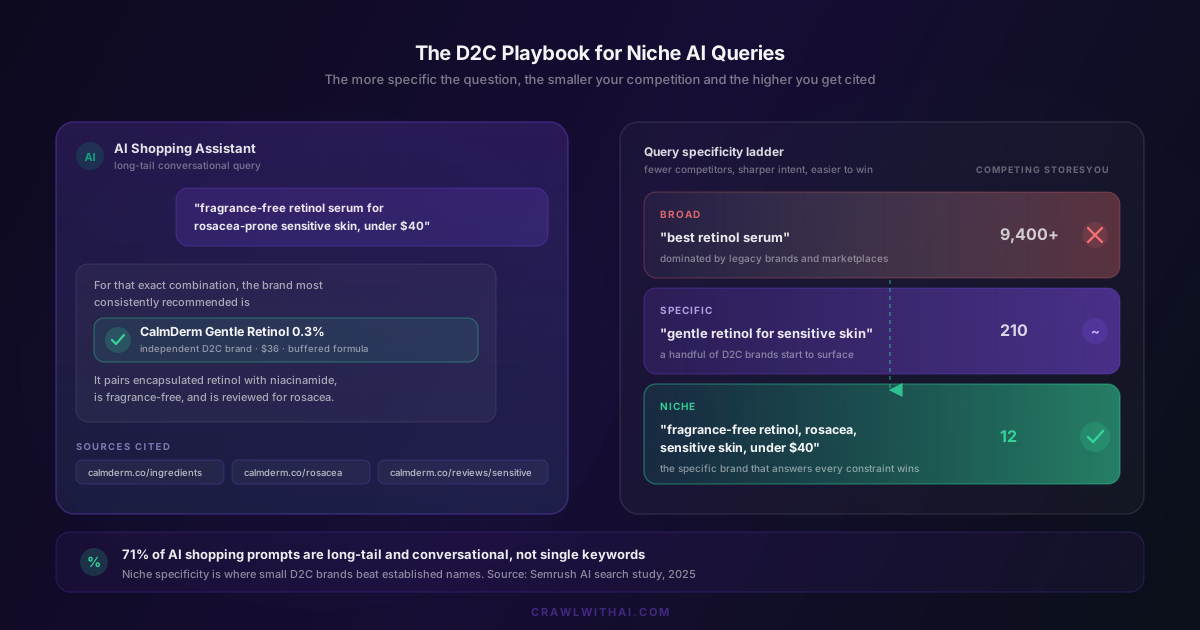
A buyer no longer types "retinol serum" into a search box. They tell ChatGPT exactly what they want: fragrance-free, gentle enough for rosacea-prone skin, under forty dollars, no purging period. The legacy brands that own the broad keyword do not appear in that answer, because none of them match every constraint at once. A small Shopify brand that makes precisely that one product does. This is the best opening in AI shopping right now, and almost nobody is building for it deliberately.
Niche AI queries are the long, specific, multi-constraint questions that broad brands cannot answer cleanly. For a D2C brand with one tight product range, they are winnable in weeks rather than years. This post is the playbook for getting recommended in niche AI queries: how to find the ones worth targeting, how to build pages that win them, and how to confirm you are actually being cited.
Why niche AI queries are the D2C opening
The economics of a broad query are brutal for a small brand. Ask an AI engine for "the best retinol serum" and you are competing against every dermatologist-backed billion-dollar brand, every marketplace listing, and a decade of accumulated authority. You will not be named. Add four constraints and the field collapses. The number of brands that genuinely make a fragrance-free, buffered retinol for sensitive, rosacea-prone skin under forty dollars is small. If you are one of them, you are no longer fighting for attention. You are the obvious answer.
This matters more every quarter because of where shopping is moving. Adobe Analytics reported that generative AI referral traffic to US retail sites grew more than 1,200 percent year over year by February 2025, and that visitors arriving from AI tools browsed longer and converted at rising rates. ChatGPT alone reached 400 million weekly active users in February 2025, per OpenAI. A growing share of those people are not searching, they are describing exactly what they need and accepting a recommendation. The brand that fits the description wins the sale before the buyer ever sees a results page.
What makes a query niche to an AI engine
A niche query is not just a long query. It is a stack of constraints the model has to satisfy all at once. "Fragrance-free retinol for rosacea under $40" carries four: an attribute (fragrance-free), an ingredient (retinol), an audience condition (rosacea-prone), and a price ceiling (under $40). The engine is not matching keywords. It is checking each constraint against what it knows about every candidate and discarding anything that fails even one.
That is why specificity helps small brands. Every constraint you can satisfy honestly removes competitors who cannot. The data backs the shift toward this kind of question. A 2025 Semrush study of AI search behaviour found that roughly 71 percent of shopping prompts to AI assistants were long-tail and conversational rather than single keywords, and that the average AI shopping prompt ran around 23 words against roughly 4 words for a typical Google query. Buyers are handing the engine a detailed brief. Your job is to be the brand that matches the brief line by line.
How to find the niche AI queries worth targeting
You do not invent these queries, you harvest them from how your buyers already talk. Three sources work better than any keyword tool.
Start with your own reviews and support tickets. The exact phrases customers use to describe why your product worked for them are the constraints other buyers will type into an AI engine. If twelve reviews say "finally something that did not flare my rosacea," that is a niche query waiting to be served. Your returns reasons are just as useful in reverse: they tell you which constraints you fail, so you stop targeting queries you cannot honestly win.
Then ask the engines directly. Open ChatGPT, Perplexity, and Gemini and run the buying questions in your category yourself. Watch which constraints they volunteer, which brands they name, and which sources they cite. You are reverse-engineering the answer you want to appear in. Our breakdown of how Perplexity decides which products to recommend shows what those citations are built from.
Finally, cross your constraints. Take your three strongest attributes and combine them with your two clearest audiences and your price band. A handful of attributes multiplies into dozens of specific, low-competition queries, each one a page you can own.
Build one page per constraint, not one page per keyword
The instinct from Google SEO is to write one page stuffed with every keyword. That fails with AI, because the model wants a clear, single-purpose source it can quote. The pattern that works is one explicit page per meaningful constraint, all linked together.
For the retinol example that means a dedicated page on the fragrance-free formulation, a page on using retinol with rosacea-prone skin, a comparison page against the obvious alternatives in the under-forty bracket, and a page on avoiding the purge period. Each page answers one question completely and links to the others with descriptive anchor text. This is the same interlinking that builds topical authority, covered in depth in our guide on how D2C brands build topical authority that gets them recommended by AI. The difference here is the angle: you are not trying to own a topic broadly, you are trying to own every specific corner of it that a real buyer might describe.
Answer the entire query, including the parts you would rather hide
The biggest mistake D2C brands make is answering the flattering constraints and dodging the rest. Price, exclusions, and who the product is not for are exactly the parts AI engines reward, because completeness is how the model decides a source is trustworthy enough to quote.
State the price plainly on the page. If a buyer asks for "under $40" and your price is buried behind a variant selector, the model may not confirm you meet the constraint and will skip you for a brand that says "$36" in plain text. Say who the product is not for. A page that reads "this is formulated for sensitive and rosacea-prone skin and is not the right choice if you want a high-strength prescription-grade retinol" gives the engine the precise boundaries it needs to match you to the right query and exclude you from the wrong one. Counterintuitively, telling the model what you do not do gets you recommended more often, not less.
Make your specifics machine-readable
A claim the engine cannot extract cleanly is a claim it will not repeat. Your constraints need to live in plain, parseable text and in your structured data, not only in a marketing video or an image.
Put the hard facts in the product description as readable sentences: fragrance-free, encapsulated retinol at 0.3 percent, formulated and reviewed for rosacea, $36. Mirror those facts in your structured data so the attributes are explicit. On Shopify that means using metafields for the attributes that matter in your category and making sure your theme outputs clean Product JSON-LD with price, availability, and description. Our walkthrough on how structured data changed e-commerce SEO covers the markup itself. The principle for niche queries is simple: every constraint a buyer might type should appear somewhere a crawler can read it as a fact, not infer it from a lifestyle photo.
Earn the third-party corroboration AI checks for
AI engines rarely take a brand's word alone. They cross-check claims against independent sources, and niche claims are the easiest to corroborate because they are so specific. When your product page says "gentle enough for rosacea" and a Reddit thread, a review site, and an expert roundup all repeat the same thing, the model treats the claim as confirmed and you become the safe answer.
You cannot fake this, but you can encourage it. Ask satisfied customers to mention the specific constraint in reviews rather than leaving generic five-star praise, because "did not trigger my rosacea" is far more useful to the model than "love it." Seed honest comparison content and get into the niche communities where your buyers actually ask for recommendations. This is the same reason unfamiliar brands keep beating household names in AI answers, which we covered in why AI recommends some unknown brands over established ones. Specific, corroborated fit beats broad recognition.
How CrawlWithAI shows which niche queries you win
The problem with niche queries is that you are flying blind. Google Search Console shows Google impressions. Shopify Analytics shows sessions and orders. Neither tells you whether ChatGPT named your brand for "fragrance-free retinol for rosacea under $40" last week, or whether a competitor took the slot, or how much revenue that single citation drove.
CrawlWithAI is a Shopify app built to close that gap. You give it the niche queries you are targeting and it runs them continuously against ChatGPT, Perplexity, Gemini, and Copilot, records whether your store is cited and which exact URL the engine quoted, and matches those citations to revenue using a fingerprinting layer that survives the loss of referrer data. Instead of guessing, you can see that your fragrance-free page is now cited in eight of ten runs of a query, that your under-forty comparison page is being quoted by Perplexity, and what each cited page earns. That turns the playbook from a hope into a feedback loop: build the page, watch the citations appear, double down on the constraints that convert.
What winning niche queries compounds into
Each niche query you win is small on its own. A dozen of them, all pointing at the same tight product range, becomes a moat. The brand that answers every specific version of a question owns the broad version by accumulation, because the model keeps seeing your domain as the place that handles this topic in detail. Big brands cannot follow you here. They are too broad to match a four-constraint query and too slow to build a page for every corner of a category. Focus is the advantage, and niche AI queries are where focus pays.
FAQ
How many constraints make a query "niche"?
Three or more is the practical threshold. A single attribute like "fragrance-free" is still broad. Stack an attribute with a use case, an audience, and a price ceiling and you have a query only a handful of brands can satisfy, which is exactly where a focused D2C store can win.
Do I need a separate page for every niche query?
Not one page per query, one page per meaningful constraint. A small set of clear, single-purpose pages, each owning one attribute or audience and all interlinked, lets the engine assemble an answer to many constraint combinations from the same handful of sources.
Will targeting niche queries hurt my broad rankings?
No. Building specific, well-linked pages strengthens your topical authority, which helps you on broader queries over time. You are adding depth, not trading one for the other.
How fast do niche query citations appear?
Faster than broad ones, because competition is thin. Most active engines refresh their sources every few weeks, so new niche pages often start getting cited within roughly four to eight weeks of publishing, assuming they are interlinked and machine-readable.
What if I cannot honestly satisfy a constraint?
Do not target that query. Targeting constraints you fail leads to returns and erodes the corroboration the model relies on. Use your returns data to drop those queries and concentrate on the ones your product genuinely wins.
Sources
- Adobe Analytics, "Generative AI Traffic to US Retail Sites": https://business.adobe.com/resources/digital-trends-report.html
- OpenAI, ChatGPT weekly active users update, February 2025: https://openai.com/news
- Semrush, "How People Use AI for Search 2025": https://www.semrush.com/blog
- Profound, "AI Search Citation Patterns Report": https://www.tryprofound.com/research
- Bain & Company, "Direct-to-Consumer in the Age of AI Search": https://www.bain.com/insights