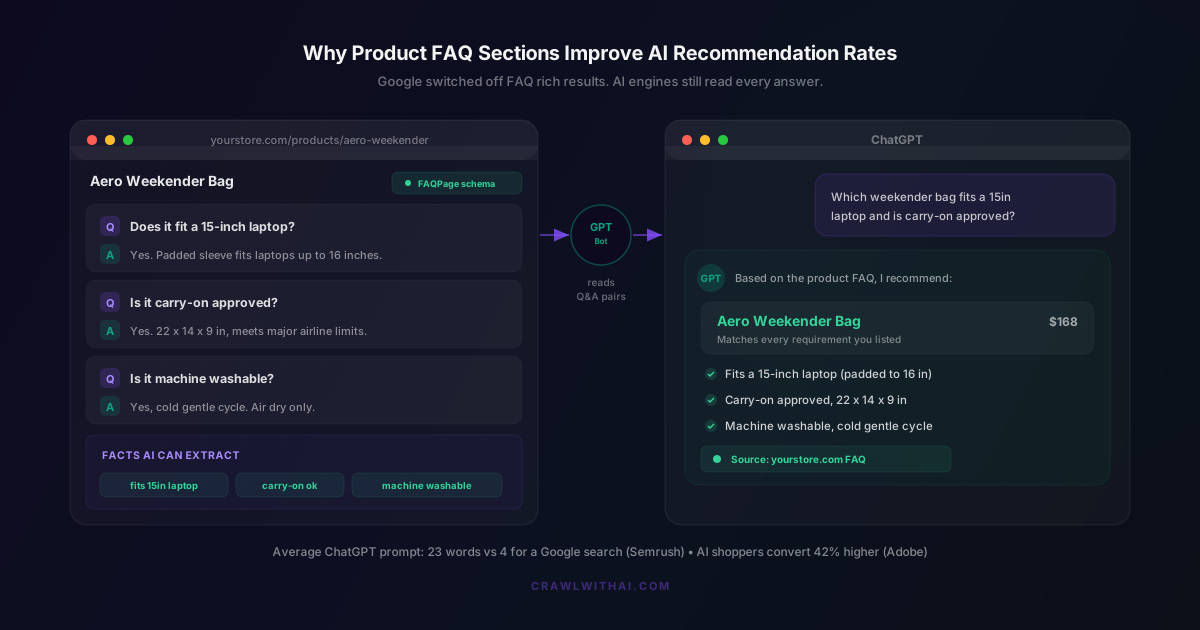
On May 7, 2026, Google switched off FAQ rich results. The expandable question and answer snippets that used to sit under some search listings stopped appearing, and by June the reporting for them was pulled out of Search Console too. Google had been winding the feature down since 2023, when it limited FAQ snippets to government and health sites after the markup turned into a spam magnet. For a lot of Shopify founders, that was the cue to strip the product FAQ section off their pages. The old SEO payoff was gone, so why keep it.
That is the wrong lesson to take from it. The Google reason to write product FAQ sections disappeared. A bigger reason showed up at the same moment. AI shopping engines like ChatGPT, Perplexity, and Gemini answer questions, and a product FAQ is a page full of pre-answered questions in the exact format those engines pull from. The stores deleting their FAQs in 2026 are throwing away one of the cleanest signals an AI has for recommending them. Here is why product FAQ sections improve your AI recommendation rates, and how to write them so an engine names your product instead of a competitor's.
AI shopping runs on questions, not keywords
Nobody types "weekender bag laptop" into ChatGPT. They ask, "which weekender bag fits a 15 inch laptop and is carry on approved." Semrush's analysis of ChatGPT search behaviour put the average prompt at 23 words, against roughly four words for a Google search. Even Google's own queries are getting longer as AI answers spread. Since AI Mode launched, one and two word searches on Google fell from 42 percent of the total to 31 percent, according to Semrush.
That shift matters for one reason. A long, conversational query carries constraints. Size, budget, use case, compatibility, a deadline. The engine has to match all of them before it recommends anything. A product FAQ is the one place on your store that already answers constraint questions in plain language. Each entry is a real question a buyer asked, answered directly. It is the shape of an AI query and the shape of an AI answer at the same time. The demand is real too. Clutch reported in January 2026 that 65 percent of consumers now use AI to research products before they buy.
What a FAQ gives an AI that a product description can't
Your product description sells. Your FAQ resolves doubt. Those are different jobs, and AI engines care far more about the second one. Descriptions are written in brand voice and packed with adjectives. An engine pulling facts out of a page skips past "premium, thoughtfully designed, built for the modern traveller" because there is nothing in it to lift. A FAQ answer is the opposite. "Does it fit a 15 inch laptop? Yes, the padded sleeve holds up to 16 inches." That is a clean fact bound to a specific question, and it drops straight into an answer.
The questions that block a purchase are the ones shoppers now ask AI first. Will it fit. Is it compatible. How do I wash it. Can I return it. How long is shipping. Most product pages either bury those answers in a wall of copy or leave them out entirely. A FAQ pulls them to the surface and labels them. For the same principle applied to your main copy, our guide on how to write Shopify product descriptions that AI can recommend covers the description side.
Google dropped FAQ rich results. That changed the reason, not the practice.
Here is the timeline, because it trips people up. FAQ rich results stopped appearing in Google search on May 7, 2026. In June, Google removed the FAQ search appearance filter, the rich result report, and Rich Results Test support. But, and this is the part stores miss, Google confirmed that FAQPage is still a valid Schema.org type and said sites do not need to rush to remove existing markup.
That distinction is the whole game. The schema on your FAQ block still tells any machine reading the page that this is a set of question and answer pairs. Google's crawler no longer turns that into a snippet. The AI crawlers still parse it, and structured Q and A is one of the easier things for them to map. Keeping the markup costs you nothing and feeds the channel that is growing. If you want to get the markup right in your theme, our walkthrough on how to use Shopify's JSON-LD output for AI SEO shows where it lives.
The questions your product FAQ sections should answer
The instinct is to fill a FAQ with soft questions that flatter the brand. "What makes your bags special." Delete those. AI recommendations turn on friction questions, the ones a shopper needs resolved before they commit. Six categories do most of the work.
Fit and sizing: "Does it fit a 15 inch laptop." Compatibility: "Will this work with a standard tripod mount." Materials and care: "Is the fabric waterproof, and can I machine wash it." Returns and shipping: "How long is delivery, and what is the return window." Use case fit: "Is this good for one bag international travel." Comparison: "How is the Pro different from the standard model."
Each of those maps to a qualifier a real shopper drops into an AI prompt. Answer them with specifics and you become the store that matches the whole query, not just part of it. This pays off more than it sounds, because AI referred shoppers are worth more once they land. Adobe found that visitors arriving on retail sites from AI sources in early 2026 converted 42 percent better than non AI traffic.
How to structure product FAQ sections so AI can extract them
The rules are mechanical. Write the question the way a buyer would say it out loud, not as a keyword string. "Is it carry on approved" beats "carry on compliance dimensions." Lead the answer with the fact, in the first sentence, and hold it to one idea. "Yes. 22 by 14 by 9 inches, within major airline limits." Make each answer stand on its own, so it still makes sense when an engine lifts it away from the question.
Two more things. Add FAQPage schema to the block even though Google no longer rewards it, because the AI crawlers read it. And do not paste the same boilerplate FAQ onto all 300 products. Identical answers across every page read as low value, and they give an engine nothing to tell your products apart. Product specific questions are the point. A number of stores also block the AI crawlers by accident, so it is worth confirming yours can even reach the page. Our post on what GPTBot actually reads when it crawls your Shopify store covers how to check.
The FAQ mistakes that keep your store out of AI answers
The most common one is the vague answer. "Our bags are built to last" tells an engine nothing it can quote. "Backed by a 5 year warranty, ships in 2 business days" gives it three facts. Specificity is the difference between a citation and a skip.
The rest are quieter. Marketing fluff dressed up as a question, with an answer that is really a pitch. The same boilerplate FAQ copied across the catalogue, so the engine cannot separate one product from another. FAQ blocks with no schema, which force the crawler to guess at the structure. And FAQs written once and never touched, which go stale as your sizing, shipping, or return terms change. None of these are hard to fix. They are just rarely audited, because most stores have no way of seeing which answers an engine is actually using. That last problem is the one worth solving properly.
How CrawlWithAI shows which FAQ answers drive recommendations
You can write a perfect product FAQ and have no idea whether it is working. Google Search Console never covered AI, and its FAQ reporting is gone as of June 2026 anyway. Shopify Analytics records the sale but files most AI referred visitors under direct traffic, so the FAQ that earned the recommendation gets no credit. Standard SEO tools count rankings and backlinks, not AI citations. The signal you most want to measure is the one none of the default tools show.
CrawlWithAI is a Shopify app built for that gap. It runs continuous shopping queries against ChatGPT, Perplexity, Gemini, and Google's AI answers for the terms your store cares about, records which of your URLs get cited, and matches those citations to revenue with a fingerprinting layer that survives the loss of referrer data. For a store investing in FAQ content, that turns a guess into a measurement. You can see which product pages get named, on which questions, and how much each one earns. Our piece on why Shopify's built in analytics misses your AI referred orders explains why the standard reporting comes up short.
There is a structural reason this keeps mattering. Adobe, tracking more than a trillion visits to US retail sites, found that individual product pages score just 66 percent on machine readability, the lowest of any major page type, even as AI traffic to those sites climbs at triple digit rates year over year. A clear, structured product FAQ is one of the cheapest ways to make your page readable to the engines sending that traffic. The stores that keep their FAQs, and measure them, are the ones getting named.
FAQ
Should I remove FAQ schema now that Google dropped FAQ rich results?
No. Google confirmed FAQPage is still a valid schema type and said you do not need to remove existing markup. Google's crawler stopped using it for snippets in May 2026, but AI crawlers still read it to understand your question and answer content. Pulling it out only helps the search feature you no longer benefit from and hurts the AI channel that is growing.
Where should the product FAQ go, on the product page or a separate page?
On the product page, next to the item it describes. AI engines recommend at the product level, so the answers need to sit with the product the engine is evaluating. A separate, generic FAQ page about shipping and returns is fine for policy, but product specific questions belong on the product page where the buying decision happens.
How many questions should a product FAQ have?
Enough to clear the real objections, usually five to ten per product. Quality beats volume. Five specific answers about fit, materials, compatibility, care, and returns do more than twenty vague ones. Every question should resolve something a buyer would otherwise hesitate over.
Do AI engines actually read FAQ content, or just product data?
Both, and the FAQ often does more. Structured product data tells an engine what the item is. The FAQ tells it whether the item fits the shopper's specific situation, which is what most AI shopping prompts are really asking. Since the average ChatGPT prompt runs around 23 words of constraints, the FAQ is frequently the part of the page that matches the query.
Will a product FAQ help my Google ranking at all anymore?
The rich result is gone, but the content still helps. Google reads the FAQ text as part of the page, it can surface in AI Overviews and AI Mode, and clear question and answer content tends to match long tail queries well. You lose the snippet, not the value of answering real questions on the page.
Sources
- Search Engine Journal, "Google Drops FAQ Rich Results From Search" (2026): https://www.searchenginejournal.com/google-drops-faq-rich-results-from-search/574429/
- Semrush, "Google AI Mode: Early Adoption and SEO Impact": https://www.semrush.com/blog/google-ai-mode-seo-impact/
- Clutch via Business Wire, "65% of Consumers Use AI to Research Products Before Making a Purchase" (2026): https://www.businesswire.com/news/home/20260122526477/en/Clutch-Report-65-of-Consumers-Use-AI-to-Research-Products-Before-Making-a-Purchase
- Adobe, "AI Traffic Grows but Retail Sites Lag in AI Search Visibility" (2026): https://business.adobe.com/blog/ai-traffic-surge-retail-sites-not-machine-readable