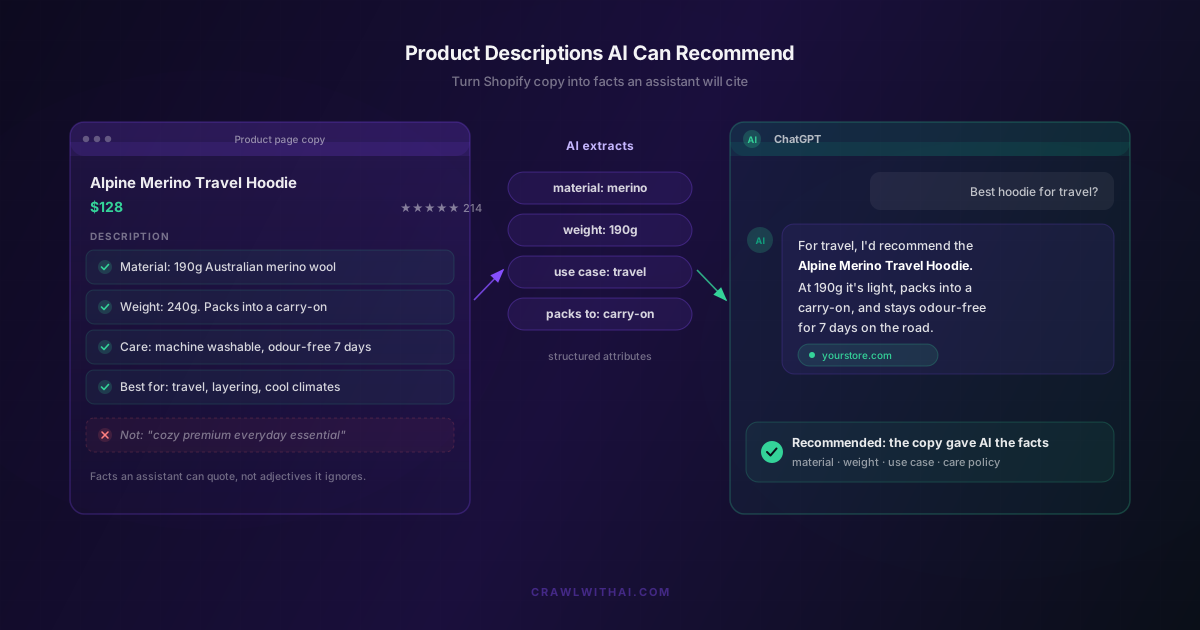
A growing share of your customers no longer start on Google. They open ChatGPT, Perplexity, or Gemini and ask a question: best hoodie for travel, gentle moisturizer for eczema, a coffee grinder under 100 dollars. The assistant reads product pages it has already crawled, picks a few products, and names them by brand. Your Shopify product descriptions are now the audition, and most stores are failing it without knowing.
The reason is simple. Most product copy was written to sound good to a skimming human or to hit a Google keyword, not to feed a model deciding whether to cite you. Adobe found that individual retail product pages are only 66% machine-readable on average, so a third of the page never reaches the assistant. This post shows how to write Shopify product descriptions that ChatGPT, Perplexity, and Gemini can quote and recommend, using the facts a model can actually extract.
Why AI reads your Shopify product descriptions differently than shoppers
A human skims. They glance at the photo, the price, the star rating, and maybe the first line. An assistant does the opposite. It reads the words. When someone asks an AI for a product, the model pulls text from pages it has crawled, decides which products match the request, and picks the ones it can describe with confidence. Your description is the raw material for that decision.
That changes what good copy means. A line like "cozy premium essential" gives a shopper a vague feeling and gives a model nothing. It cannot match "cozy" to a query about merino weight or carry-on packability. Researchers who study attribute extraction call this the difference between explicit and implicit signal. A 2024 arXiv study on using large language models to pull product attributes found models did best when descriptions stated values plainly and struggled when the text only implied them. Adjectives are implied signal. Facts are explicit signal.
The shift is already in buyer behavior. Adobe's survey of more than 5,000 US shoppers found 39% have used AI for online shopping and 85% of them said it improved the experience. Most of those people are researching products, and 66% told Adobe they believe AI tools give accurate results. When a buyer trusts the assistant and the assistant trusts your copy, you get recommended. When your copy is filler, you get skipped and never see it happen. We broke down the mechanics in how ChatGPT recommends products.
A third of your product page is invisible to AI
Here is the number that should worry every Shopify store owner. Adobe built an AI Content Visibility Checker that scores how much of a page a large language model can actually read. Across the US retail sector, homepages averaged 75%. Category pages scored 74%. Individual product pages, the ones that actually sell, came in lowest at 66%.
That means on a typical product page, a third of the content is invisible to the models deciding whether to recommend you. Some of that is technical, like text buried in JavaScript or locked inside images. A lot of it is the description itself. Copy that reads as marketing mood rather than product fact gives the model nothing to extract, so it may as well not be there.
The gap between winners and losers is wide. Adobe found the best retail sites scored 82.5% on homepage readability while the weakest scored 54.2%, a 52% spread. The stores pulling ahead are not writing more copy. They are writing copy a machine can parse. This is the same divide we covered in Shopify SEO vs AI SEO: ranking for Google and getting cited by AI are now two different jobs.
Write Shopify product descriptions with facts, not adjectives
The single biggest change is to replace adjectives with numbers and named attributes. "Lightweight" becomes "240g." "Durable" becomes "rated for 500 wash cycles." "Great for travel" becomes "packs into a carry-on and fits under an airline seat." Specificity is what an assistant can quote back to a buyer, and quotable copy is what gets cited.
Think about the query behind the recommendation. Someone asks for a low-sugar snack that survives a lunchbox. A description that says "healthy and delicious" loses. A description that says "3g of sugar, individually wrapped, stays solid up to 90 degrees" wins, because every clause maps to something the buyer asked for. The model is matching your stated facts against the query, one attribute at a time.
This also protects you from a quiet failure mode. Assistants are cautious about claims they cannot ground. If your page says "the best moisturizer for dry skin" with nothing behind it, a careful model will not repeat an unverifiable superlative. If your page says "contains 5% panthenol and ceramides, fragrance-free," the model can state that plainly, because it is a fact rather than a boast. Grounded claims travel. Marketing claims stall.
Cover the attributes AI extracts from your copy
Models are trying to build a structured picture of your product from unstructured text. The more attributes you state clearly, the more complete that picture. For most Shopify products the attributes that matter are material and ingredients, dimensions and weight, use case and who it is for, compatibility, care and warranty, and how the product differs from the obvious alternative.
That last one matters more than people expect. Assistants often have to choose between similar products, including two of your own. If your SKUs look identical in the copy, the model cannot tell a buyer which to pick, so it may pick neither. Spell out the difference in plain language a shopper would use. "Warmer than our cotton version, but 60g heavier" tells the model exactly when to recommend each one.
Write these as facts a model can lift, not as a wall of prose. You do not need keyword stuffing. You need coverage. Every real question a buyer might ask should have a plain answer somewhere in the visible text. We go deeper on the catalogue-wide version of this in why D2C brands should build an AI-readable product catalogue.
Answer the questions buyers actually ask the assistant
AI shopping is conversational, so the descriptions that win read like they are answering questions. Buyers do not ask for a "premium hydration essential." They ask "will this run under a jacket," "is it machine washable," "does it itch." Each of those is a question your copy can answer in one sentence, and each answered question is another reason for the assistant to choose you.
A practical move is to add a short FAQ block to your product pages and answer the real questions your support inbox already gets. This does two jobs at once. Human buyers get their objection handled, and the model gets clean question-and-answer pairs that are easy to extract and cite. Product reviews do similar work, which is why they carry so much weight in recommendations, a pattern we covered in the role of product reviews in AI recommendations.
Keep the answers consistent across the page. If your description says "machine washable" but your care tab says "hand wash only," you have handed the model a contradiction. Assistants treat contradictions as a reason to distrust the whole page, and a distrusted page does not get recommended.
Structure the page so a model can parse it
How you format the copy matters as much as what it says. Long unbroken paragraphs bury facts. Short blocks, clear subheadings, and labeled specs let a model find and lift each attribute. A "Specifications" section with plain label and value pairs is close to ideal, because it reads like the structured data the model is already trying to build.
Back the visible copy with structured data. Shopify themes can output Product schema in JSON-LD, which states your name, price, availability, brand, and reviews in a format built for machines. The visible description and the schema should agree. When they do, you reinforce the same facts twice. We cover the technical side in how structured data changed ecommerce SEO and what crawlers actually pull in what GPTBot actually reads.
Do not forget image alt text. A lot of product information lives only in photos, which models cannot see, so the alt text is your one chance to state it in words. "Model is 5 foot 9 wearing size medium" is worth more to an assistant than "product image 1." That same alt text also helps Google, which we broke down in how image alt text affects product discovery.
The description mistakes that get your products skipped
A few habits reliably cost stores recommendations. The first is writing for one reader when you now have three: a human on a phone, an assistant deciding whether to cite you, and increasingly an agent evaluating whether to auto-purchase. Copy that is pure vibe serves the human badly and the other two not at all.
The second is duplicated manufacturer copy. If your description is the same text every other retailer of that product uses, you have given the model no reason to pick your store over a larger one. Rewrite it with your own facts, your own use cases, and your own comparisons.
The third is hiding facts behind interactions. Specs in a tab that only loads on click, sizing in a pop-up, details rendered by JavaScript after the page loads. Anything a model has to work to reach is content it may never read, which is a big part of why product pages score only 66% on readability. If a fact matters, put it in the visible text.
How CrawlWithAI shows which descriptions get recommended
The hard part is not the writing. It is knowing whether the writing worked. You can rewrite fifty descriptions and have no idea if ChatGPT now recommends you, because AI referrals rarely show up cleanly in your analytics. That is the gap CrawlWithAI closes.
It watches which AI platforms crawl your store and how often, then tracks whether your products get surfaced in AI answers for the buying questions that matter in your category. Instead of guessing, you see which descriptions get cited, which competitors get named next to you, and where your copy still leaves the model with nothing to quote. When you rewrite a page fact-first, you can watch its citation rate move.
That feedback loop turns description work from a shot in the dark into a measurable channel. You fix the pages that are invisible, confirm the model picks them up, and tie the change to the revenue it drives. Writing descriptions AI can recommend only pays off if you can prove it is happening.
Start with your ten best sellers
You do not need to rewrite the whole catalogue this week. Pull your ten highest-revenue products and read each description as if you were a model trying to match it to a buyer's question. Where you find an adjective, replace it with a fact. Where you find a claim, ground it. Where a buyer would have a question, answer it in a sentence.
Then check whether assistants start naming those products. The stores that win the next two years of AI shopping are not the ones with the biggest ad budgets. They are the ones whose product pages tell a machine exactly what they sell and who it is for.
FAQ
What makes a product description easy for AI to recommend? Specific, stated facts. Models recommend products they can describe with confidence, so material, weight, dimensions, use case, and care details written in plain text get quoted while vague adjectives get ignored. Adobe found individual product pages are only 66% machine-readable on average, so most stores have room to make their copy far more extractable.
Do I need structured data, or is good copy enough? Both help, and they work best together. Visible copy is what assistants read first, but Product schema in JSON-LD restates your facts in a format built for machines. When the description and the schema agree, you reinforce the same attributes twice. If you can only do one thing this week, fix the visible description, because that is where the biggest readability gap sits.
Will writing for AI hurt my copy for human shoppers? No, it usually helps. Usability research on product pages, including work from the Baymard Institute, consistently finds that shoppers abandon purchases when descriptions leave out details they need. Fact-first copy answers human objections and feeds the model at the same time. You write for a person, an assistant, and an agent with one clear description.
How is this different from writing for conversions? It overlaps but is not identical. Conversion copy persuades the human already on your page. AI copy has to get you onto the page in the first place by earning the recommendation. We cover the conversion side in why most Shopify product descriptions fail to convert. The good news is that fact-first copy serves both goals.
How do I know if my new descriptions are actually getting recommended? Your analytics will not tell you cleanly, because AI referrals often arrive with no referrer. You need to track AI visibility directly: which platforms crawl your store and whether your products appear in AI answers for your category. Tools like CrawlWithAI monitor citation rates so you can tie a rewrite to a measurable change.
Sources
- Adobe Digital Insights (Vivek Pandya), "AI traffic grows but retail sites lag in AI search visibility," April 16 2026. https://business.adobe.com/blog/ai-traffic-surge-retail-sites-not-machine-readable
- Capital One Shopping Research, "AI Shopping Statistics (2026 Report)." https://capitaloneshopping.com/research/ai-shopping-statistics/
- Search Engine Land, "New data: 77% use AI to shop. Nearly 1 in 3 won't let it spend." https://searchengineland.com/new-data-77-use-ai-to-shop-nearly-1-in-3-wont-let-it-spend-475614
- "Using LLMs for the Extraction and Normalization of Product Attribute Values," arXiv:2403.02130. https://arxiv.org/abs/2403.02130
- "ExtractGPT: Exploring the Potential of Large Language Models for Product Attribute Value Extraction," arXiv:2310.12537. https://arxiv.org/abs/2310.12537