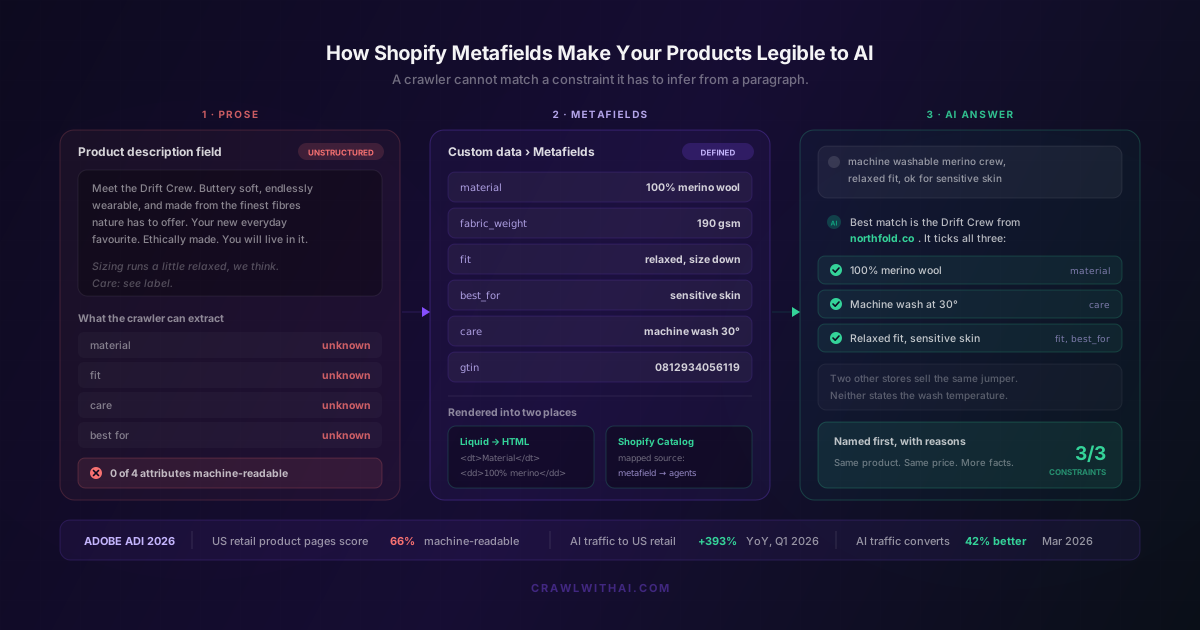
A shopper types "machine washable merino crew, relaxed fit, nothing scratchy" into ChatGPT. You sell exactly that jumper. It washes at 30 degrees, it is cut relaxed, and it is the softest 190 gsm merino you could source. You know all of this. Your product description does not say any of it, at least not in words a machine can pull out. It says "buttery soft, endlessly wearable, made from the finest fibres nature has to offer."
So the crawler moves on and recommends a competitor whose spec table lists a wash temperature. This is the gap Shopify metafields close, and almost nobody uses them for it. Most stores treat metafields as a theme feature, a way to show a size chart or a care icon. They are the cleanest mechanism Shopify gives you for handing AI crawlers structured, unambiguous product facts, and since Shopify Catalog started syndicating product data to AI channels, they feed that pipeline directly too.
What Adobe found when it measured how readable retail pages actually are
In April 2026, Adobe published benchmark data from its AI Content Visibility Checker, a tool that scores how much of a web page an LLM can actually read. The data covered the US retail sector, drawn from Adobe's base of over one trillion visits to US retail sites.
Homepages averaged 75%. Category pages averaged 74%. Product pages, the ones that decide whether you get recommended, came in worst at 66%. Roughly a third of the content on a typical retail product page is invisible to a language model. Adobe's Vivek Pandya put it plainly: retailers have thousands of SKUs, and much of that content is currently invisible to LLMs.
That number matters more every quarter. Adobe measured AI traffic to US retail sites up 393% year over year across the first three months of 2026, and up 693% during the November to December 2025 holiday season. In March 2026, AI traffic converted 42% better than non-AI traffic, a record high and a reversal from March 2025 when the same channel converted 38% worse. The traffic is now both large and good. Your product pages are still two thirds legible.
Why product descriptions fail AI crawlers and metafields do not
The problem with a description field is that it is one blob of text with no schema. Everything in it is the same type of thing: prose. A crawler reading "made from the finest fibres nature has to offer" has no way to know whether that is a material claim, a marketing flourish, or both. It cannot fill a material slot from it with any confidence.
A metafield is different in kind, not degree. Define a product metafield with the namespace custom and the key material, set its value to "100% merino wool", and you have created an attribute-value pair. There is no inference step. The name of the field tells the machine what the value means.
This is why spec tables outperform paragraphs in AI answers. The structure is the signal. Metafields let you store that structure once, in Shopify's data model, rather than retyping it into every description and hoping your team keeps the format consistent. Because metafield definitions enforce validation rules, the values stay clean across ten thousand SKUs instead of drifting into "merino", "Merino wool", "100% Merino" and "wool blend".
The metafields that actually move AI recommendations
Not all attributes are equal. The ones worth defining first are the ones shoppers put constraints on. Look at your own support inbox and your site search logs, then define metafields for what people keep asking:
Material and composition. The single most requested attribute in apparel, homeware and beauty. "100% merino wool", not "premium natural fibres".
Fit and sizing behaviour. "Relaxed, size down for a classic fit" answers a question AI gets asked constantly and almost no store answers in text.
Care and maintenance. "Machine wash 30 degrees, do not tumble dry." Trivially easy to state. Rarely stated. Frequently the deciding constraint.
Best for, and not for. "Sensitive skin", "cold weather layering", "not suitable for induction hobs". The negative case is undervalued. AI systems that can rule you out correctly will also rule you in correctly.
Dimensions and weight. Real numbers with units. "190 gsm", "42cm x 30cm x 18cm", "1.2kg".
Identifiers. GTIN, UPC, ISBN. Shopify's own guidance lists barcode identifiers among the product details AI platforms consider when matching products to searches.
Shopify gives you two shortcuts here. Standard metafield definitions are pre-built templates with reserved namespaces and keys that Shopify has assigned specific meanings, which makes them interoperable across the platform rather than private to your store. Category metafields go further: assign a product to Apparel & Accessories > Clothing > Clothing Tops > Shirts and Shopify offers size, neckline, sleeve length type, age group, fabric, target gender, clothing features and color as ready-made fields. Use the standard definitions where they exist. Invent custom ones only for what is genuinely specific to you.
Defining a metafield is not the same as an AI crawler seeing it
Here is where most stores fall over. A metafield sitting in your admin is invisible to GPTBot. It exists in Shopify's database. It is not in the HTML your server returns.
Metafields reach AI crawlers by two separate routes, and you should be deliberate about both.
The first is your theme. Connect the metafield to a dynamic source in the theme editor, or reference it in Liquid, and Shopify renders the value server side into the HTML. That matters because AI crawlers do not execute JavaScript. As we covered in why Shopify themes affect your AI visibility, Vercel and MERJ's network-wide study found GPTBot, ClaudeBot and PerplexityBot all download JavaScript without ever running it. A metafield rendered through Liquid arrives fully formed. A metafield injected by an app script arrives as an empty div.
The second route is your JSON-LD. Metafield values can be piped into your structured data block so material, size, gtin13 and additionalProperty carry real values instead of nulls. This is the version that pays best, because JSON-LD is server rendered and purpose-built for machines. If you are starting from scratch there, how structured data changed e-commerce SEO is the wider context.
Render the metafield in both places and keep them saying the same thing. Content and schema that disagree is worse than either alone.
Shopify Catalog Mapping changed what metafields are for
In December 2025, Shopify launched Agentic Storefronts, which pushes merchant product data into ChatGPT, Google AI Mode, Gemini, Microsoft Copilot and Meta through a system called Shopify Catalog. Tobi Lütke's framing was that Shopify is "making every Shopify store agent-ready by default."
Default is the operative word. Shopify Catalog lists your products with title, description, options, images, price and availability, structured so AI agents can parse them. If your real product data lives in metafields rather than those default fields, the default is wrong for you.
That is what Shopify Catalog Mapping exists to fix. In your admin you can remap the source for your product title, product description and product category to a product metafield or a metaobject reference. Shopify's own documentation says mapping is most useful for stores using custom data and grouping logic such as metafields, metaobjects, tag prefixes, or delimiters in product titles. You can also set custom variant grouping using a metafield, so agents cluster your products the way you intend rather than the way your title strings imply.
The important nuance: mapping changes how your products are represented to AI channels without touching your storefront. Your customer-facing description can stay lyrical while the agent gets the structured version. That is the reason metafields stopped being a theme detail and became an AI distribution decision.
One trap while you are in there. Blocking AI crawlers in robots.txt only affects open-web discovery, it does not stop Shopify Catalog syndicating your data to channels you have switched on. Those are separate taps, which surprises people. We went through the crawler-blocking side in the Shopify robots.txt settings that block AI crawlers.
The rollout that works on a real catalogue
Nobody is going to hand-fill fifteen metafields across 4,000 SKUs. Sequence it:
- Pick five attributes, not fifteen. The ones shoppers constrain on. Start with your best-selling collection only.
- Use standard and category definitions where they exist. Free interoperability, no naming debates.
- Fill them from what you already have. Supplier spec sheets, care labels, returns data. Most of this sits in a spreadsheet already, and bulk edit gets you a long way in an afternoon.
- Render them server side. Theme editor dynamic source, plus JSON-LD. Then View Page Source and search for the value. If you cannot find it, neither can GPTBot.
- Map the sources in Shopify Catalog Mapping if your description or category lives in a metafield.
- Extend to the rest of the catalogue once the first collection shows movement.
How CrawlWithAI closes the loop on this
The frustrating part of metafield work is that you cannot see whether it landed. You add material and care to 300 products, render them into Liquid and JSON-LD, and then you wait. Shopify tells you the metafield exists. It does not tell you whether ChatGPT started recommending you because of it.
CrawlWithAI reads your store the way GPTBot and PerplexityBot read it, raw HTML only, and shows which product attributes survive into the crawlable page and which are still stuck in your admin or behind a script. It flags the empty schema fields and the metafields you defined but never rendered. Then it tracks whether ChatGPT, Perplexity and Gemini are recommending your products, and attributes the revenue those recommendations drive.
That turns this from a chore into a decision. Add a care metafield across one collection and you can see whether citations and AI-attributed revenue moved. If they did, you know what to do with the other 3,700 SKUs. If they did not, you have learned something cheap.
Frequently asked questions
Do Shopify metafields directly improve AI recommendations?
Not by existing. A metafield only helps once its value reaches the crawler: rendered server side into your HTML through Liquid, piped into your JSON-LD, or mapped as a source in Shopify Catalog Mapping. A defined but unrendered metafield does nothing for AI visibility.
Should I use custom metafields or Shopify's standard definitions?
Standard definitions first. Shopify reserves specific namespaces and keys with defined meanings, which makes them interoperable across the platform and easier to connect to themes. Category metafields cover most common attributes automatically once you assign a product category. Use custom metafields only for what is genuinely unique to your catalogue.
Can I keep my marketing copy and still give AI structured data?
Yes, and this is the point of Shopify Catalog Mapping. You can map the description that goes to AI channels to a metafield while your storefront keeps the version written for humans. Shopify's documentation is clear that mapping influences how products are represented on AI channels without affecting the product data in your store.
How many metafields should I define?
Five to eight well-chosen ones beat twenty half-filled ones. Sparse or inconsistent values are worse than absent ones, because they teach the crawler that your data is unreliable. Pick the attributes shoppers actually constrain on and fill them completely.
Do metafields help with Google as well as AI?
Yes, when they feed your structured data. Metafield values rendered into JSON-LD populate the same Product schema properties Google reads for rich results, so one piece of work serves both channels. That dual benefit is covered in product feed quality and how it affects Google and AI.
Sources
- Adobe, U.S. retailers see surge in AI traffic, but many websites are not entirely readable by machines
- Shopify, Introducing Shopify Agentic Storefronts
- Shopify, Shopify Catalog and product discovery for agentic storefronts
- Shopify, Mapping your product data sources for Shopify Catalog
- Shopify, Optimizing your products for AI platforms
- Shopify, Metafields
- Shopify, List of standard metafield definitions
- Vercel and MERJ, The rise of the AI crawler