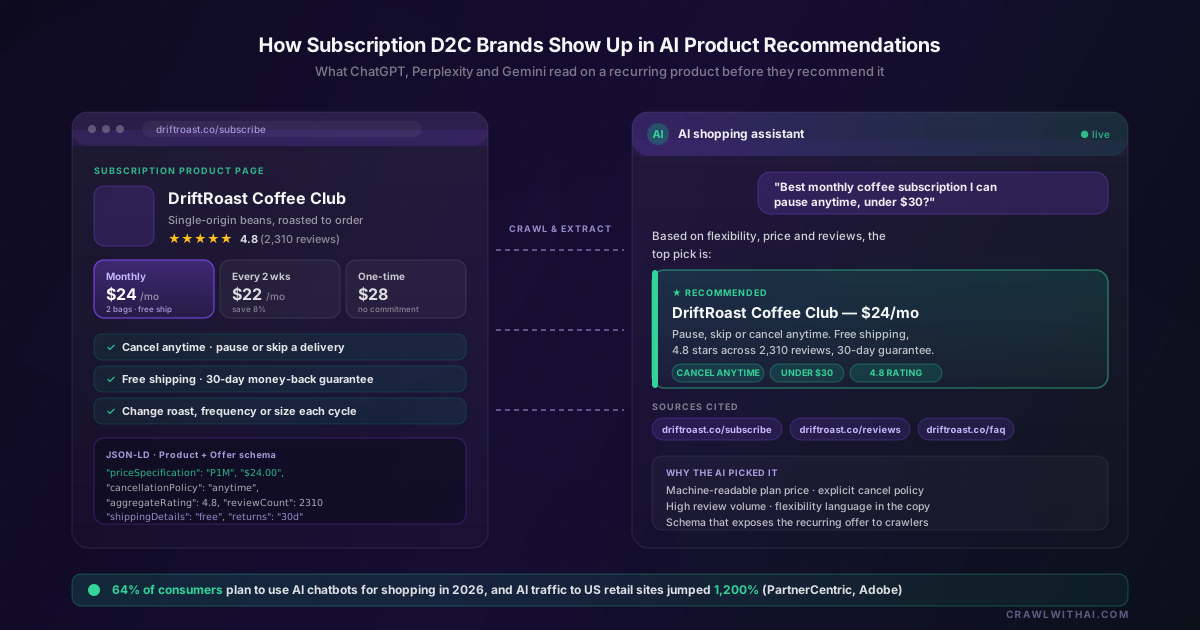
A founder running a $3M coffee subscription asked an AI assistant to recommend the best monthly coffee club under $30 that you can pause anytime. Her product fit the query exactly. The AI named three competitors and skipped her entirely. She has better beans, better reviews, and a lower price. None of that reached the model, because the things that make a subscription worth recommending were buried in a checkout flow no crawler ever sees.
This is the quiet problem for subscription D2C brands in AI product recommendations. One-off products are easy for an AI to describe. A subscription is a relationship with terms, and most of those terms live in places AI cannot read. If the model cannot find the plan price, the cancellation policy, and the flexibility, it has nothing to recommend, so it recommends the brand that made those facts obvious instead.
Why subscriptions are harder for AI to recommend than one-off products
When someone asks ChatGPT for a good pair of running shoes, the model has a clean target. Name, price, a few attributes, done. When someone asks for a good meal kit subscription, the model has to reason about price per week, commitment length, how easy it is to cancel, whether you can skip a box, and whether customers stuck around. That is five or six facts instead of two, and subscription brands tend to hide most of them.
The demand is real and growing fast. Adobe Analytics reported that traffic to US retail websites from generative AI sources jumped 1,200% year over year as of early 2025, and AI traffic to US retailers rose another 393% in the first quarter of 2026 according to data Adobe shared with TechCrunch. A Deloitte holiday survey found 56% of consumers planned to use AI chatbots to compare prices and find deals, and 47% planned to use AI to summarize reviews before buying. People are asking AI to vet recurring purchases for them, and recurring purchases are exactly the category where a wrong choice costs the most.
The category is not small either. Precedence Research values the global subscription e-commerce market on a path toward $49.77 billion by 2035, growing at a 9.23% compound annual rate. That is a lot of recurring revenue being routed through assistants that cannot read half of what a subscription brand offers.
What AI actually reads on a subscription product page
An AI assistant pulls from your public, crawlable pages. For a subscription, that means the product page, the subscribe page, the FAQ, the reviews, and the shipping and returns pages. It does not log in, add to cart, or click through a Recharge or Skio widget to find your plan terms. If a fact only appears after a plan selection inside a JavaScript widget, the model usually never sees it.
So the test is simple. Open your subscribe page in a browser with JavaScript disabled. Whatever survives is roughly what the AI gets. For most subscription D2C stores, that is a product photo, a vague headline, and a Subscribe button. The plan price, billing frequency, and cancel terms vanish into the app after a click.
The fix is to put the recurring terms in plain page text, not only inside the widget. State the monthly price, the per-shipment price, the billing cadence, and the cancellation policy as readable copy on the page. Our guide on why most Shopify product descriptions fail to convert covers the same principle for one-off products. For subscriptions the stakes are higher, because the missing facts are the whole offer.
The flexibility signals that decide subscription recommendations
Watch how people phrase subscription queries. Best meal kit you can cancel anytime. Coffee club you can pause when traveling. The flexibility is not a footnote in the query. It is the query. People have been burned by subscriptions that were easy to start and hard to stop, so the first thing they ask AI to confirm is that they can get out.
If your page says cancel anytime, pause or skip a shipment, and change frequency each cycle, in plain text, an AI can match those phrases to the intent. If that information is locked behind a support page, the model assumes the worst and picks a competitor who said it out loud. The brands that win these picks are not always the most flexible. They are the ones whose flexibility is legible. There is a churn payoff too: Recurly's subscription research shows consumer goods subscriptions live or die on perceived control, so the same words that win the AI pick also cut cancellations after the first box.
How AI weighs price across recurring plans
A one-time product has one price. A subscription has a price grid. Monthly versus every two weeks, a discount for committing, a higher one-time rate. When a query includes a budget, like under $30, the AI has to figure out which of your prices applies. If your page only shows a per-bag price or a strikethrough that needs a click to resolve, the model may compare the wrong number and drop you for being too expensive.
State the effective recurring price in clear terms. Twenty four dollars per month, ships two bags, free shipping. That lets the AI confirm the budget match in one read. Vague pricing is a disqualifier in a price-filtered query, which connects to a point we made in how AI platforms weigh price against quality: the model can only weigh the numbers it can actually parse.
There is now a second reason to get pricing machine-readable. OpenAI's Instant Checkout, built on the Agentic Commerce Protocol with Stripe, lets shoppers buy inside ChatGPT, and it is rolling out to Shopify merchants including Glossier, SKIMS, Spanx, and Vuori. ChatGPT handles roughly 50 million shopping-related queries a day against a base of around 800 million weekly users. As checkout moves into the chat, structured pricing decides whether your subscription is even buyable in the conversation.
Why reviews matter more for subscriptions in AI answers
Reviews carry extra weight for recurring products because the buyer is committing to repeat purchases, not a single risk. A 4.8 rating across 2,310 reviews tells the AI that real people stayed subscribed and stayed happy, while a thin review count, even at five stars, reads as unproven. Deloitte found 47% of shoppers use AI specifically to summarize reviews, so your review corpus is direct input to the recommendation.
Make reviews crawlable as text, not trapped in a widget that loads as an image or an iframe the model skips, and surface the aggregate rating and review count in your page markup. Subscription-specific reviews help most, the ones that mention sticking with the product for months, the ease of pausing, the consistency of each shipment. Those phrases map to subscription intent in a way generic product praise does not. We go deeper in the role of product reviews in AI recommendations.
The schema and structured data most subscription brands skip
Structured data is how you hand an AI the facts in a format it does not have to guess at. For subscriptions, that means Product and Offer schema that exposes the recurring price, the billing period, the cancellation terms, the aggregate rating, and the shipping and returns policy. Most Shopify subscription apps render the plan UI client-side and never emit matching structured data, so the recurring offer stays invisible to crawlers.
A clean JSON-LD block that states priceSpecification with the billing period, aggregateRating with the real review count, and shippingDetails with your free-shipping and returns terms gives the model an unambiguous source, and removes the parsing risk that quietly drops subscription stores from price-filtered queries. Our breakdown of how structured data changed e-commerce SEO explains the mechanics, and they apply double for recurring products where the terms are the offer.
How CrawlWithAI helps subscription brands win these recommendations
The hard part is that you cannot see what the AI sees. You do not know whether ChatGPT read your plan price, whether Perplexity found your cancel policy, or whether Gemini dropped you because your pricing rendered too late, so you are guessing at which fix matters.
CrawlWithAI is a Shopify app that closes the gap for subscription D2C brands. It runs continuous shopping queries against ChatGPT, Perplexity, Gemini, Grok, and Claude for the subscription keywords your brand cares about, then logs whether your store was recommended, which pages were cited, and which competitors won the queries you lost. It checks what each engine can actually extract from your subscribe page, flags the recurring price, cancellation terms, and review signals trapped in client-side widgets, and shows which structured data the engines could not parse.
It then ties those recommendations back to Shopify orders, so you see the revenue a ChatGPT or Perplexity pick actually drove rather than watching it get miscredited to direct or branded search. For a subscription brand, where one recommendation can mean months of recurring revenue, knowing which engine sent the customer is the difference between guessing and fixing. The work pairs with the playbook in how D2C brands win in AI recommendations.
What to fix this week
Start with the JavaScript-disabled test on your subscribe page and write down everything that disappears. Put your recurring price, billing cadence, and cancel-anytime language into plain page text above the widget. Add Product and Offer schema that states the billing period, the aggregate rating, and the shipping and returns terms. Surface your review count as crawlable text. None of this rebuilds your store. It makes the terms of the relationship readable to a machine that was never invited into your checkout.
The shift is already here. PartnerCentric found 49% of consumers used AI while shopping in 2025, and 64% plan to use AI chatbots in 2026. A growing share of those queries are about subscriptions, the purchases people most want a second opinion on before they commit. The brands that make their terms legible to AI now will collect those recommendations. The ones that keep their best facts behind a Subscribe button will keep losing picks they should have won.
FAQ
Why does AI skip my subscription even though my product is better?
Usually because the facts that make it better are not crawlable. If your plan price, cancellation policy, and reviews live inside a JavaScript widget, the AI never reads them and recommends the brand that stated those facts as plain text. Quality the model cannot parse does not count.
What is the single most important page to fix for AI recommendations?
The subscribe or product page. Open it with JavaScript disabled and see what remains. Put the recurring price, the billing cadence, and the cancel-anytime language into readable text on that page, outside the widget, before doing anything else.
Do I need structured data if my page text already states the terms?
Plain text helps and is the first step. Structured data removes the guesswork, handing engines the price, billing period, rating, and policies in a format they do not have to interpret. For subscriptions, where one query can filter on price and cancel terms at once, the schema lowers the risk of being dropped.
How do AI assistants treat the different plan tiers I offer?
They try to match the tier to the query. A budget like under $30 should resolve against your effective recurring price, not a one-time rate or a per-unit number. If pricing only appears after a plan selection, the AI may compare the wrong figure and disqualify you. State the effective monthly price clearly.
Will Instant Checkout in ChatGPT change how subscriptions get recommended?
It raises the stakes. As shoppers buy inside ChatGPT through the Agentic Commerce Protocol, the engine needs clean, structured pricing and terms to present and transact your offer. Brands with machine-readable plans can be both recommended and bought in the chat. Brands with terms hidden in a widget risk being left out of the transaction entirely.
Sources
- Adobe Analytics: Traffic to US Retail Websites from Generative AI Sources Jumps 1,200 Percent: https://blog.adobe.com/en/publish/2025/03/17/adobe-analytics-traffic-to-us-retail-websites-from-generative-ai-sources-jumps-1200-percent
- TechCrunch on Adobe data, AI traffic to US retailers rose 393% in Q1 2026: https://techcrunch.com/2026/04/16/ai-traffic-to-us-retailers-rose-393-in-q1-and-its-boosting-their-revenue-too/
- Deloitte 2025 holiday AI shopping survey, via Digiday: https://digiday.com/marketing/how-consumers-are-using-ai-to-shop-in-2025-by-the-numbers/
- PartnerCentric AI Shopping Use and Perception Statistics: https://partnercentric.com/blog/ai-shopping-statistics-trends/
- OpenAI, Buy it in ChatGPT: Instant Checkout and the Agentic Commerce Protocol: https://openai.com/index/buy-it-in-chatgpt/
- Recurly Customer Churn Rate Benchmarks: https://recurly.com/research/churn-rate-benchmarks/
- Precedence Research, Subscription E-Commerce Market Size: https://www.precedenceresearch.com/subscription-e-commerce-market