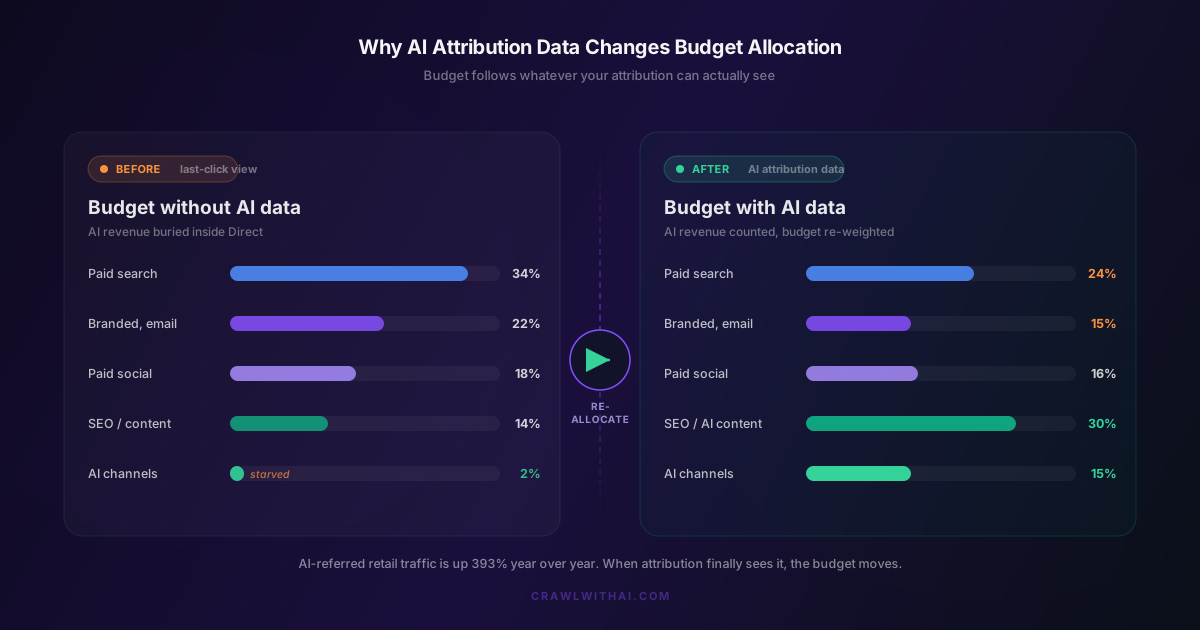
Picture the meeting where next quarter's marketing spend gets decided. Someone pulls up the dashboard. Paid search shows a fat return, branded campaigns look healthy, and the line for AI channels either does not exist or reads close to zero. So the money goes where the numbers point. Paid search gets more. AI content gets a shrug. Everyone moves on.
Here is the problem with that meeting. The dashboard is not showing you what drives revenue. It is showing you what your attribution can measure, and those are not the same thing. AI attribution data is the piece that has been missing, and once it lands on the table, the whole allocation argument changes. The revenue was always there. You just could not see it, so you kept funding the channels that could raise their hand.
The Budget Always Follows What You Can Measure
Marketing budgets are not generous. Gartner's 2026 CMO Spend Survey put them at 7.8% of company revenue, and 56% of the CMOs surveyed said they do not have the budget to deliver their own 2026 strategy. When money is that tight, every dollar has to justify itself with a number. No number, no dollar.
That rule works fine until a channel starts driving sales it cannot report. Then the rule turns against you. The channel grows, customers arrive, orders close, and none of it shows up in the column the finance team reads. So the budget keeps flowing to the channels that document themselves well, whether or not they are the ones actually creating demand.
AI recommendations are the clearest example running today. A customer asks ChatGPT for the best option in your category, sees your brand named, and buys. That sale is real. But if your reports cannot connect it back to the AI that started it, the AI channel looks dead on the dashboard, and dead channels do not get funded. Budget follows measurement, not truth. Fixing the measurement is the only way to fix the allocation.
Why AI Attribution Data Went Missing From the Math
AI attribution data is hard to capture because AI traffic breaks the tracking chain marketers have relied on for two decades. That chain assumes a click carries a tag, the tag lands in analytics, and the sale gets credited to a source. AI recommendations skip every step.
There are three breaks. AI platforms often pass no referrer, so a session from the ChatGPT app arrives with no source and defaults to Direct. The links AI generates almost never carry UTM parameters, because no marketer built them, a gap we covered in why UTM parameters break when traffic comes from ChatGPT. And a chat window is not a web page in tracking terms, so it fires no pixel and joins no click path.
The result is a swelling Direct bucket that gets read as loyal repeat buyers when much of it is fresh AI-driven demand in disguise. If you run on Shopify's built-in reporting, that misread is baked in, which is why Shopify analytics misses AI-referred orders by default. The revenue is landing. The label on it is wrong, and a wrong label sends the budget to the wrong place.
What Actually Changes When You Can See AI-Driven Revenue
The moment AI attribution data is in front of you, the size of the channel stops being a guess. And the numbers are not small. Adobe Analytics reported that traffic to US retail sites from generative AI sources rose 393% year over year in the first quarter of 2026, and has climbed more than 1,300% since Adobe began tracking it in October 2024.
Volume alone would not justify a budget shift. Quality does. Adobe found that revenue per visit from AI-referred traffic ran 37% higher than from other sources, because the AI has already done the comparison shopping before the customer lands on you. These are not tire-kickers. They are pre-qualified buyers arriving with intent.
Demand is moving to match. Salesforce's 2025 Connected Shoppers Report found that 39% of shoppers now use AI for product discovery, rising to 54% among Gen Z. When two in five of your potential customers start their search inside an AI, and those who click convert at a premium, a channel reading zero on your dashboard is not a small reporting gap. It is the difference between funding where growth is and funding where growth was.
The Channels That Get Over-Funded When AI Is Invisible
When AI attribution data is missing, the credit for AI-driven sales does not vanish. It gets handed to whatever channel the customer touched last. That is almost always the channels you are already over-funding.
Paid search is the biggest recipient. Gartner's 2025 survey found paid media takes 30.6% of the average marketing budget, the largest single line. A lot of that spend is catching branded searches from people who already decided to buy, often because an AI named you days earlier. You pay for the click, the click converts, and paid search books a win it did not earn. Branded search and email do the same, catching a customer at the finish line and claiming the whole race.
This is the core failure of last-click attribution, which misses most AI-driven revenue. The last touch is easy to measure, so it collects credit that belongs upstream. Budget then piles onto the finish line while the starting line goes unfunded. You are not buying growth. You are paying a toll to meet customers the AI already sent you, and calling the toll a growth channel.
The Work That Gets Starved Without AI Attribution Data
If over-funded channels are one side of the ledger, starved work is the other. The work that earns AI recommendations is exactly the work that struggles to claim credit, so it loses the budget fight every quarter.
That work is unglamorous. Clear product descriptions an AI can parse. Structured data and clean specs. Honest reviews, detailed FAQ content, and shipping and return policies stated plainly. None of it fires a conversion pixel the day you publish it. Its payoff shows up later, as a mention inside an AI answer that leads to a sale your dashboard files under Direct. So it reads as a cost with no return, and it gets cut.
The gap is visible in the aggregate numbers. Gartner's 2026 survey found CMOs allocate 15.3% of budget to AI on average, but only 30% of organisations are ready to scale it. The organisations Gartner rated AI-ready put 21.3% of budget into AI, well above the pack. The difference is not belief. It is sight. Teams that can measure AI outcomes fund the work that produces them. Teams that cannot keep starving it, then wonder why the AI keeps recommending a competitor who invested in being readable.
How to Reallocate Once the Data Is in Front of You
Seeing AI revenue is the hard part. Acting on it follows a short list.
Give AI its own channel in reporting. Stop letting AI-referred sessions dissolve into Direct, and match known AI referrers so the channel can be measured on its own line. You cannot budget for a channel that has no row. Second, move off last-click. A model that only rewards the final touch will always underfund discovery. Multi-touch and position-based models spread credit across the real path, which is the point of how multi-touch attribution models handle AI referrals differently.
Third, shift spend from the toll to the source. When AI attribution data shows branded search catching demand the AI created, some of that paid budget belongs upstream, in the content and product data that earned the recommendation. Fourth, hold the new allocation to the same standard as everything else. Track the AI channel's revenue over time and adjust, the same way you would a paid campaign. The goal is not to fund AI on faith. It is to fund it on evidence, which is only possible once the evidence exists. Building that evidence layer is the whole job of a revenue attribution model that includes AI channels.
How CrawlWithAI Gives You the Attribution Data to Reallocate
Most tools try to reverse-engineer AI traffic after it arrives, from a referrer the app already stripped. CrawlWithAI works the other end of the problem. It monitors when ChatGPT, Perplexity, Gemini and other assistants mention and recommend your store, tracks which of those recommendations drive clicks, and ties that activity to real orders in your Shopify store.
That changes what the budget meeting sees. Instead of an AI line reading zero, you get a revenue figure showing how much of your income is genuinely AI-influenced, next to whatever your other analytics report. The sessions that used to disappear into Direct become a measured channel with a number attached, and a channel with a number is a channel that can win budget.
It also tells you where the recommendations come from, so the reallocation is specific rather than vague. You can see which products and which queries get you cited, then fund the content and product data behind them instead of guessing. The point is not to spend more. It is to stop spending against a dashboard that cannot see half of what is working.
FAQ
What is AI attribution data? It is the record of which sales and sessions were driven by AI assistants like ChatGPT, Perplexity and Gemini, separated from your other traffic. Standard analytics cannot produce it reliably, because AI traffic usually arrives with no referrer and no UTM tag, so it lands in Direct. AI attribution data is what you get when you identify those visits and connect them back to the AI that caused them.
Why does missing AI attribution data lead to a misallocated budget? Because budget follows whatever gets measured. If AI-driven sales get credited to the last channel the customer touched, usually branded search or email, then paid search looks better than it is and AI content looks worse. You end up funding the finish line and starving the start, which is the opposite of funding growth.
How much revenue are stores missing without it? It depends on your mix, but the trend line is steep. Adobe reported AI-referred retail traffic up 393% year over year in early 2026, converting and spending at a premium. A store that cannot see that channel is not missing a rounding error. It is misreading its fastest-growing source of demand as anonymous Direct traffic.
Do I need to leave last-click attribution to fix this? For AI, effectively yes. AI discovery happens early in the journey, and last-click hands all the credit to the final step. A multi-touch or position-based model is what lets the early AI touch keep some of the credit it earned, so the budget can follow it.
Will reallocating budget toward AI reduce my paid search spend? Often it rebalances rather than cuts. Some paid search spend is catching demand the AI already created, so a share of it can move upstream to the content and product data that earn recommendations. You are not abandoning paid search. You are stopping it from taking credit, and budget, for work another channel did.
Sources
- Gartner, 2026 CMO Spend Survey Finds CMOs Allocate 15.3% of Marketing Budgets to AI: https://www.gartner.com/en/newsroom/press-releases/2026-05-11-gartner-2026-cmo-spend-survey-finds-cmos-allocate-15-point-3-percent-of-marketing-budgets-to-ai-but-only-30-percent-are-ready-to-scale-ai-capabilities
- Gartner, 2025 CMO Spend Survey Reveals Marketing Budgets Have Flatlined at 7.7% of Company Revenue: https://www.gartner.com/en/newsroom/press-releases/2025-05-12-gartner-2025-cmo-spend-survey-reveals-marketing-budgets-have-flatlined-at-seven-percent-of-overall-company-revenue
- Gartner, Digital Channels Account for 61.1% of Total Marketing Spend: https://www.gartner.com/en/newsroom/press-releases/2025-06-02-gartner-survey-finds-digital-channels-account-for-61-point-1-percent-of-total-marketing-spend
- Digital Commerce 360, Adobe: AI-referred traffic to retail sites doubles in a year: https://www.digitalcommerce360.com/2026/06/17/adobe-ai-referred-traffic-to-retail-sites-doubles-in-a-year/
- Adobe, The Explosive Rise of Generative AI Referral Traffic: https://business.adobe.com/blog/the-explosive-rise-of-generative-ai-referral-traffic
- Salesforce, With AI Adoption Surging, Shopping Behavior Is at an Inflection Point (2025 Connected Shoppers Report): https://www.salesforce.com/news/stories/consumer-shopping-ai-trends-2025/