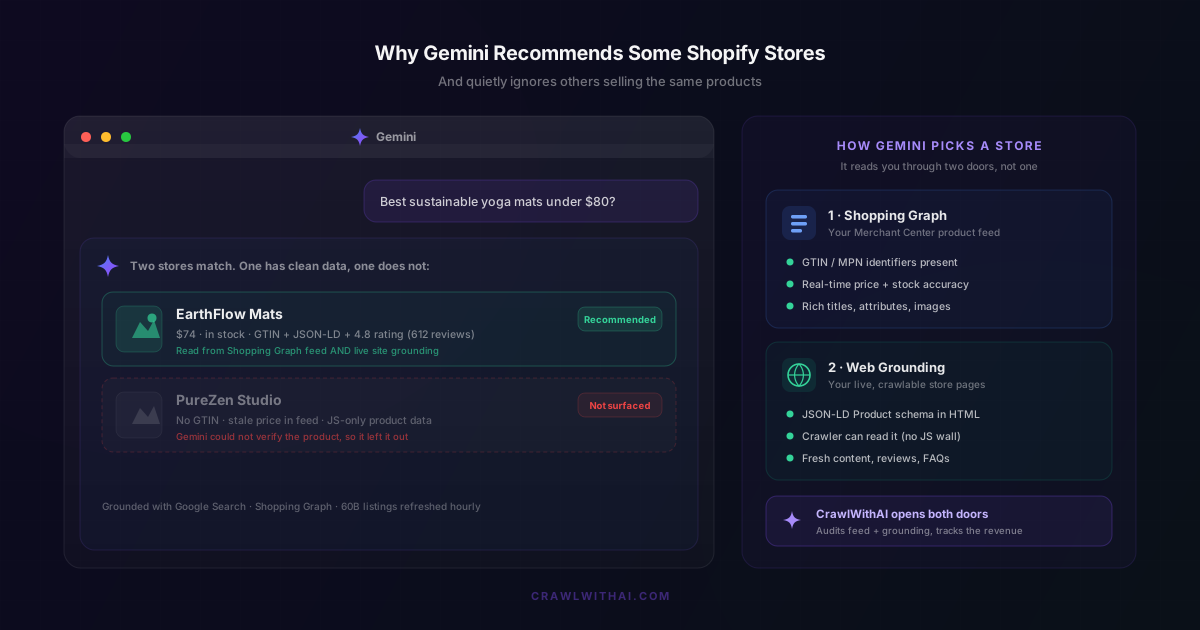
Google's Gemini app passed 750 million monthly active users at the end of 2025, according to TechCrunch. Its AI Mode in Search crossed 1 billion. Plenty of those people are not just asking questions anymore. They are shopping. Someone types "best sustainable yoga mats under $80" and Gemini hands back a short list of products, by name, with prices and a place to buy.
Here is the part that should bother you. Two Shopify stores can sell nearly the same yoga mat at nearly the same price, and Gemini will name one and never mention the other. It is not random, and you cannot pay your way in. The reason why Gemini recommends some Shopify stores and ignores others comes down to how it reads your store, and most owners have never seen the mechanism. Once you do, the gap is fixable.
Gemini Reads Your Store Through Two Doors
Most store owners picture Gemini as a single black box. It is closer to two doors, and you have to be standing inside both.
The first door is the Shopping Graph, Google's structured product catalog. The second is grounding with Google Search, where Gemini pulls live web pages and cites them inside its answer. Google's developer documentation describes the grounding step plainly: the model decides whether a search would improve the answer, runs one or more queries, then synthesizes a response with a groundingMetadata field that lists the exact sources it used.
A store that wins in Gemini is clean in both places. Its products are correctly filed in the Shopping Graph, and its live pages are crawlable and consistent with that feed. A store that gets ignored is usually missing from one door or contradicting itself across the two. When Gemini cannot reconcile what your feed says with what your page says, the safe move for the model is to leave you out and recommend a store it can verify.
The Shopping Graph Is the First Filter
The Shopping Graph is the bigger of the two doors, and it is the one most Shopify owners underuse. Google announced at I/O in May 2026 that the graph now holds more than 60 billion product listings, with 2 billion of them refreshed every hour. That same graph powers AI Mode, AI Overviews, and the Gemini app. One feed feeds all of them.
Getting in costs nothing. Products submitted through Google Merchant Center appear in the Shopping tab, AI Mode, and Gemini surfaces with no cost per impression or click. There is no separate application and no AI-specific campaign type. The feed that already powers your free Shopping listings is the same feed Gemini reads when it builds a recommendation.
This is why product feed quality matters as much for AI as it does for Google Shopping. If your Merchant Center feed is thin, stale, or full of disapprovals, you are not a smaller presence in Gemini. You are absent from the first door entirely, and the second door rarely carries a store on its own.
Missing Product Identifiers Quietly Remove You
The fastest way to disappear from Gemini is to ship a feed without proper identifiers. The minimum fields Google uses to file a product are GTINs, MPNs, brand, Google product category, product type, and condition. These are how Gemini sorts your item into the Shopping Graph and decides which queries it can answer with your product.
GTINs do the heaviest lifting. According to Shopify's own 2026 guidance on Google AI shopping visibility, missing GTINs significantly reduce a product's eligibility to appear in AI Mode results. The reason is matching. A GTIN lets Google connect your listing to the same product across reviews, price comparisons, and other sellers. Without it, your mat is an island the model cannot tie to anything, so it favors the competitor it can place in context.
Most Shopify stores fail here without noticing. Custom or white-label products ship without barcodes, the GTIN field gets left blank, and the listing technically syncs but lands in a weaker tier. Fill the identifier fields first. It is the cheapest visibility you will ever buy.
Stale Prices and Inventory Get You Dropped
Gemini treats accuracy as a ranking signal, not a nicety. Real-time pricing and inventory correctness directly affect whether a product is surfaced in AI Mode, and price mismatches between your feed and your live page are one of the most common causes of disapproval in Merchant Center.
Think about it from the model's side. Gemini reads $74 in your feed, then grounds against your live product page and sees $89. It cannot tell which number is true, and recommending a wrong price burns user trust. So it drops you and names the store whose feed and page agree. The 2 billion hourly refreshes Google runs exist precisely to keep this data current, and stores that let their feed drift fall out of that refresh cycle.
For Shopify owners this is mostly a sync problem. Flash sales, app-based discounts, and manual price edits often update the storefront but not the feed. Every gap between the two is a reason for Gemini to pick someone else.
The Second Door Is Your Live Site, and Most Stores Leave It Locked
The Shopping Graph gets you considered. Grounding is where Gemini confirms the details and decides how confidently to talk about you. This door reads your actual pages, and it is where thin or blocked stores lose.
Three things decide whether grounding works in your favor. First, JSON-LD Product schema in your page HTML, which is the format Google has recommended for machine-readable content since May 2025 and the cleanest way to state price, availability, rating, and brand. Second, crawlability. If your key product data only renders through client-side JavaScript, Google's crawler may never see it in the initial HTML, so put the important content in the page source, not behind a script. Third, supporting content like reviews and FAQs that the model can quote.
This is the same discipline behind structured data for ecommerce SEO, and it is why Shopify owners need an AI visibility strategy separate from classic SEO. A store can rank fine on a Google results page and still be unreadable to a grounding crawler that needs clean, server-rendered facts.
Freshness Decides the Tie
When two stores are equally clean, Gemini breaks the tie on recency, and it breaks it hard. A 2026 analysis by Amsive found that roughly half of AI citations come from content published or updated within the last 13 weeks, with citation likelihood dropping more than threefold once content passes the three-month mark.
For a product catalog, that turns updates into a ranking activity rather than housekeeping. A description you last touched 18 months ago is competing against a rival page refreshed last week, and the fresher page wins the citation. Refresh product copy, restock messaging, and review counts on a schedule. When an item comes back in stock, update the page and the feed the same day so both doors reflect the change.
Freshness also compounds with the Shopping Graph's hourly refresh. A store that updates often stays inside the live data Gemini trusts. A store that updates rarely slips into the stale tier, where the model treats its claims with less confidence and quietly prefers a competitor.
Why Two Identical Stores Get Different Answers
Put the doors together and the mystery dissolves. The store Gemini recommends has a complete feed with GTINs, prices that match its live pages, JSON-LD a crawler can read without running scripts, and content refreshed inside that 13-week window. Every signal agrees with every other signal, so the model can recommend it without risk.
The ignored store usually fails one quiet check. A blank GTIN field. A sale price that updated on the storefront but not in the feed. Product specs trapped in JavaScript. A description from two years ago. None of these feels fatal on its own. To a model that has to defend its answer with citations, any one of them is enough reason to pick the store it can verify instead. This is also why Gemini and AI Mode behave differently from a plain Google ranking: the bar is not relevance, it is verifiable confidence.
The encouraging part is that none of these are creative problems. They are data problems, and data problems are fixable on a fixed timeline.
How CrawlWithAI Gets Your Store Into Gemini's Answers
CrawlWithAI exists to open both doors for Shopify stores. It checks the Shopping Graph side and the grounding side together, which is the only way to find the contradiction that is keeping you out.
On the feed side, it flags missing GTINs and identifiers, catches price and stock mismatches between your storefront and your Merchant Center data, and surfaces the disapprovals quietly throttling your reach. On the grounding side, it confirms your JSON-LD is present and crawlable, checks that product data is in the HTML rather than locked behind scripts, and watches content freshness against the window that decides ties.
Then it does the part most analytics tools miss. Shopify and GA4 file most Gemini-driven visits as "direct," so the revenue looks like it came from nowhere. CrawlWithAI uses confidence-scored attribution to show how much revenue Gemini and other AI platforms actually drive, so you can prove the work paid off instead of optimizing blind. If you have read how Perplexity decides which products to recommend, this is the same idea applied to Google's stack, where the Shopping Graph adds a structured layer the others do not have.
FAQ
Why does Gemini recommend my competitor but not me when we sell the same product? Almost always a data gap, not a quality gap. The competitor likely has complete product identifiers, a feed price that matches their live page, and crawlable structured data, while one of those is missing or inconsistent on your store. Gemini recommends the store it can verify with the least risk.
Do I need to pay Google to appear in Gemini shopping results? No. Listings submitted through Google Merchant Center appear in AI Mode and the Gemini app at no cost per impression or click. There is no paid placement program for organic recommendations and no separate AI campaign to buy. Visibility comes from feed quality and a crawlable store, not ad spend.
How important are GTINs for Gemini recommendations? Very. GTINs let Google match your product to reviews, price comparisons, and other sellers across the Shopping Graph. Shopify's 2026 guidance notes that missing GTINs significantly reduce eligibility for AI-surfaced results. If you sell custom or white-label items without barcodes, request valid identifiers or use the correct identifier-exists settings rather than leaving the field blank.
How is Gemini different from ChatGPT for product recommendations? Gemini reads two sources: Google's Shopping Graph feed and live web grounding through Google Search. ChatGPT leans more on training data plus its own browsing. The practical difference is that your Merchant Center feed directly influences Gemini, so feed accuracy and identifiers carry weight there that they do not carry on platforms without a structured product graph.
How fast can I get back into Gemini's recommendations after fixing my data? The Shopping Graph refreshes 2 billion listings every hour, so feed corrections like GTINs and price fixes can be reflected within a day or two of your feed updating. Grounding and content freshness take longer to settle because the crawler has to revisit your pages, but identifier and price fixes are the fastest wins.
Sources
- https://techcrunch.com/2026/02/04/googles-gemini-app-has-surpassed-750m-monthly-active-users/
- https://blog.google/products-and-platforms/products/shopping/google-shopping-cart/
- https://www.shopify.com/blog/google-ai-shopping
- https://ai.google.dev/gemini-api/docs/google-search
- https://developers.google.com/search/docs/appearance/structured-data/product
- https://www.amsive.com/insights/seo/ai-search-citations-content-freshness/