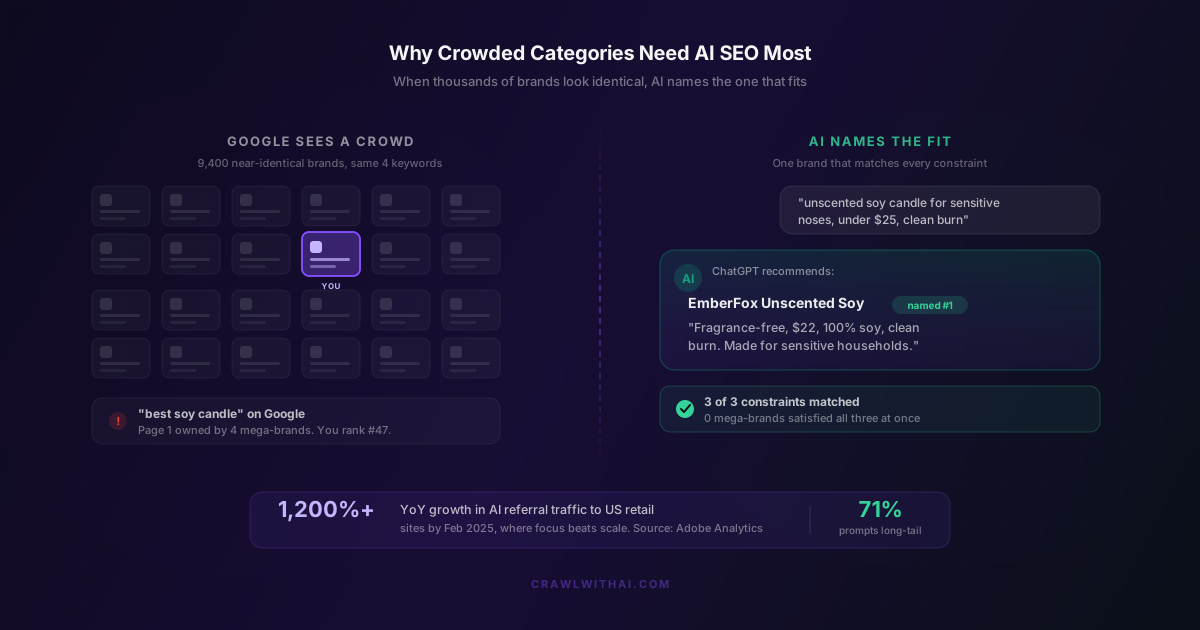
There are roughly 2.5 million live Shopify stores, and the most crowded corners of the platform are candles, supplements, skincare, coffee, and apparel. If you sell in one of them, you already know the problem. Search "best soy candle" and the first page belongs to four brands with eight-figure ad budgets and a decade of backlinks. Your product might be better. It does not matter. On Google, a crowded category is a wall, and you are on the wrong side of it. This is exactly why AI SEO matters more to you than to almost anyone else.
AI search changes the math. When a buyer asks ChatGPT for "an unscented soy candle for a sensitive household under $25," the engine does not rank a thousand stores. It names one or two that fit the request exactly. The more identical the shelf looks to Google, the more a single specific match stands out to an AI engine. For a focused D2C brand stuck in a saturated category, that is the best opening in years, and most stores are not building for it. This post is about why crowded categories reward AI SEO so heavily, and how to take the slot.
The crowded category problem Google cannot fix
Saturation is not a feeling, it is a number. Shopify has powered more than 7.2 million stores since launch, and a large share of the survivors are clustered in the same few high-demand categories. Storeleads put live Shopify stores at roughly 2.5 million in early 2025, with churn so heavy that the platform shed a big chunk of storefronts year over year. Beauty, fashion, and home goods are the most contested of all. When ten thousand brands sell a near-identical product, the broad keyword that describes it is the single most expensive piece of real estate in the category.
Google resolves that contest with authority, and authority compounds. Backlinks, domain age, brand search volume, and budget all favour the incumbent. A new D2C brand with a genuinely better candle still starts at position 47, because the ranking signals that decide page one have nothing to do with whether the product fits a specific buyer. We covered the mechanics of this in why Shopify stores with great products rank poorly. In a crowded category, those mechanics are not a disadvantage you can grind away. They are a structural ceiling.
What "crowded" looks like to an AI engine
An AI engine does not render a page of ten blue links, so it never shows the buyer the crowd. It reads the request, checks its candidates against each requirement, and composes one answer naming the brands that fit. The thousand stores that almost match are not ranked lower. They are simply absent. That single difference is why a category that feels hopeless on Google can be wide open in an AI answer.
It also happens to be where shopping is heading. Adobe Analytics reported that traffic to US retail sites from generative AI sources jumped about 1,200 percent between July 2024 and February 2025, and kept climbing through the year. Those visits are not low-intent browsing. Adobe found AI-referred sessions lasted 41 percent longer and produced 12 percent more page views than other traffic, and during the 2025 holiday period AI referrals converted at a meaningfully higher rate than the site average. People arriving from an AI answer have already been handed a recommendation. In a crowded category, being the brand named in that recommendation is worth more than ranking third on a page nobody scrolls.
Why AI SEO rewards specificity over scale
Here is the part that flips the whole game for small brands. On Google, scale wins. With AI SEO, specificity wins, and specificity is the one thing a focused D2C brand has more of than the giants.
AI shopping prompts are long and loaded with constraints. Semrush's 2025 analysis of AI search behaviour found that roughly 71 percent of shopping prompts were long-tail and conversational rather than single keywords, and the average AI prompt ran far longer than a typical Google query. A buyer does not type "candle." They type "unscented soy candle for a sensitive household, clean burn, under $25." Every constraint in that sentence eliminates competitors who cannot satisfy it. The four mega-brands that own the broad keyword each fail at least one of those conditions, because mass-market products are built to be broadly acceptable, not specifically perfect. Your single tight product line can match all three at once. We broke down how to harvest and target these in the D2C playbook for niche AI queries. In a crowded category, constraint stacking is how you turn ten thousand competitors into zero.
The differentiators that actually win AI citations
If specificity is the weapon, your job is to make your specifics impossible to miss. Most D2C brands in crowded categories bury their real edge under the same generic copy everyone else writes. "Premium quality, ethically made, you will love it" describes every candle on the shelf and tells an AI engine nothing.
State the exact thing you are best at, in plain language. The use case, the formulation, the price, the material, and crucially, who the product is not for. An engine treats completeness as a trust signal, so a page that says "fragrance-free, 100% soy, clean burn, $22, made for sensitive and allergy-prone households, not the right pick if you want a strong scent throw" gives the model the precise boundaries it needs to match you to the right query and exclude you from the wrong one. Telling the model what you do not do gets you recommended more often, not less, because it confirms you are the honest answer to a specific question rather than another brand claiming to be everything.
Make your edge machine-readable
A differentiator the engine cannot extract cleanly is a differentiator it will not repeat. In a crowded category this is where most brands quietly lose, because their best selling point lives in a lifestyle photo or a founder video that a crawler cannot read.
Put the hard facts in the product description as readable sentences, then mirror them in your structured data so the attributes are explicit rather than inferred. On Shopify that means using metafields for the attributes that matter in your category and making sure your theme outputs clean Product JSON-LD with price, availability, and a real description. Our walkthrough on how structured data changed e-commerce SEO covers the markup itself. The rule for a saturated category is simple: every claim that separates you from the other nine thousand stores should appear somewhere a crawler reads it as a fact, not somewhere it has to guess.
Earn the corroboration that breaks the tie
AI engines rarely take a brand's word alone, and in a crowded category they are especially cautious, because everyone is making similar claims. They cross-check. When your page says "made for sensitive households" and a Reddit thread, a review, and an independent roundup all repeat the same specific thing, the model treats the claim as confirmed and you become the safe pick.
You cannot fabricate this, but you can steer it. Ask happy customers to name the specific reason your product worked, because "did not trigger my allergies" is far more useful to the model than a generic five stars. Seed honest comparison content and show up in the communities where your buyers actually ask for recommendations. This is the same dynamic that lets unfamiliar brands beat household names in AI answers, which we covered in why AI recommends some unknown brands over established ones. Specific, corroborated fit beats broad recognition, and in a crowded category that is the only edge that scales.
Why incumbents cannot follow you into the niche
The reason this strategy holds is that the big brands in your category are structurally unable to copy it. They are too broad to honestly match a three-constraint query, because their product is designed to sell to everyone. They are too slow to build a dedicated, machine-readable page for every specific corner of the category. And their incentives point the other way, toward defending the broad keyword with ad spend rather than chasing a hundred small, specific questions.
That asymmetry is the moat. You are not trying to out-authority a brand with a ten-year head start. You are answering the exact questions they cannot answer cleanly, one constraint at a time, until the engine treats your domain as the place that handles this category in detail. The same focus that made you invisible on Google is what makes you the obvious answer in an AI response.
How CrawlWithAI tracks your AI SEO wins in a crowded category
The hard part of all this is that you are flying blind. In a category with thousands of competitors, you have no idea which specific queries name your brand, which name a rival, and which still default to the four incumbents. Google Search Console shows Google impressions. Shopify Analytics shows sessions and orders. Neither tells you whether ChatGPT recommended you for "unscented soy candle for sensitive households under $25" last week, or what that single citation earned.
CrawlWithAI is a Shopify app built to close that gap. You give it the constraint-rich queries that matter in your category and it runs them continuously against ChatGPT, Perplexity, Gemini, and Copilot, records whether your store is cited and which exact URL the engine quoted, and ties those citations to revenue using a fingerprinting layer that survives the loss of referrer data. Instead of guessing, you can watch your fragrance-free page get named in eight of ten runs, see which competitor holds the slot you want, and measure what each cited page brings in. In a crowded category, that feedback loop is the difference between hoping you stand out and knowing exactly where you do.
FAQ
Does AI SEO replace Google SEO in a crowded category?
No, it sits alongside it. Google still drives volume, and the structured, specific pages that win AI citations also help your organic rankings over time. The point is that in a saturated category, AI search is the channel where a focused brand can win quickly, while Google rankings stay slow and budget-bound. For the fuller comparison, see Shopify SEO vs AI SEO.
How long until a crowded-category brand starts getting cited?
Faster than you would expect, because niche competition is thin even inside a crowded category. Most active engines refresh their sources every few weeks, so a new, well-linked, machine-readable page targeting a specific constraint often starts appearing in citations within roughly four to eight weeks.
I sell in fashion, the most saturated category of all. Can this still work?
Yes, and arguably it works best there, because the broad keywords are the most hopeless and the specific queries are the most plentiful. Fashion buyers ask AI for very precise combinations of fit, fabric, occasion, size range, and price. A label that genuinely nails one of those combinations can own it while the broad term stays locked up by giants.
Do I need more products to win, or fewer?
Fewer and clearer beats more and vague. A tight range where every product has an obvious, specific reason to exist is far easier for an engine to match to a query than a sprawling catalogue of near-duplicates. Depth of clarity on each product matters more than breadth of SKUs.
How do I find which AI queries my category buyers actually ask?
Mine your own reviews and support tickets for the exact phrases customers use, then run those buying questions through ChatGPT, Perplexity, and Gemini yourself to see which constraints the engines volunteer and which brands they name. That is the same harvesting approach we detail in the D2C playbook for niche AI queries.
Sources
- Adobe Analytics, "Traffic to US Retail Websites from Generative AI Sources Jumps 1,200 Percent": https://blog.adobe.com/en/publish/2025/03/17/adobe-analytics-traffic-to-us-retail-websites-from-generative-ai-sources-jumps-1200-percent
- Adobe Business, "The explosive rise of generative AI referral traffic": https://business.adobe.com/blog/the-explosive-rise-of-generative-ai-referral-traffic
- Storeleads, "The State of Shopify in 2026": https://storeleads.app/reports/shopify
- Semrush, "How People Use AI for Search 2025": https://www.semrush.com/blog
- Digital Commerce 360, "Generative AI shifts online holiday shopping traffic in 2025": https://www.digitalcommerce360.com/2026/01/13/generative-ai-online-holiday-shopping-traffic-2025/