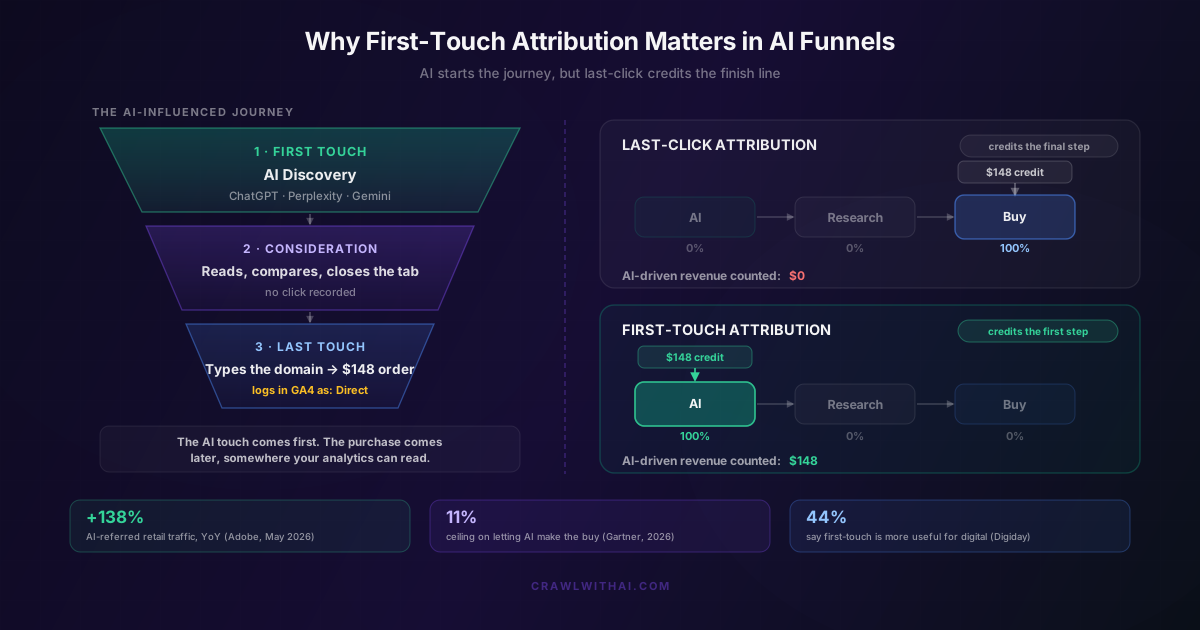
A customer opens ChatGPT and asks for the best trail running shoes for wide feet under 150 dollars. It names your store. They read the answer, close the tab, and get on with their day. Three days later they type your domain straight into the address bar and buy a 148 dollar pair. Open your Shopify dashboard the next morning and that order says one thing: Direct. The chat that introduced the buyer, the moment the sale was really won, left no fingerprint your analytics can see.
This is the gap first-touch attribution exists to close. Last-click hands all the credit to the final step, so AI gets nothing and Direct gets everything. First-touch attribution does the opposite. It rewards the channel that started the journey, which in an AI-influenced funnel is increasingly an AI answer. The reason this choice suddenly matters is structural. AI now owns the discovery step for a large and growing share of shoppers, while the purchase still happens somewhere your tracking can read. Reward only the finish line and you go blind to your fastest-growing source of demand.
What First-Touch Attribution Actually Does
First-touch attribution gives 100 percent of the credit for a sale to the first interaction a customer had with your brand. Last-click does the reverse and gives all of it to the final interaction before checkout. Both are single-touch models. They answer different questions. Last-click answers "what closed this customer." First-touch answers "what introduced them in the first place."
Most analytics tools default to last-click, or a close cousin of it. Google Analytics 4 uses last non-direct click as its baseline before its data-driven model kicks in, which means an unlabeled visit gets pushed back to whatever channel touched the customer most recently. That default made sense when the opener and the closer were usually the same channel. A shopper found you on Google and bought from Google. The first touch and the last touch were one click apart, so it barely mattered which one you rewarded.
AI broke that assumption. The opener and the closer are now often different channels, sometimes days apart. Once that split exists, the model you pick stops being a reporting preference and starts deciding which channels look alive and which look dead.
Why AI Is Almost Always the First Touch, Not the Last
People use AI to figure out what to buy, then leave to buy it. Gartner put numbers on this in a survey of US consumers published in May 2026. Willingness to let an AI tool actually make the purchase decision topped out at just 11 percent, even in low-stakes categories like personal care and household supplies. Consumers were far more open to AI that helps them research, compare options, and narrow a shortlist, as long as they keep the final call themselves. They want a research assistant, not a buying agent.
That preference puts AI at the top of the funnel by design. The model recommends, the shopper decides, and the actual transaction lands on a channel the shopper controls: a typed domain, a branded search, an email they had saved. Your last-click report sees that controlled final step and nothing before it. The AI conversation that did the persuading sits upstream, invisible, exactly the pattern we covered in the dark funnel problem. The AI touch is the opener almost every time, and almost never the closer.
The Numbers Say AI Owns Discovery
The discovery shift is not a hunch. Capital One Shopping's 2026 research found that close to 60 percent of consumers have already used AI to shop, and that 58 percent use generative AI instead of traditional search to find recommendations. Among shoppers already using AI, 72 percent treat it as their primary tool for researching products and brands. Research is the first touch. That is the job shoppers are handing to AI.
The traffic data backs it up. Adobe Analytics, reported by Digital Commerce 360 in June 2026, found that AI-referred traffic to US retail sites grew 138 percent year over year in May 2026 and is up 1,324 percent since Adobe began tracking it in October 2024. These are not idle browsers. Adobe found AI-referred visitors converted 54 percent better than non-AI traffic, spent 53 percent more time on site, and browsed 23 percent more pages per visit. They arrive already informed because the AI did the filtering. That is what a high-intent first touch looks like.
Put the two findings together. A channel that introduces the majority of shoppers, sends visitors who convert better, and grows triple digits year over year is the definition of a first touch worth measuring. Last-click gives it a zero.
What Last-Click Does to That Journey
Run the trail-shoe sale through a last-click model and the result is clean and wrong. The final step was a direct visit, so Direct gets 100 percent of the 148 dollars. AI gets nothing. Branded search and email, the channels that tend to catch customers at the end, get inflated for work AI did at the start.
Repeat that across thousands of orders and the distortion compounds into bad budget. You read your growing Direct and branded-search lines as proof that brand loyalty and retargeting are carrying the business, so you fund them harder. You starve the product data and content that actually earn AI recommendations, because the dashboard says they drive almost no revenue. The money flows to the channels that close, away from the channel that opens, and the gap widens every quarter as AI traffic climbs. This is the same blind spot we broke down in why last-click attribution misses your AI revenue, seen from the angle of which touch you choose to reward.
Why First-Touch Attribution Matters More Now Than It Used To
For years, the first-touch versus last-click debate was mostly academic for e-commerce. The journeys were short and the channels overlapped, so the two models often landed in roughly the same place. The argument was about precision, not about whole channels appearing or vanishing.
AI ended the truce. There is now a hard structural split in the funnel: the opener is an AI answer, the closer is a direct or branded visit. First-touch is the only single-touch model that even looks at the opener, which makes it the simplest way to see AI's contribution at all. The market is starting to notice. In Digiday's attribution research, 44 percent of marketers said a first-touch model is more useful for measuring digital campaigns, yet last-touch remained the most common method in practice at 41 percent. The default most stores run is now the one actively hiding their newest channel. That is why first-touch attribution deserves a fresh look in 2026 specifically: the cost of defaulting to last-click is no longer a rounding error.
Where First-Touch Attribution Falls Short
First-touch is a corrective lens, not a final answer, and it is worth being honest about its limits. It over-credits the opener and ignores everything after it. The comparison content that built trust in the middle, the email that recovered an abandoned cart, the retargeting that nudged the final click all get zero under pure first-touch, the same way AI gets zero under last-click. Optimize on first-touch alone and you risk overfunding awareness while starving the touches that actually close.
There is a second catch that bites harder with AI. First-touch can only credit a first touch it can see. When an AI platform strips the referrer, the visit arrives as Direct, and even a first-touch model has nothing to attach the credit to. Switching your model does not recover a source that was never sent, a problem we get into in AI-referred sessions versus direct traffic. So the honest play is to use first-touch to reveal that AI is opening journeys, then move toward a multi-touch model or a confidence-scored view that gives AI partial, defensible credit instead of all-or-nothing.
How CrawlWithAI Captures the First Touch
The reason you cannot fix this by flipping a setting is that the first touch happens off your site. It lives inside the AI conversation, and by the time the shopper reaches you, the source is usually gone. A first-touch model in GA4 still cannot credit a session that shows up labeled Direct.
CrawlWithAI works the problem from the side where the first touch is still visible. Instead of waiting for a browser to hand over a referrer it already deleted, it monitors when ChatGPT, Perplexity, Gemini, and other assistants mention and recommend your store. It tracks which of those recommendations drive clicks, then ties that activity back to orders in your Shopify store. The opening AI touch becomes a recorded event rather than a guess.
That turns first-touch from a wish into a measurement. You can see how many journeys an AI answer started, how much revenue those journeys produced, and where AI sits relative to the direct and branded visits that close them. With the opener finally on the books, you can assign credit on purpose and fund the channel that introduces your customers, not just the one that rings them up.
FAQ
What is first-touch attribution in plain terms? First-touch attribution gives all the credit for a sale to the first interaction a customer had with your brand, rather than the last one before checkout. If a shopper discovered you through ChatGPT and bought a week later, first-touch credits the ChatGPT discovery. Last-click would credit the final visit instead.
Is first-touch attribution better than last-click for AI traffic? It is better at one specific job: showing that AI introduced the customer. Because AI is overwhelmingly a discovery channel, last-click gives it close to zero, while first-touch surfaces it. First-touch is not a complete model, though. It ignores the middle and the close, so it works best as a corrective lens before you move to a multi-touch or confidence-scored view.
Can I just switch Google Analytics 4 to a first-touch model? Only partway. You can change how GA4 distributes credit, but AI sessions frequently arrive with no referrer and land in Direct. A first-touch model still cannot credit a touch it never recorded. Seeing AI as a first touch usually requires tracking the AI side, where the recommendation actually happened.
Will first-touch attribution over-credit AI? It can. Pure first-touch hands AI 100 percent of any sale it opened, which ignores the nurturing and closing that followed. That is the mirror image of last-click's mistake. The point of running first-touch is not to crown AI, it is to prove AI belongs in the model at all, then split credit fairly across touches.
How do I see AI as a first touch when the referrer is missing? Watch the AI platforms directly instead of waiting on the browser. Monitoring when assistants cite and recommend your store captures the opening touch even when the session later shows up as Direct, then connects it to the order it influenced.
Sources
- Digital Commerce 360, Adobe: AI-referred traffic to retail sites doubles in a year (June 2026): https://www.digitalcommerce360.com/2026/06/17/adobe-ai-referred-traffic-to-retail-sites-doubles-in-a-year/
- Gartner, Consumers Want AI Shopping Help, But Not AI Purchase Decisions (May 2026): https://www.gartner.com/en/newsroom/press-releases/2026-05-27-gartner-survey-finds-consumers-want-ai-shopping-help-but-not-ai-purchase-decisions
- Capital One Shopping, AI Shopping Statistics 2026: https://capitaloneshopping.com/research/ai-shopping-statistics/
- Ruler Analytics, Marketing Attribution Statistics (citing Digiday, The Attribution Problem): https://www.ruleranalytics.com/blog/insight/marketing-attribution-stats/
- Adobe, The explosive rise of generative AI referral traffic: https://business.adobe.com/blog/the-explosive-rise-of-generative-ai-referral-traffic