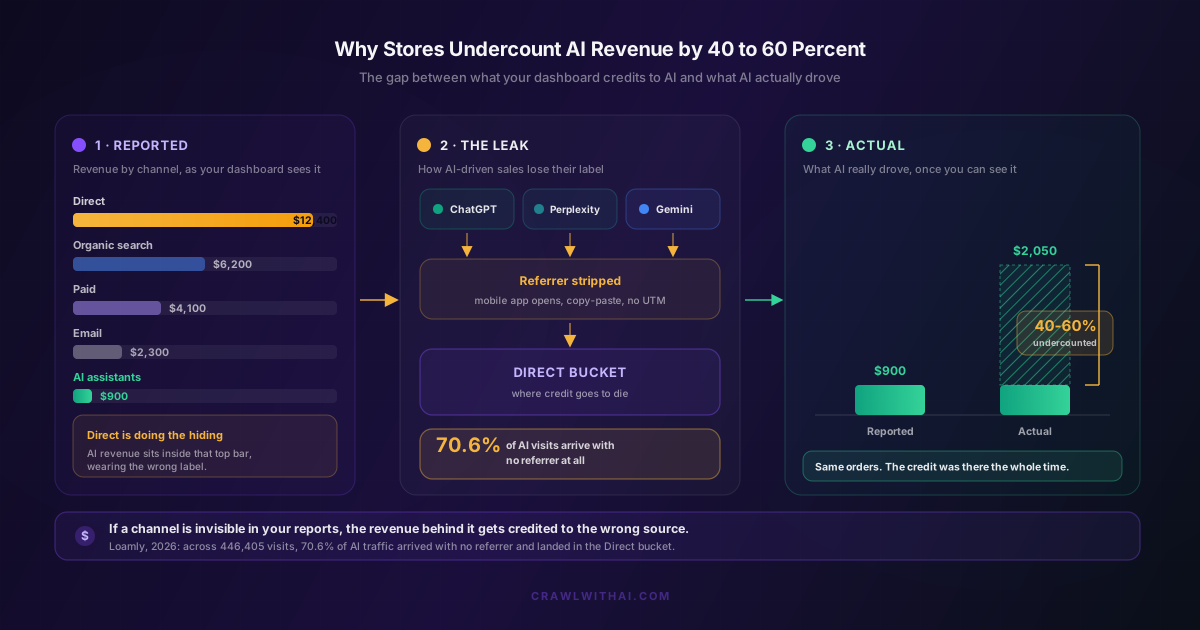
Pull the last twelve months of revenue by channel in any Shopify store and AI will look like a rounding error. A few hundred dollars, maybe a thousand, filed under a "ChatGPT" line if the store even has one. Then look at the Direct bucket. It is fat, it is growing, and nobody can explain why. Those two facts are connected. Most stores undercount AI revenue by 40 to 60 percent, and the missing money is sitting in Direct wearing the wrong name tag.
This is not a rounding problem you can wave off. AI traffic to US retail sites rose 393 percent in the first quarter of 2026 compared with a year earlier, according to Adobe Analytics. The channel growing fastest is also the one your analytics reads worst. When you cannot see revenue, you cannot fund the work that created it, so you keep starving your quickest-growing source of demand. This post explains where the 40 to 60 percent undercount comes from, why AI sales keep landing in Direct, and how to size the gap in your own store.
What Undercounting AI Revenue Actually Means
Undercounting AI revenue means your reports credit AI for far fewer sales than it actually influenced. It is not that the money vanished. The orders landed and the cash cleared. What went missing is the link between the sale and the AI assistant that sent it.
Two things drive that. First, a large share of AI-referred visits carry no referrer, so your analytics has nothing to label them with. Second, many AI-influenced buyers do their research in the chat and then arrive later through a branded search or a direct type-in, which severs the trail completely. Either way the order shows up as Direct or branded organic, and AI gets zero credit.
The result is a store that thinks AI is trivial while AI is quietly becoming its best-converting channel. You are not measuring a small channel accurately. You are measuring a big channel badly.
Where the 40 to 60 Percent Number Comes From
Start with the traffic. Loamly analyzed 446,405 visits and found that 70.6 percent of AI traffic arrived with no referrer header, which means Google Analytics 4 filed it as Direct. Only 29.4 percent kept a readable AI referrer. So before you account for anything else, roughly seven of every ten AI-driven sessions are invisible as AI.
Now temper that. Stores recover part of the gap through UTM tags on links they control, through branded search overlap, and through the minority of AI visits that do pass a referrer. That recovery pulls the revenue undercount down from the raw 70 percent traffic figure. In practice, most stores that instrument this properly find their true AI-influenced revenue is 40 to 60 percent higher than what their dashboard reported. The dashboard was not lying on purpose. It just never had the data.
The pattern shows up in the wild. Search Engine Journal reported a case where a marketer saw 86 percent of new users classified as Direct while that Direct traffic grew 126 percent year over year and referral traffic fell 90 percent. Those were not people typing a URL from memory. They were coming from AI, and the analytics had no way to say so.
Why AI Referrals Vanish Into Direct Traffic
The mechanics are boring, which is exactly why they get ignored. Analytics tools were built on one rule: if a session has no readable referrer, call it Direct. That was fine when the only unlabeled traffic was bookmarks and type-ins. It breaks when a fast-growing channel passes no referrer by design.
Three things strip the signal. When a buyer taps a link inside the ChatGPT or Perplexity mobile app, the in-app browser often opens without a referral chain. When a buyer copies a URL out of an AI answer instead of clicking it, no referrer is sent at all. And when a buyer reads a recommendation, closes the app, and types your domain later, there was never a click to track in the first place. We covered the click-level version of this in why UTM parameters break when traffic comes from ChatGPT.
Every one of those journeys ends in the same place. The order lands, the session gets stamped Direct, and your fastest-growing demand source disappears into the one bucket you have been trained to read as loyal repeat buyers. A growing share of it is not repeat buyers at all. It is first-time customers who just asked an AI what to buy. We dug into that misread in why not all direct traffic is branded.
The Conversion Twist That Makes It Worse
Here is the part that turns a measurement annoyance into a real financial miss. AI traffic does not just convert. It converts better than almost anything else you have.
Adobe found that in March 2026, AI-referred visitors converted 42 percent better than regular customers and drove 37 percent more revenue per visit. A year earlier the same traffic converted worse than average, so this flipped fast. Loamly's data is sharper still: the dark AI traffic hiding in Direct converted at 10.21 percent versus 2.46 percent for non-AI, more than four times the rate. Microsoft Clarity, studying 1,200 sites, put AI's sign-up conversion at eleven times organic search.
Stack those facts. The invisible channel is also the high-converting channel. That means the revenue you are misfiling is worth more per visit than the traffic you are counting correctly. Your undercount is not spread evenly across low-value sessions. It is concentrated in your best customers. That is why a 70 percent traffic blind spot translates into a revenue undercount that stings more than the raw number suggests.
What the Undercount Costs You in Budget Decisions
Bad data does not stay quietly wrong. It drives spending. If your dashboard says AI drove 900 dollars last month and paid search drove 4,100, you will fund paid search and ignore AI. The catch is that the 900 is fiction, and the paid number probably includes AI-influenced buyers who searched your brand after a chat recommended it.
So you double down on the channel that gets last-click credit and starve the one that actually built the intent. This is the same last-click trap we described in why last-click attribution misses most of your AI-driven revenue, except now the scale is large enough to distort your whole budget. Salesforce estimated that AI agents influenced 20 percent of all Cyber Week 2025 orders and touched 67 billion dollars in sales. A channel at that scale is not one you want to fly blind on.
The compounding cost is strategic. Competitors who measure AI properly will outspend you on AI visibility because they can see the return. You will sit out the fastest-growing acquisition channel in ecommerce because your own reports told you it was not worth the effort.
How to Size Your Own AI Revenue Undercount
You cannot recover a referrer that was never sent, but you can estimate the gap well enough to act. Three moves get you most of the way.
First, add a post-purchase survey. One question at checkout, "How did you first hear about us?", with an explicit "AI assistant such as ChatGPT, Perplexity, or Gemini" option. This is the single most reliable tool for catching buyers who researched in a chat and arrived looking like Direct. Compare the share who pick AI against the share your analytics credits to AI. The distance between those two numbers is your undercount.
Second, watch your server logs for AI crawlers. GPTBot, PerplexityBot, Google-Extended, and ClaudeBot leave clear traces when they read your pages. Rising crawl activity means AI systems are indexing your catalog, which is the precondition for being recommended and then referred. If Shopify's own reports are the only place you look, you will keep missing this, as we explained in why Shopify analytics misses AI-referred orders.
Third, correlate new-customer Direct traffic with your AI visibility over time. Zero-click AI buyers usually show up as first-time customers arriving directly. When your AI visibility climbs and new-customer Direct climbs in the same window with no other cause, you are watching the undercount happen. We walk through the full modeling approach in how to build a revenue attribution model that includes AI channels.
How CrawlWithAI Closes the Gap
Standard analytics tries to fix this from the demand side, by catching a referrer that AI assistants do not send. That approach will always miss the 70 percent that arrives clean. CrawlWithAI works from the other end.
It monitors which AI platforms crawl your store and how often, tracks whether your products and brand get surfaced in AI answers for the buying questions that matter in your category, and scores your citation share against the competitors that assistants name next to you. Instead of guessing what your Direct bucket contains, you get a direct read on your AI visibility and how it is trending.
That visibility signal is what you line up against your new-customer Direct movements to model the revenue AI is actually driving. CrawlWithAI applies confidence scoring to each AI-attributed order, so the number you report is defensible rather than a guess, an approach we detail in how confidence scoring works in AI revenue attribution. The goal is not a prettier chart. It is a revenue figure you can take to a budget meeting and defend.
Start This Quarter
You do not need new infrastructure to begin. Turn on the post-purchase survey this week and let it run. Pull eighteen months of new-customer Direct traffic and look for the unexplained climb. If it is there, you are almost certainly staring at AI revenue your reports have credited to nothing.
Then treat AI visibility as a real line item with real budget, even though it produces traffic your dashboard reads poorly. The customer who asked an assistant what to buy and then bought from you is worth exactly as much as any other. Right now they are just invisible, and invisible revenue is the easiest kind to lose.
FAQ
How much do stores actually undercount AI revenue? Most stores that instrument AI tracking properly find their true AI-influenced revenue is 40 to 60 percent higher than their dashboard reported. The traffic gap is even larger. Loamly measured that 70.6 percent of AI visits arrive with no referrer and get filed as Direct. The revenue undercount lands lower than the traffic undercount because stores recover part of the gap through UTMs and branded search.
Why does AI revenue show up as Direct traffic? Because AI assistants often pass no referrer. Mobile app links open without a referral chain, copied URLs carry nothing, and buyers who research in a chat and type your domain later were never a trackable click. Google Analytics 4 and Shopify both file sessions with no referrer as Direct, so AI-driven orders land beside bookmarks and type-ins.
Is AI traffic even worth tracking if the volume is small? Yes, because it converts. Adobe found AI visitors converted 42 percent better than regular customers in March 2026, and Loamly measured dark AI converting more than four times better than non-AI traffic. Low volume and high conversion means the revenue impact is bigger than the session count suggests.
How do I estimate my own undercount without a special tool? Add a post-purchase survey with an AI assistant option and compare the share of customers who pick it against the share your analytics credits to AI. The gap between those two figures is a rough size of your undercount. Server log crawler activity and new-customer Direct trends confirm the picture.
Does fixing attribution actually change anything? It changes where you spend. When AI revenue is invisible you fund the channels that get last-click credit and ignore AI. Once you can see AI's real contribution, you can fund AI visibility with the same discipline you apply to paid search.
Sources
- Loamly: "State of AI Traffic 2026: Industry Benchmark Report," updated February 2026. https://www.loamly.ai/blog/state-of-ai-traffic-2026-benchmark-report
- TechCrunch / Adobe Analytics: "AI traffic to US retailers rose 393% in Q1, and it's boosting their revenue too," April 2026. https://techcrunch.com/2026/04/16/ai-traffic-to-us-retailers-rose-393-in-q1-and-its-boosting-their-revenue-too/
- Search Engine Journal: "When 'Direct' Means 'We Don't Know': CMOs Rethink Attribution in AI Search." https://www.searchenginejournal.com/when-direct-means-we-dont-know-cmos-rethink-attribution-in-ai-search/549783/
- Salesforce: "AI and Agents Propel Cyber Week to Record $336.6B in Global Spend," December 2025. https://www.salesforce.com/news/press-releases/2025/12/05/cyber-week-ai-agents-sales/
- Microsoft Clarity: "AI Traffic Converts at 3x the Rate of Other Channels, Study Finds." https://clarity.microsoft.com/blog/ai-traffic-converts-at-3x-the-rate-of-other-channels-study/